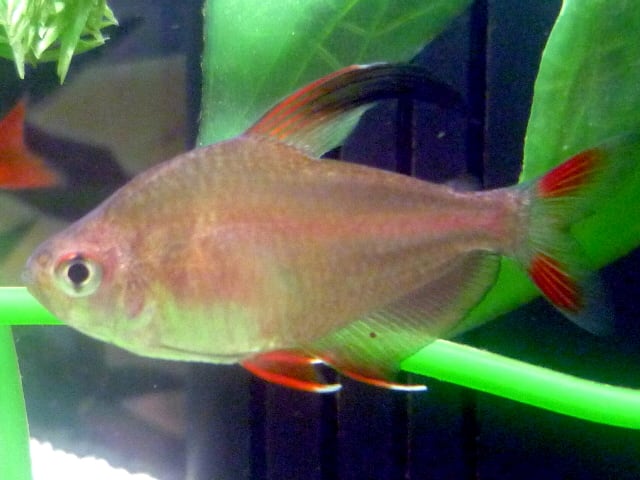
Rosy tetra
Hyphessobrycon rosaceus
Parameter dashboard
23.9-27.8 °C
5.5-7.5
4 cm
5 years
Care guide
The rosy tetra is a delicate South American characid from Guyana, Suriname, and Brazil, where it inhabits sluggish, forested tributaries and blackwater environments stained dark by tannins. Males are the more colourful sex, developing a warm rosy-pink flush across the body and sporting elegantly extended dorsal and anal fins as they mature. They reach a modest 4 cm in standard length, making them suitable for smaller community aquaria. Most fish sold today are commercially bred on farms rather than wild-caught.
In the aquarium, rosy tetras look best in a dimly lit blackwater-style setup with a sandy substrate, driftwood branches, and dried leaf litter that releases tannins into the water. The lighting should be subdued, as bright conditions cause them to become shy and washed out in colour. They also adapt well to well-planted aquaria. A tank of at least 60 cm x 37.5 cm x 30 cm (70 litres) is adequate for a small shoal. Soft, acidic water with a temperature of 24–28 °C best replicates their natural habitat.
Rosy tetras are exceptionally peaceful and should not be kept with boisterous or much larger tankmates. They thrive alongside other small South American species such as other Hyphessobrycon and Hemigrammus tetras, pencil fish, Apistogramma dwarf cichlids, and Corydoras. They are shoaling by nature and should always be maintained in groups of at least six, ideally ten or more. Their diet in nature consists of small invertebrates, but in the aquarium they accept quality dried flakes and granules alongside regular servings of live and frozen foods for optimum health and colour.
Source
Further reading on identification and aquarium care.
Tankmate compatibility (sample)
Pairwise screening against other species in the database (prioritizing the same family when data is available).
Review first (3)
Caution or avoid from automated rules — confirm before mixing.
| Species | Assessment | Notes |
|---|---|---|
| Ember tetra Hyphessobrycon amandae Caution | Caution | Fish 2x+ larger may eat smaller tankmates Open pair in Compare → |
| Jewel tetra Hyphessobrycon eques Caution | Caution | close relatives, and one of them is territorial, so both claim the same kind of space Open pair in Compare → |
| Neon tetra Paracheirodon innesi Caution | Caution | the two share only a narrow band of temperature, so one of them sits at the edge of its range Open pair in Compare → |
9 species with compatible assessment in this sampleCollapse to hide the list; use “Open pair in Compare” for the full matrix.
| Species | Assessment | Notes |
|---|---|---|
| Blackline penguinfish Thayeria boehlkei Compatible | Compatible | No rule-based conflicts detected for this pair. Open pair in Compare → |
| Bleeding-heart tetra Hyphessobrycon erythrostigma Compatible | Compatible | No rule-based conflicts detected for this pair. Open pair in Compare → |
| Buenos Aires tetra Hyphessobrycon anisitsi Compatible | Compatible | No rule-based conflicts detected for this pair. Open pair in Compare → |
| Colombian Tetra Hyphessobrycon columbianus Compatible | Compatible | No rule-based conflicts detected for this pair. Open pair in Compare → |
| Diamond tetra Moenkhausia pittieri Compatible | Compatible | No rule-based conflicts detected for this pair. Open pair in Compare → |
| Head-and-taillight tetra Hemigrammus ocellifer Compatible | Compatible | No rule-based conflicts detected for this pair. Open pair in Compare → |
| Lemon tetra Hyphessobrycon pulchripinnis Compatible | Compatible | No rule-based conflicts detected for this pair. Open pair in Compare → |
| Red phantom tetra Hyphessobrycon sweglesi Compatible | Compatible | No rule-based conflicts detected for this pair. Open pair in Compare → |
| Rummy-nose tetra Hemigrammus rhodostomus Compatible | Compatible | No rule-based conflicts detected for this pair. Open pair in Compare → |
Same rule engine as Compare. Not a substitute for observation, tank size, or acclimation.
Related species
Was this page useful? Spot anything wrong?