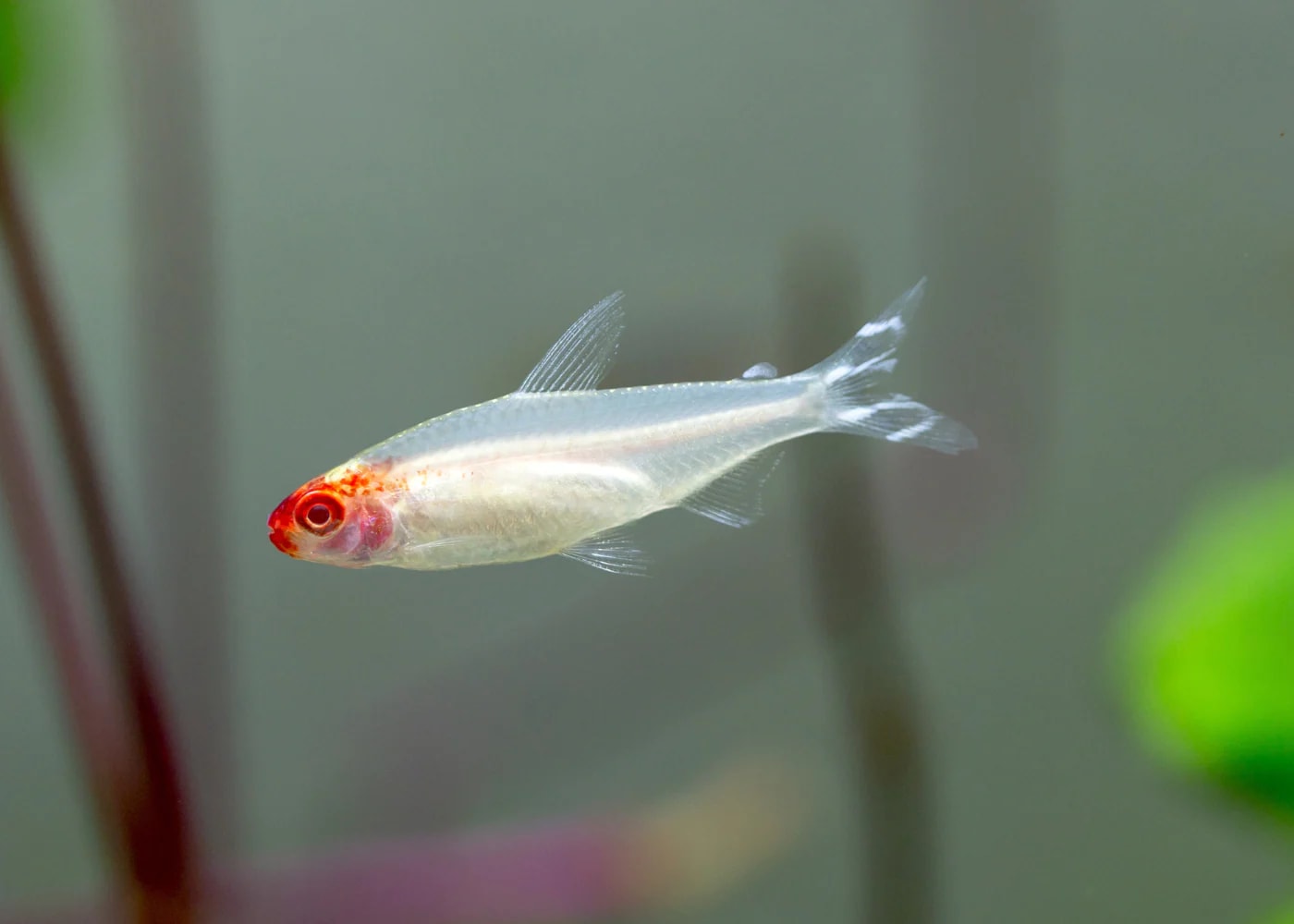
Rummy-nose tetra
Hemigrammus rhodostomus
Parameter dashboard
24-27 °C
5.5-7
5 cm
5 years
Care guide
The rummy-nose tetra (Hemigrammus rhodostomus) is a classic South American characin cherished by aquarists for its vivid red head and boldly banded caudal fin pattern. It inhabits blackwater rivers and tributaries of the Rio Orinoco and lower Amazon basins in Venezuela and Brazil, where the water is stained brown by tannins and highly acidic. Reaching a maximum of 5 cm, this is a tightly shoaling species that must be kept in groups of at least 10 to feel secure and display natural behaviour — solitary specimens or small groups quickly become stressed and lose their vibrant coloration. The tank should ideally be at least 90 cm in length to accommodate their active swimming style. A biotope setup with river sand, driftwood branches, and dried leaf litter brings out the best in these fish, though they also thrive in well-planted conventional aquaria. The rummy-nose is renowned as an "indicator fish": its red head fades noticeably when water quality deteriorates or conditions are stressful, making it an excellent early-warning system for the aquarist. An omnivore, it accepts all small foods but benefits from a varied diet of dried flakes, granules, and small live or frozen fare to maintain peak colour. It is entirely peaceful and makes an ideal dither fish for Apistogramma dwarf cichlid communities or discus tanks.
Source
Further reading on identification and aquarium care.
Tankmate compatibility (sample)
Pairwise screening against other species in the database (prioritizing the same family when data is available).
Review first (1)
Caution or avoid from automated rules — confirm before mixing.
| Species | Assessment | Notes |
|---|---|---|
| Neon tetra Paracheirodon innesi Caution | Caution | the two share only a narrow band of temperature, so one of them sits at the edge of its range Open pair in Compare → |
11 species with compatible assessment in this sampleCollapse to hide the list; use “Open pair in Compare” for the full matrix.
| Species | Assessment | Notes |
|---|---|---|
| Black widow tetra Gymnocorymbus ternetzi Compatible | Compatible | No rule-based conflicts detected for this pair. Open pair in Compare → |
| Blackline penguinfish Thayeria boehlkei Compatible | Compatible | No rule-based conflicts detected for this pair. Open pair in Compare → |
| Buenos Aires tetra Hyphessobrycon anisitsi Compatible | Compatible | No rule-based conflicts detected for this pair. Open pair in Compare → |
| Cardinal tetra Paracheirodon axelrodi Compatible | Compatible | No rule-based conflicts detected for this pair. Open pair in Compare → |
| Diamond tetra Moenkhausia pittieri Compatible | Compatible | No rule-based conflicts detected for this pair. Open pair in Compare → |
| Glass bloodfin Prionobrama filigera Compatible | Compatible | No rule-based conflicts detected for this pair. Open pair in Compare → |
| Head-and-taillight tetra Hemigrammus ocellifer Compatible | Compatible | No rule-based conflicts detected for this pair. Open pair in Compare → |
| Lemon tetra Hyphessobrycon pulchripinnis Compatible | Compatible | No rule-based conflicts detected for this pair. Open pair in Compare → |
| Ornate tetra Hyphessobrycon bentosi Compatible | Compatible | No rule-based conflicts detected for this pair. Open pair in Compare → |
| Red phantom tetra Hyphessobrycon sweglesi Compatible | Compatible | No rule-based conflicts detected for this pair. Open pair in Compare → |
| Rosy tetra Hyphessobrycon rosaceus Compatible | Compatible | No rule-based conflicts detected for this pair. Open pair in Compare → |
Same rule engine as Compare. Not a substitute for observation, tank size, or acclimation.
Related species
Was this page useful? Spot anything wrong?