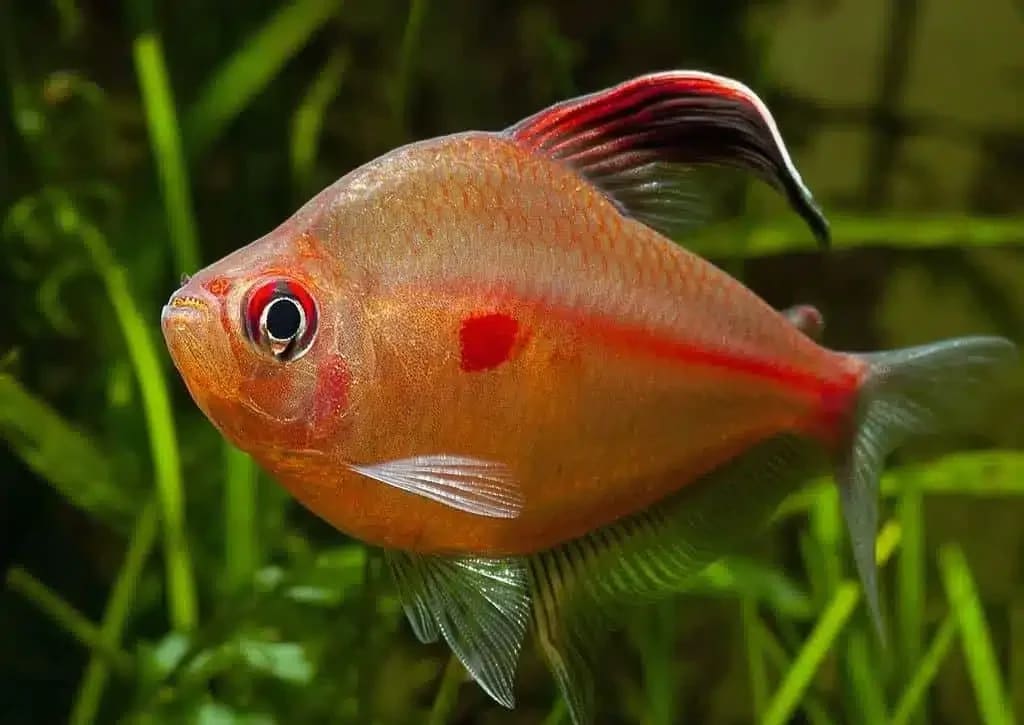
Bleeding-heart tetra
Hyphessobrycon erythrostigma
Parameter dashboard
21-28 °C
4-7.5
6 cm
5 years
Care guide
The bleeding heart tetra is native to the sluggish, tannin-stained tributaries and forest lakes of the upper Amazon where Brazil, Peru and Colombia meet. The striking red blotch on the flank — the "bleeding heart" — gives the fish its common name. Adult males grow to about 6 cm and develop noticeably extended dorsal, pelvic and anal fins, while females stay rounder and slightly smaller.
These tetras need soft, acidic water to thrive. In the aquarium keep the temperature at 21–28 °C and pH at 4.0–7.5, though they colour up best at the softer, more acidic end of that range. Dimly lit tanks with a dark substrate, floating plants and leaf litter that leaches tannins suit them well. A tank with a footprint of at least 90 × 30 cm (about 81 litres) is recommended for a mixed-sex group of eight to ten. They are intolerant of accumulated organic waste and must never be added to an uncycled tank.
In the wild the stomach contents of specimens from Lake Ayapuá were over 98 % fruit remains, with the rest being aquatic insects. In captivity they accept good-quality flakes and granules but need regular live or frozen foods — bloodworm, Daphnia and Artemia — to maintain condition. Submerged pieces of fresh fruit are also eagerly grazed.
Despite the territorial displays that males perform towards one another, this is a peaceful species that fits well in a community of similarly-sized characins, corydoras and small cichlids. It is an egg-scatterer with no parental care. The species is known to be susceptible to a condition that makes the scales appear metallic gold; affected fish show no discomfort and their lifespan appears unaffected.
Source
Further reading on identification and aquarium care.
Tankmate compatibility (sample)
Pairwise screening against other species in the database (prioritizing the same family when data is available).
Review first (1)
Caution or avoid from automated rules — confirm before mixing.
| Species | Assessment | Notes |
|---|---|---|
| Jewel tetra Hyphessobrycon eques Caution | Caution | close relatives, and one of them is territorial, so both claim the same kind of space Open pair in Compare → |
11 species with compatible assessment in this sampleCollapse to hide the list; use “Open pair in Compare” for the full matrix.
| Species | Assessment | Notes |
|---|---|---|
| Blackline penguinfish Thayeria boehlkei Compatible | Compatible | No rule-based conflicts detected for this pair. Open pair in Compare → |
| Buenos Aires tetra Hyphessobrycon anisitsi Compatible | Compatible | No rule-based conflicts detected for this pair. Open pair in Compare → |
| Colombian Tetra Hyphessobrycon columbianus Compatible | Compatible | No rule-based conflicts detected for this pair. Open pair in Compare → |
| Diamond tetra Moenkhausia pittieri Compatible | Compatible | No rule-based conflicts detected for this pair. Open pair in Compare → |
| Head-and-taillight tetra Hemigrammus ocellifer Compatible | Compatible | No rule-based conflicts detected for this pair. Open pair in Compare → |
| Lemon tetra Hyphessobrycon pulchripinnis Compatible | Compatible | No rule-based conflicts detected for this pair. Open pair in Compare → |
| Ornate tetra Hyphessobrycon bentosi Compatible | Compatible | No rule-based conflicts detected for this pair. Open pair in Compare → |
| Red phantom tetra Hyphessobrycon sweglesi Compatible | Compatible | No rule-based conflicts detected for this pair. Open pair in Compare → |
| Rosy tetra Hyphessobrycon rosaceus Compatible | Compatible | No rule-based conflicts detected for this pair. Open pair in Compare → |
| Rummy-nose tetra Hemigrammus rhodostomus Compatible | Compatible | No rule-based conflicts detected for this pair. Open pair in Compare → |
| Silvertip tetra Hasemania nana Compatible | Compatible | No rule-based conflicts detected for this pair. Open pair in Compare → |
Same rule engine as Compare. Not a substitute for observation, tank size, or acclimation.
Related species
Was this page useful? Spot anything wrong?