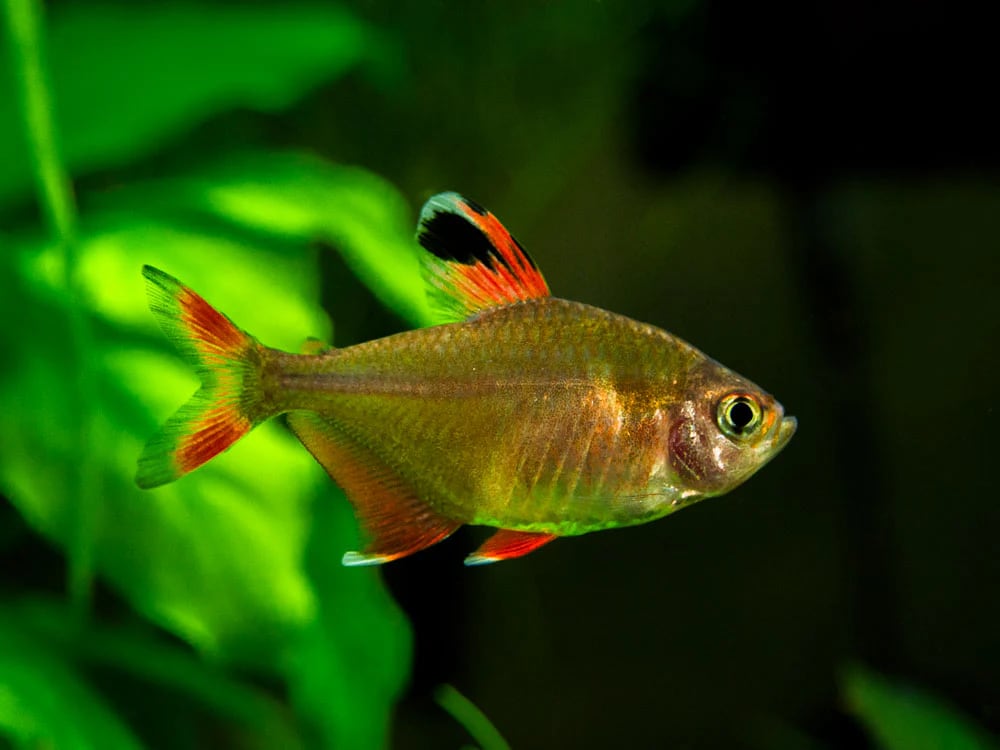
Ornate tetra
Hyphessobrycon bentosi
Parameter dashboard
20-28 °C
5-7.5
4.5 cm
5 years
Care guide
The Ornate Tetra (Hyphessobrycon bentosi) is an elegant characin from the sluggish tributaries, forest lakes, and side channels of the lower Amazon basin in Brazil. First described in 1908 from specimens collected near Óbidos, Pará, it inhabits soft, poorly-buffered waters stained brown by tannins and organic acids from decomposing plant material. Reaching a standard length of 40–45 mm, it displays a translucent silvery body with a distinctive dark dorsal-fin marking, red-tipped fins, and a subtle rosy sheen that becomes more pronounced in well-maintained specimens, embodying the classic tetra form and temperament that has made this group a cornerstone of the aquarium hobby.
The Ornate Tetra is a very peaceful schooling fish that should be kept in groups of eight to ten or more, where males establish temporary dominance hierarchies that drive the most interesting behavioral displays and intensify their coloration. Ideal tankmates include similarly-sized characins, gasteropelecids, lebiasinids, and small catfish such as Corydoras or Otocinclus. They thrive in a well-furnished biotope-style setup featuring a dark sandy substrate, driftwood roots and branches, dried leaf litter, and dim lighting provided by floating vegetation — an arrangement that mimics their natural blackwater habitat. They are omnivorous, feeding on small invertebrates, crustaceans, filamentous algae, and fallen fruit in nature, and in the aquarium they do well on a varied diet of quality dried foods supplemented with live and frozen chironomid larvae, Daphnia, and mosquito larvae.
This species requires stable, pristine water conditions and should never be introduced to a biologically immature aquarium — it is sensitive to the accumulation of organic pollutants, making regular weekly water changes essential. Optimal parameters include a temperature of 20–28°C, pH 5.0–7.5, and very soft to moderately hard water. Like most small characins, they are egg-scattering free spawners with no parental care. Adults spawn readily when conditioned with live foods, scattering eggs among fine-leaved plants or spawning mops. The fry require exceptionally small initial foods — Paramecium or proprietary 5–50 micron fry powders — before graduating to Artemia nauplii and microworm as they grow. A separate rearing tank is recommended to protect eggs and fry from adult predation.
Sources
- seriouslyfish.com — https://www.seriouslyfish.com/species/hyphessobrycon-bentosi/
- seriouslyfish.com — https://www.seriouslyfish.com/species/megalamphodus-bentosi
Further reading on identification and aquarium care.
Tankmate compatibility (sample)
Pairwise screening against other species in the database (prioritizing the same family when data is available).
Review first (4)
Caution or avoid from automated rules — confirm before mixing.
| Species | Assessment | Notes |
|---|---|---|
| Black widow tetra Gymnocorymbus ternetzi Avoid | Avoid | Fin nippers should not be kept with long-finned species Open pair in Compare → |
| Buenos Aires tetra Hyphessobrycon anisitsi Avoid | Avoid | Fin nippers should not be kept with long-finned species Open pair in Compare → |
| Colombian Tetra Hyphessobrycon columbianus Avoid | Avoid | Fin nippers should not be kept with long-finned species Open pair in Compare → |
| Silvertip tetra Hasemania nana Avoid | Avoid | Fin nippers should not be kept with long-finned species Open pair in Compare → |
8 species with compatible assessment in this sampleCollapse to hide the list; use “Open pair in Compare” for the full matrix.
| Species | Assessment | Notes |
|---|---|---|
| Black neon tetra Hyphessobrycon herbertaxelrodi Compatible | Compatible | No rule-based conflicts detected for this pair. Open pair in Compare → |
| Black phantom tetra Hyphessobrycon megalopterus Compatible | Compatible | No rule-based conflicts detected for this pair. Open pair in Compare → |
| Bleeding-heart tetra Hyphessobrycon erythrostigma Compatible | Compatible | No rule-based conflicts detected for this pair. Open pair in Compare → |
| Diamond tetra Moenkhausia pittieri Compatible | Compatible | No rule-based conflicts detected for this pair. Open pair in Compare → |
| Glass bloodfin Prionobrama filigera Compatible | Compatible | No rule-based conflicts detected for this pair. Open pair in Compare → |
| Lemon tetra Hyphessobrycon pulchripinnis Compatible | Compatible | No rule-based conflicts detected for this pair. Open pair in Compare → |
| Rosy tetra Hyphessobrycon rosaceus Compatible | Compatible | No rule-based conflicts detected for this pair. Open pair in Compare → |
| Rummy-nose tetra Hemigrammus rhodostomus Compatible | Compatible | No rule-based conflicts detected for this pair. Open pair in Compare → |
Same rule engine as Compare. Not a substitute for observation, tank size, or acclimation.
Related species
Was this page useful? Spot anything wrong?