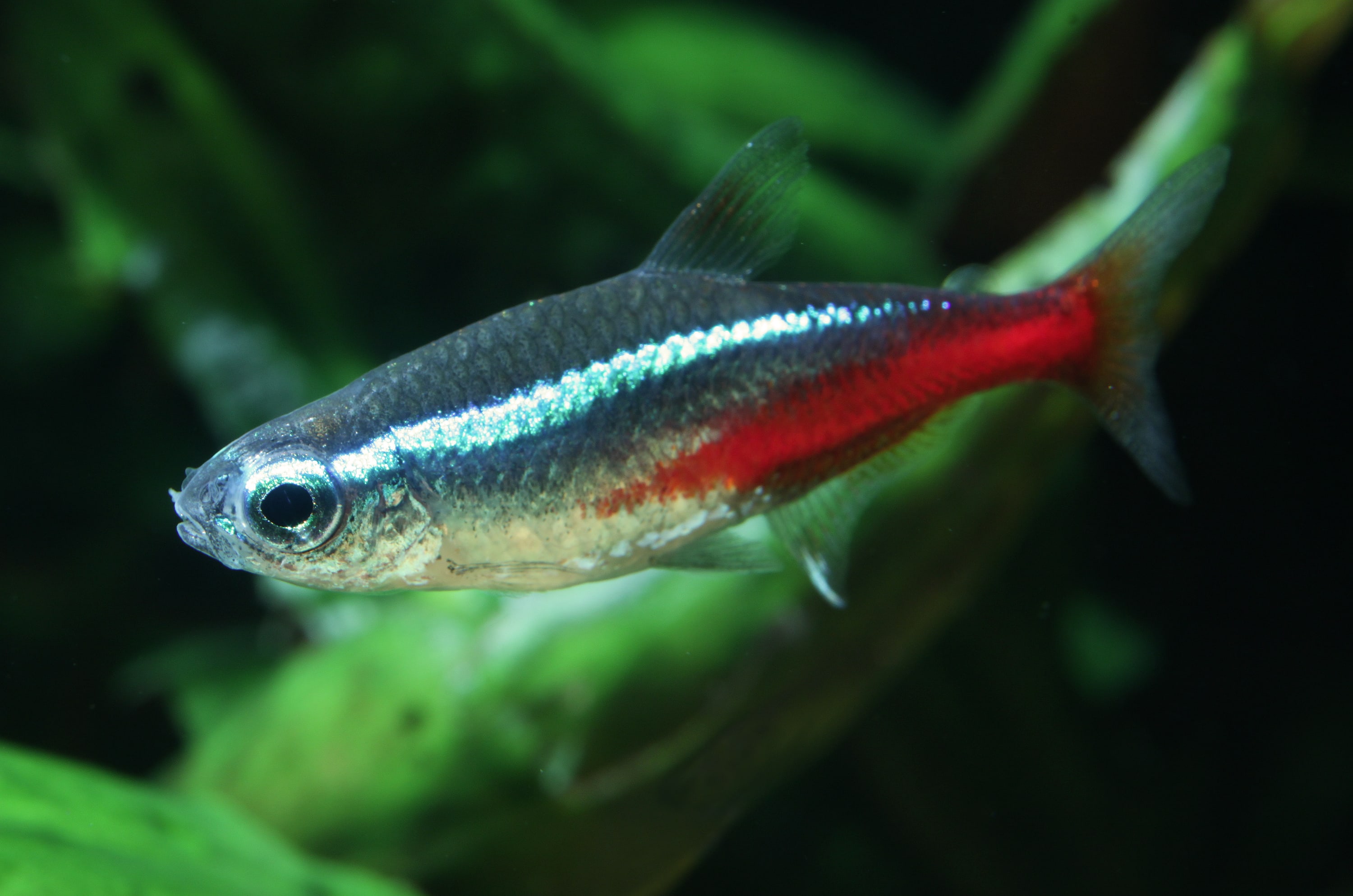
Neon tetra
Paracheirodon innesi
Parameter dashboard
21-25 °C
4-7.5
3 cm
5 years
Care guide
The neon tetra reaches about 3 cm standard length and remains one of the most popular aquarium fish worldwide. A tank with a base of 60 by 30 cm (about 54 L) can house a good-sized school of 8–10 or more, and subdued lighting and softer water suit their forest-stream origins. The published pH range is 4.0–7.5; this spans acidic to slightly alkaline water and is not a target to reproduce the extremes. Commercially bred fish can be more adaptable than wild stock. The published maintenance temperature range is 21–25 °C. They are generally peaceful; choose similarly sized, non-predatory tankmates that share their water requirements. The diet is omnivorous — fine flake, micro pellets, and small live or frozen foods. Keep the tank well planted with subdued lighting and a dark substrate, conditions that mimic the blackwater streams of the upper Amazon basin where wild populations occur. Commercial breeding has produced several colour strains (golden, albino, long-fin) but these are often less robust than the wild type. Neon tetra disease is a risk; buy from reputable sources.
Source
Further reading on identification and aquarium care.
Tankmate compatibility (sample)
Pairwise screening against other species in the database (prioritizing the same family when data is available).
Review first (9)
Caution or avoid from automated rules — confirm before mixing.
| Species | Assessment | Notes |
|---|---|---|
| Black widow tetra Gymnocorymbus ternetzi Caution | Caution | Fish 2x+ larger may eat smaller tankmates Open pair in Compare → |
| Bleeding-heart tetra Hyphessobrycon erythrostigma Caution | Caution | Fish 2x+ larger may eat smaller tankmates Open pair in Compare → |
| Buenos Aires tetra Hyphessobrycon anisitsi Caution | Caution | Fish 2x+ larger may eat smaller tankmates Open pair in Compare → |
| Colombian Tetra Hyphessobrycon columbianus Caution | Caution | Fish 2x+ larger may eat smaller tankmates Open pair in Compare → |
| Diamond tetra Moenkhausia pittieri Caution | Caution | Fish 2x+ larger may eat smaller tankmates · the two share only a narrow band of temperature, so one of them sits at the edge of its range Open pair in Compare → |
| Glass bloodfin Prionobrama filigera Caution | Caution | Fish 2x+ larger may eat smaller tankmates Open pair in Compare → |
| Glowlight tetra Hemigrammus erythrozonus Caution | Caution | the two share only a narrow band of temperature, so one of them sits at the edge of its range Open pair in Compare → |
| Head-and-taillight tetra Hemigrammus ocellifer Caution | Caution | the two share only a narrow band of temperature, so one of them sits at the edge of its range Open pair in Compare → |
| Rosy tetra Hyphessobrycon rosaceus Caution | Caution | the two share only a narrow band of temperature, so one of them sits at the edge of its range Open pair in Compare → |
3 species with compatible assessment in this sampleCollapse to hide the list; use “Open pair in Compare” for the full matrix.
| Species | Assessment | Notes |
|---|---|---|
| Black phantom tetra Hyphessobrycon megalopterus Compatible | Compatible | No rule-based conflicts detected for this pair. Open pair in Compare → |
| Cardinal tetra Paracheirodon axelrodi Compatible | Compatible | No rule-based conflicts detected for this pair. Open pair in Compare → |
| Ornate tetra Hyphessobrycon bentosi Compatible | Compatible | No rule-based conflicts detected for this pair. Open pair in Compare → |
Same rule engine as Compare. Not a substitute for observation, tank size, or acclimation.
Related species
Was this page useful? Spot anything wrong?