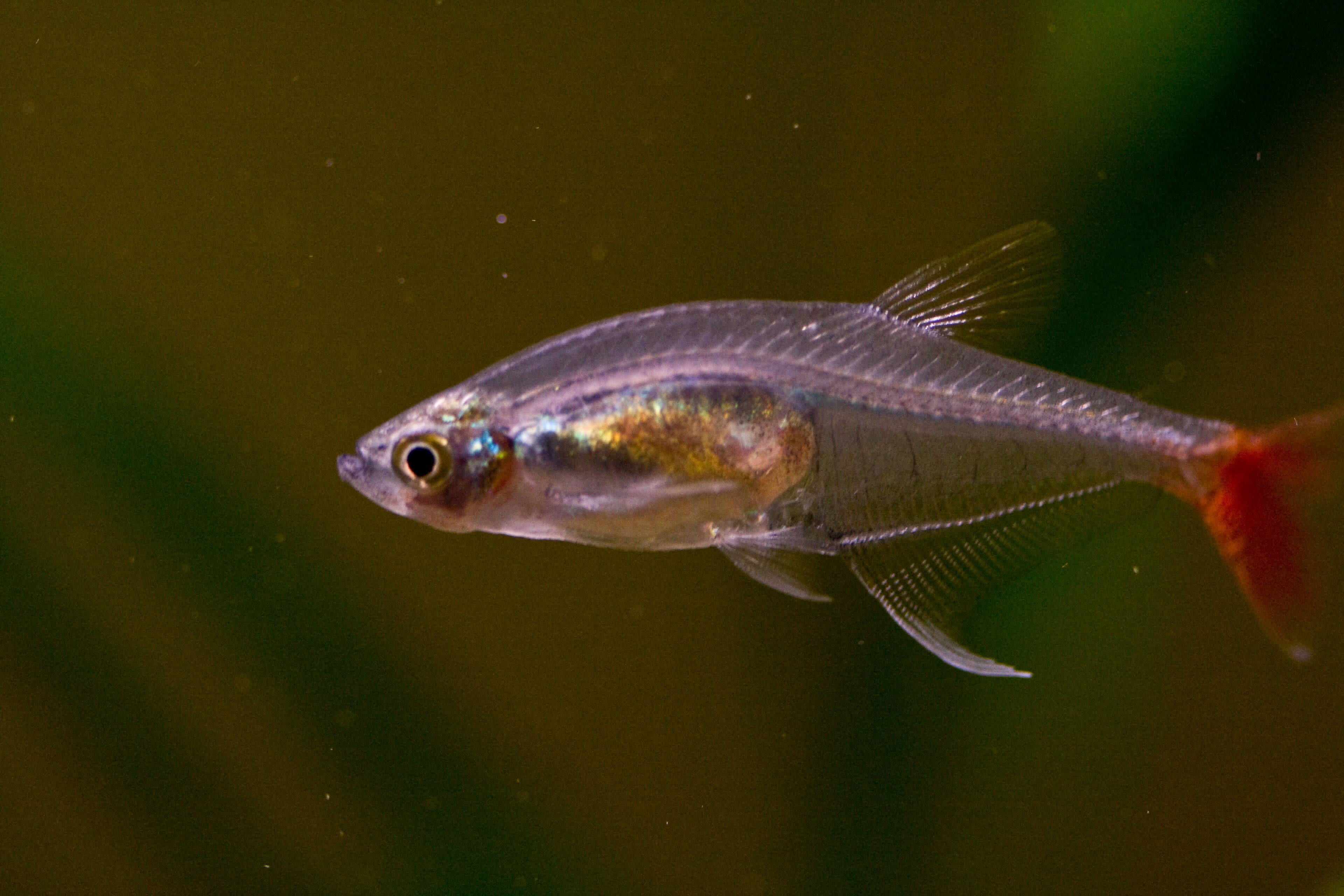
Glass bloodfin
Prionobrama filigera
Parameter dashboard
23-27 °C
6-7.5
6 cm
7 years
Care guide
The glass bloodfin tetra (Prionobrama filigera) is a subtly beautiful South American characin distinguished by its semi-transparent body and brilliant red-orange caudal fin — a striking contrast that gives the species both its common name and its visual appeal. Native to the Amazon River drainage across Ecuador, Colombia, Peru, Bolivia, and Brazil, this active, pelagic species inhabits smaller streams, creeks, and tributaries where it forms schools near the upper water layers. It grows to around 6 cm in length and exhibits a slightly compressed, keeled body shape with an upturned mouth adapted for picking small invertebrates from the water surface.
Despite being somewhat underappreciated in the hobby, the glass bloodfin is an excellent choice for beginners. It is unfussy regarding water chemistry, accepts a wide variety of foods (particularly fond of live and frozen Daphnia, bloodworm, and Cyclops, but readily taking high-quality dried alternatives), and is robust when maintained under stable conditions. Males may engage in harmless squabbling over hierarchy, but the species is otherwise peaceful and makes an ideal tankmate for other similarly-sized South American species including Corydoras, smaller Loricariid catfish, Apistogramma dwarf cichlids, and Mikrogeophagus rams. They are naturally skittish and should always be kept in groups of at least 6–8 specimens. Avoid larger, fast-swimming fish that compete strongly for food and space.
An aquarium of 70–80 liters with dimensions of 60 × 37.5 cm or larger is adequate for a small school. The tank should contain plenty of open swimming space with some patches of floating vegetation to provide shade and security. Driftwood twigs, dried leaf litter, and a dark substrate help create a natural-looking set-up that encourages the fish to display their best coloration. Recommended water parameters include a temperature of 23–27°C, pH 6.0–7.5, and hardness up to 30°H. Breeding is achievable in a separate spawning tank with soft, acidic water and fine-leaved plants; eggs hatch within 14–36 hours and fry become free-swimming after 3–4 days.
Source
Further reading on identification and aquarium care.
Tankmate compatibility (sample)
Pairwise screening against other species in the database (prioritizing the same family when data is available).
Review first (2)
Caution or avoid from automated rules — confirm before mixing.
| Species | Assessment | Notes |
|---|---|---|
| Ember tetra Hyphessobrycon amandae Caution | Caution | Fish 2x+ larger may eat smaller tankmates Open pair in Compare → |
| Neon tetra Paracheirodon innesi Caution | Caution | Fish 2x+ larger may eat smaller tankmates Open pair in Compare → |
10 species with compatible assessment in this sampleCollapse to hide the list; use “Open pair in Compare” for the full matrix.
| Species | Assessment | Notes |
|---|---|---|
| Blackline penguinfish Thayeria boehlkei Compatible | Compatible | No rule-based conflicts detected for this pair. Open pair in Compare → |
| Bleeding-heart tetra Hyphessobrycon erythrostigma Compatible | Compatible | No rule-based conflicts detected for this pair. Open pair in Compare → |
| Cardinal tetra Paracheirodon axelrodi Compatible | Compatible | No rule-based conflicts detected for this pair. Open pair in Compare → |
| Colombian Tetra Hyphessobrycon columbianus Compatible | Compatible | No rule-based conflicts detected for this pair. Open pair in Compare → |
| Diamond tetra Moenkhausia pittieri Compatible | Compatible | No rule-based conflicts detected for this pair. Open pair in Compare → |
| Lemon tetra Hyphessobrycon pulchripinnis Compatible | Compatible | No rule-based conflicts detected for this pair. Open pair in Compare → |
| Ornate tetra Hyphessobrycon bentosi Compatible | Compatible | No rule-based conflicts detected for this pair. Open pair in Compare → |
| Rosy tetra Hyphessobrycon rosaceus Compatible | Compatible | No rule-based conflicts detected for this pair. Open pair in Compare → |
| Rummy-nose tetra Hemigrammus rhodostomus Compatible | Compatible | No rule-based conflicts detected for this pair. Open pair in Compare → |
| Silvertip tetra Hasemania nana Compatible | Compatible | No rule-based conflicts detected for this pair. Open pair in Compare → |
Same rule engine as Compare. Not a substitute for observation, tank size, or acclimation.
Related species
Was this page useful? Spot anything wrong?