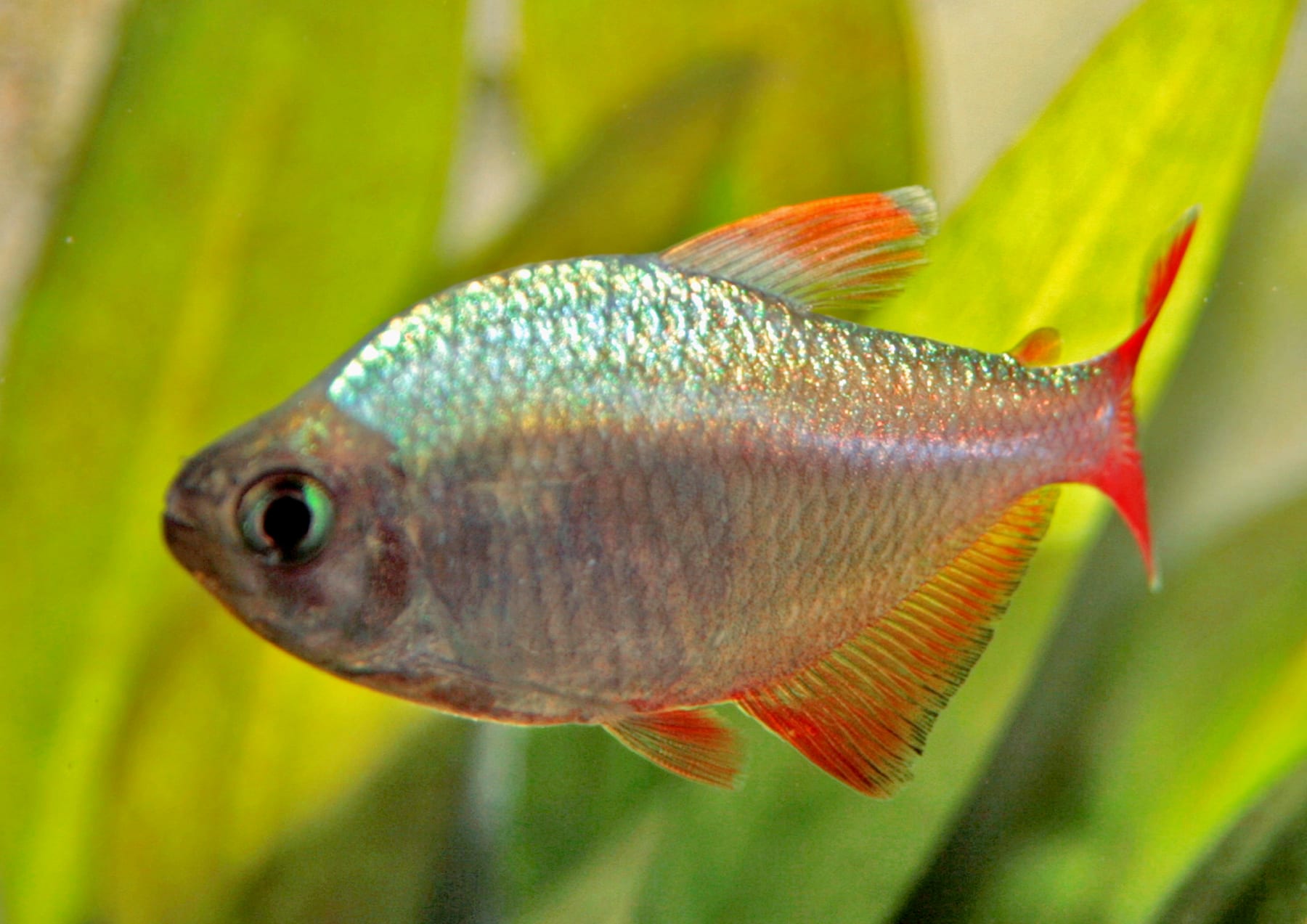
Colombian Tetra
Hyphessobrycon columbianus
Parameter dashboard
20-28 °C
5-7.5
6.5 cm
5 years
Care guide
The Colombian tetra is endemic to a single river system — the Río Acandí in Chocó department, northern Colombia, near the Panama border. It was misidentified as Hyphessobrycon ecuadorensis for years before its formal description in 2002. The fish is also traded under the names Blue Flame tetra and Colombian Red Fin tetra, referencing the blue-grey body and red-orange fins that intensify in dominant males. Standard length reaches about 6.5 cm.
A mixed-sex group of at least eight to ten should be housed in a tank with a 90 × 30 cm base (81 litres) or larger. These tetras are active swimmers and appreciate open water in the middle zone with some planted margins. The temperature range spans 20–28 °C, pH 5.0–7.5, with hardness from very soft to moderately hard. Good filtration and regular water changes are more important than any particular water chemistry.
Colombian tetras are foraging omnivores. A varied diet of quality flakes and granules supplemented with live or frozen bloodworm, Daphnia and Artemia brings out the best colour and keeps the fish in spawning condition. They are generally peaceful and mix well with similarly-sized characins, corydoras, small loricariids and non-predatory medium-sized cichlids.
Males are more intensely coloured, slimmer and slightly smaller than females, with a more extended dorsal fin. Breeding is straightforward for an experienced hobbyist: the fish are egg-scatterers that spawn readily in a separate tank with soft, acidic water and fine-leaved plants or a mesh base to protect the eggs. A well-conditioned female can produce up to 2,000 eggs per spawn, which hatch in 24–36 hours.
Source
Further reading on identification and aquarium care.
Tankmate compatibility (sample)
Pairwise screening against other species in the database (prioritizing the same family when data is available).
Review first (4)
Caution or avoid from automated rules — confirm before mixing.
| Species | Assessment | Notes |
|---|---|---|
| Ember tetra Hyphessobrycon amandae Caution | Caution | Fish 2x+ larger may eat smaller tankmates Open pair in Compare → |
| Jewel tetra Hyphessobrycon eques Caution | Caution | close relatives, and one of them is territorial, so both claim the same kind of space Open pair in Compare → |
| Black phantom tetra Hyphessobrycon megalopterus Avoid | Avoid | Fin nippers should not be kept with long-finned species Open pair in Compare → |
| Ornate tetra Hyphessobrycon bentosi Avoid | Avoid | Fin nippers should not be kept with long-finned species Open pair in Compare → |
8 species with compatible assessment in this sampleCollapse to hide the list; use “Open pair in Compare” for the full matrix.
| Species | Assessment | Notes |
|---|---|---|
| Black neon tetra Hyphessobrycon herbertaxelrodi Compatible | Compatible | No rule-based conflicts detected for this pair. Open pair in Compare → |
| Black widow tetra Gymnocorymbus ternetzi Compatible | Compatible | No rule-based conflicts detected for this pair. Open pair in Compare → |
| Buenos Aires tetra Hyphessobrycon anisitsi Compatible | Compatible | No rule-based conflicts detected for this pair. Open pair in Compare → |
| Glass bloodfin Prionobrama filigera Compatible | Compatible | No rule-based conflicts detected for this pair. Open pair in Compare → |
| Glowlight tetra Hemigrammus erythrozonus Compatible | Compatible | No rule-based conflicts detected for this pair. Open pair in Compare → |
| Head-and-taillight tetra Hemigrammus ocellifer Compatible | Compatible | No rule-based conflicts detected for this pair. Open pair in Compare → |
| Rummy-nose tetra Hemigrammus rhodostomus Compatible | Compatible | No rule-based conflicts detected for this pair. Open pair in Compare → |
| Silvertip tetra Hasemania nana Compatible | Compatible | No rule-based conflicts detected for this pair. Open pair in Compare → |
Same rule engine as Compare. Not a substitute for observation, tank size, or acclimation.
Related species
Was this page useful? Spot anything wrong?