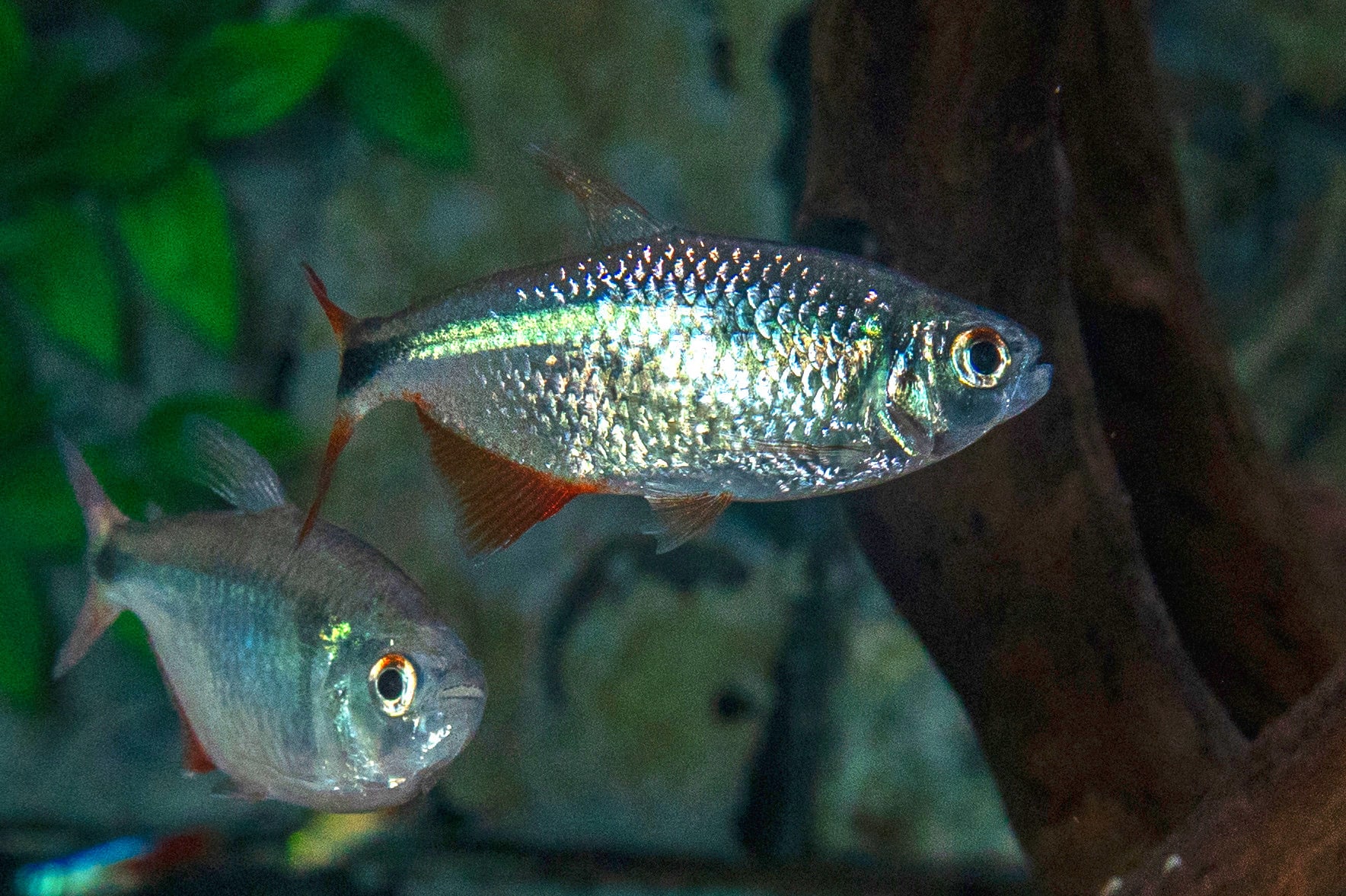
Buenos Aires tetra
Hyphessobrycon anisitsi
Parameter dashboard
16-28 °C
5.5-8.5
6 cm
5 years
Care guide
The Buenos Aires tetra is a robust, active characid from the subtropical and temperate waters of southern Brazil, Paraguay, Uruguay, and northern Argentina. It is named after the capital city of Argentina, though its natural range extends well beyond that region. Unlike many of its tropical relatives, this species inhabits waters that experience cooler winters and abundant rainfall, giving it remarkable tolerance for lower temperatures. It reaches about 5–6 cm in standard length and is distinguished by its silvery body, reddish fins, and a black marking on the dorsal fin.
These tetras are undemanding but need plenty of swimming space. An aquarium with base dimensions of at least 90 cm x 30 cm (~81 litres) should be considered the minimum. Filtration does not need to be particularly strong, though they appreciate a degree of water movement. They are adaptable across a wide range of conditions — temperatures from 16–28 °C, pH from 5.5–8.5, and hardness up to 357 ppm. However, they should not be maintained at the upper end of the temperature range for extended periods as they are naturally a subtropical species.
Buenos Aires tetras have a reputation for nipping the fins of tankmates, especially when kept in insufficient numbers or cramped conditions. A group of at least eight to ten specimens is recommended, as the fish form loose hierarchies and rival males continually compete, creating a natural distraction. They are not ideal companions for shy, slow-moving, or long-finned fish. Their diet is omnivorous — they accept most foods and benefit from plant or algal content in their diet. Live and frozen foods supplement their nutrition and enhance colouration.
Source
Further reading on identification and aquarium care.
Tankmate compatibility (sample)
Pairwise screening against other species in the database (prioritizing the same family when data is available).
Review first (4)
Caution or avoid from automated rules — confirm before mixing.
| Species | Assessment | Notes |
|---|---|---|
| Ember tetra Hyphessobrycon amandae Caution | Caution | Fish 2x+ larger may eat smaller tankmates Open pair in Compare → |
| Neon tetra Paracheirodon innesi Caution | Caution | Fish 2x+ larger may eat smaller tankmates Open pair in Compare → |
| Diamond tetra Moenkhausia pittieri Avoid | Avoid | Fin nippers should not be kept with long-finned species Open pair in Compare → |
| Red phantom tetra Hyphessobrycon sweglesi Avoid | Avoid | Fin nippers should not be kept with long-finned species Open pair in Compare → |
8 species with compatible assessment in this sampleCollapse to hide the list; use “Open pair in Compare” for the full matrix.
| Species | Assessment | Notes |
|---|---|---|
| Bleeding-heart tetra Hyphessobrycon erythrostigma Compatible | Compatible | No rule-based conflicts detected for this pair. Open pair in Compare → |
| Cardinal tetra Paracheirodon axelrodi Compatible | Compatible | No rule-based conflicts detected for this pair. Open pair in Compare → |
| Colombian Tetra Hyphessobrycon columbianus Compatible | Compatible | No rule-based conflicts detected for this pair. Open pair in Compare → |
| Glass bloodfin Prionobrama filigera Compatible | Compatible | No rule-based conflicts detected for this pair. Open pair in Compare → |
| Head-and-taillight tetra Hemigrammus ocellifer Compatible | Compatible | No rule-based conflicts detected for this pair. Open pair in Compare → |
| Lemon tetra Hyphessobrycon pulchripinnis Compatible | Compatible | No rule-based conflicts detected for this pair. Open pair in Compare → |
| Rosy tetra Hyphessobrycon rosaceus Compatible | Compatible | No rule-based conflicts detected for this pair. Open pair in Compare → |
| Rummy-nose tetra Hemigrammus rhodostomus Compatible | Compatible | No rule-based conflicts detected for this pair. Open pair in Compare → |
Same rule engine as Compare. Not a substitute for observation, tank size, or acclimation.
Related species
Was this page useful? Spot anything wrong?