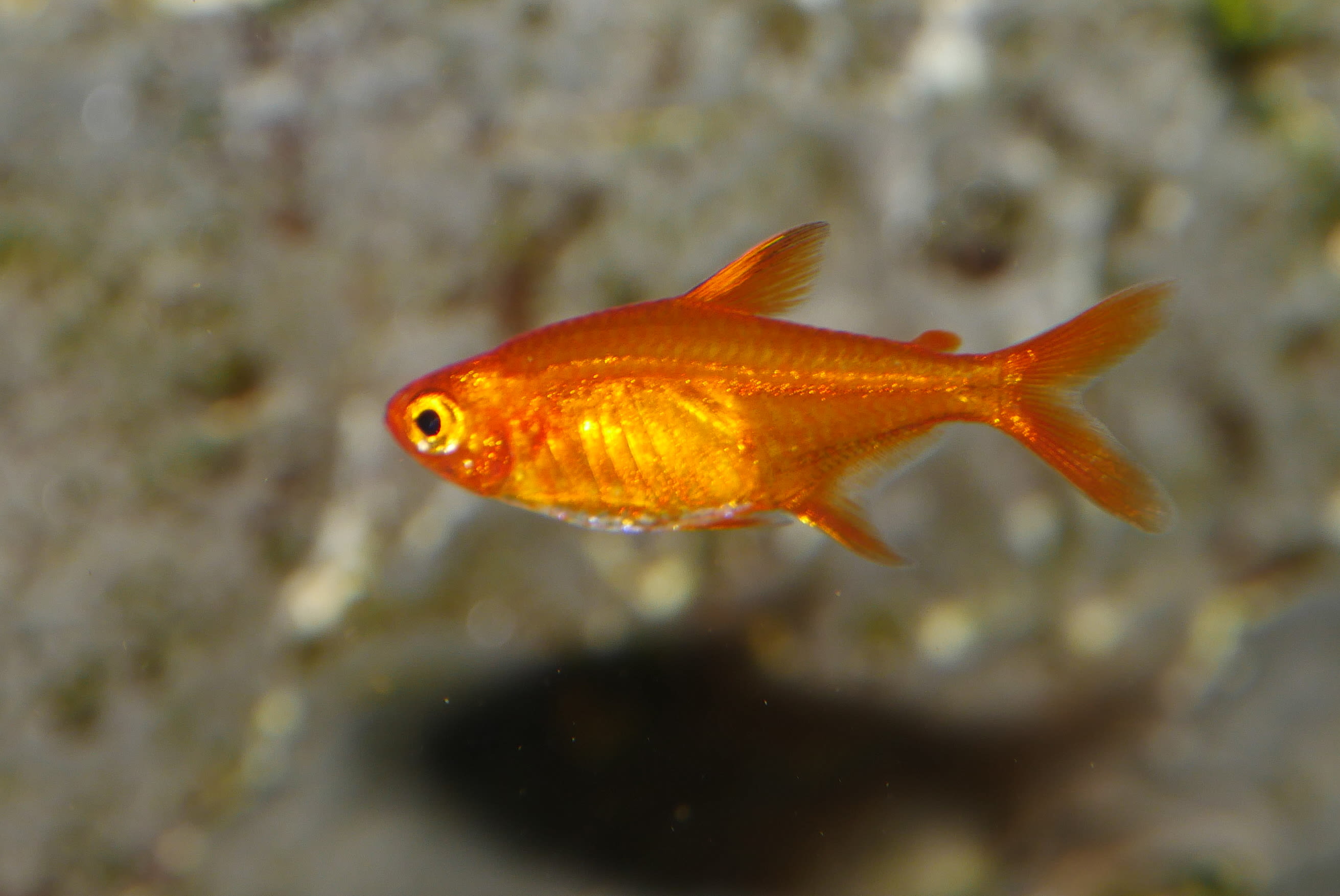
Ember tetra
Hyphessobrycon amandae
Parameter dashboard
20-28 °C
5-7
2 cm
3 years
Care guide
The ember tetra (Hyphessobrycon amandae) is a diminutive characin endemic to the Rio das Mortes, a principal tributary of the Araguaia system in central and western Brazil. Reaching a maximum standard length of just 15–20 mm (0.6–0.8 inches), this tiny fish packs a vivid punch of colour — its entire body glows in shades of fiery orange to deep amber, making it one of the most eye-catching nano species for the planted aquarium. Despite its small size, it is robust, undemanding, and equally suitable for both beginners and experienced aquascapers working with smaller set-ups.
Ember tetras are a gregarious, schooling species and should be maintained in groups of 8–10 or more. In such numbers they form a tight, constantly moving shoal that adds remarkable warmth and life to any aquascape. They are very peaceful and will not compete well with boisterous or much larger tankmates, making them ideal companions for similarly-sized characins, small Corydoras and loricariid catfish, dwarf cichlids such as Apistogramma species, and sedate surface-dwellers like hatchetfish. In nature they are micropredators feeding on tiny invertebrates and zooplankton, and in the aquarium they accept high-quality dried foods of a suitable size but should be offered daily meals of small live and frozen fare such as Artemia nauplii, Moina, and microworm.
An aquarium with base dimensions of at least 45 × 30 cm (roughly 40 litres) is adequate for a small school. The tank should be heavily planted with a dark substrate, driftwood branches, and dried leaf litter to replicate the soft, acidic blackwater conditions of their natural habitat. Floating plants help diffuse the light and encourage natural behaviour. Gentle filtration is preferred — an air-powered sponge filter is ideal. Recommended water parameters include a temperature of 20–28°C, pH 5.0–7.0, and hardness 18–179 ppm. Breeding is possible in a separate setup; the adults scatter eggs and provide no parental care.
Source
Further reading on identification and aquarium care.
Tankmate compatibility (sample)
Pairwise screening against other species in the database (prioritizing the same family when data is available).
Review first (8)
Caution or avoid from automated rules — confirm before mixing.
| Species | Assessment | Notes |
|---|---|---|
| Bleeding-heart tetra Hyphessobrycon erythrostigma Caution | Caution | Fish 2x+ larger may eat smaller tankmates Open pair in Compare → |
| Buenos Aires tetra Hyphessobrycon anisitsi Caution | Caution | Fish 2x+ larger may eat smaller tankmates Open pair in Compare → |
| Colombian Tetra Hyphessobrycon columbianus Caution | Caution | Fish 2x+ larger may eat smaller tankmates Open pair in Compare → |
| Diamond tetra Moenkhausia pittieri Caution | Caution | Fish 2x+ larger may eat smaller tankmates Open pair in Compare → |
| Glass bloodfin Prionobrama filigera Caution | Caution | Fish 2x+ larger may eat smaller tankmates Open pair in Compare → |
| Glowlight tetra Hemigrammus erythrozonus Caution | Caution | Fish 2x+ larger may eat smaller tankmates Open pair in Compare → |
| Ornate tetra Hyphessobrycon bentosi Caution | Caution | Fish 2x+ larger may eat smaller tankmates Open pair in Compare → |
| Rosy tetra Hyphessobrycon rosaceus Caution | Caution | Fish 2x+ larger may eat smaller tankmates Open pair in Compare → |
4 species with compatible assessment in this sampleCollapse to hide the list; use “Open pair in Compare” for the full matrix.
| Species | Assessment | Notes |
|---|---|---|
| Blackline penguinfish Thayeria boehlkei Compatible | Compatible | No rule-based conflicts detected for this pair. Open pair in Compare → |
| Cardinal tetra Paracheirodon axelrodi Compatible | Compatible | No rule-based conflicts detected for this pair. Open pair in Compare → |
| Neon tetra Paracheirodon innesi Compatible | Compatible | No rule-based conflicts detected for this pair. Open pair in Compare → |
| Red phantom tetra Hyphessobrycon sweglesi Compatible | Compatible | No rule-based conflicts detected for this pair. Open pair in Compare → |
Same rule engine as Compare. Not a substitute for observation, tank size, or acclimation.
Related species
Was this page useful? Spot anything wrong?