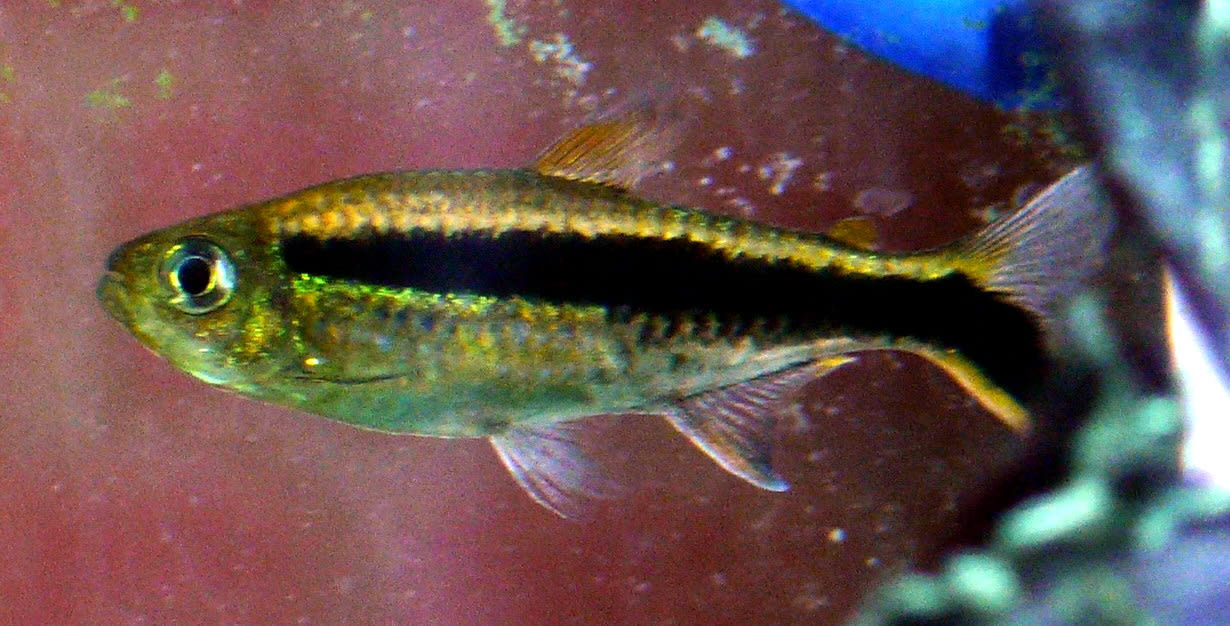
Blackline penguinfish
Thayeria boehlkei
Parameter dashboard
22-28 °C
5.5-8
3.6 cm
5 years
Care guide
Thayeria boehlkei, known as the Blackline Penguinfish or False Penguin Tetra, is a peaceful schooling characin from the upper Amazon basin in Peru and the Rio Araguaia in Brazil. It reaches about 3.6 cm standard length, though a total length of 6 cm has been reported. The name comes from the distinctive black line running along its lower flank. A group of 6–10 individuals requires a tank with a base of at least 60 × 37.5 cm, ideally larger for maximum comfort. Water conditions are highly adaptable: temperature 22–28 °C, pH 5.5–8.0, with hardness up to 20 °H, reflecting the fact that almost all fish in the trade are mass-produced from captive-bred stock. The species makes a superb addition to the well-planted aquarium with a dark substrate, driftwood, and floating plants to provide shady conditions. A micropredator by nature, it feeds on insects, worms, crustaceans, and other small invertebrates in the wild. In the aquarium it is unfussy and greedily accepts dried flakes and granules, but should be offered regular meals of live and frozen foods such as bloodworm, Daphnia, and Artemia for optimal health and colouration. Peaceful and schooling, it should never be kept in groups smaller than six. Fin-nipping behaviour occasionally attributed to this species is usually absent when kept in sufficient numbers. Suitable tankmates include Hemigrammus and Hyphessobrycon tetras, pencil fish, Apistogramma dwarf cichlids, Corydoras, and small Loricariids. Females are more rounded in the belly and slightly less intensely coloured than males.
Source
Further reading on identification and aquarium care.
Tankmate compatibility (sample)
Pairwise screening against other species in the database (prioritizing the same family when data is available).
Review first (1)
Caution or avoid from automated rules — confirm before mixing.
| Species | Assessment | Notes |
|---|---|---|
| Jewel tetra Hyphessobrycon eques Caution | Caution | close relatives, and one of them is territorial, so both claim the same kind of space Open pair in Compare → |
11 species with compatible assessment in this sampleCollapse to hide the list; use “Open pair in Compare” for the full matrix.
| Species | Assessment | Notes |
|---|---|---|
| Black neon tetra Hyphessobrycon herbertaxelrodi Compatible | Compatible | No rule-based conflicts detected for this pair. Open pair in Compare → |
| Black phantom tetra Hyphessobrycon megalopterus Compatible | Compatible | No rule-based conflicts detected for this pair. Open pair in Compare → |
| Bleeding-heart tetra Hyphessobrycon erythrostigma Compatible | Compatible | No rule-based conflicts detected for this pair. Open pair in Compare → |
| Diamond tetra Moenkhausia pittieri Compatible | Compatible | No rule-based conflicts detected for this pair. Open pair in Compare → |
| Ember tetra Hyphessobrycon amandae Compatible | Compatible | No rule-based conflicts detected for this pair. Open pair in Compare → |
| Head-and-taillight tetra Hemigrammus ocellifer Compatible | Compatible | No rule-based conflicts detected for this pair. Open pair in Compare → |
| Lemon tetra Hyphessobrycon pulchripinnis Compatible | Compatible | No rule-based conflicts detected for this pair. Open pair in Compare → |
| Neon tetra Paracheirodon innesi Compatible | Compatible | No rule-based conflicts detected for this pair. Open pair in Compare → |
| Ornate tetra Hyphessobrycon bentosi Compatible | Compatible | No rule-based conflicts detected for this pair. Open pair in Compare → |
| Red phantom tetra Hyphessobrycon sweglesi Compatible | Compatible | No rule-based conflicts detected for this pair. Open pair in Compare → |
| Rummy-nose tetra Hemigrammus rhodostomus Compatible | Compatible | No rule-based conflicts detected for this pair. Open pair in Compare → |
Same rule engine as Compare. Not a substitute for observation, tank size, or acclimation.
Related species
Was this page useful? Spot anything wrong?