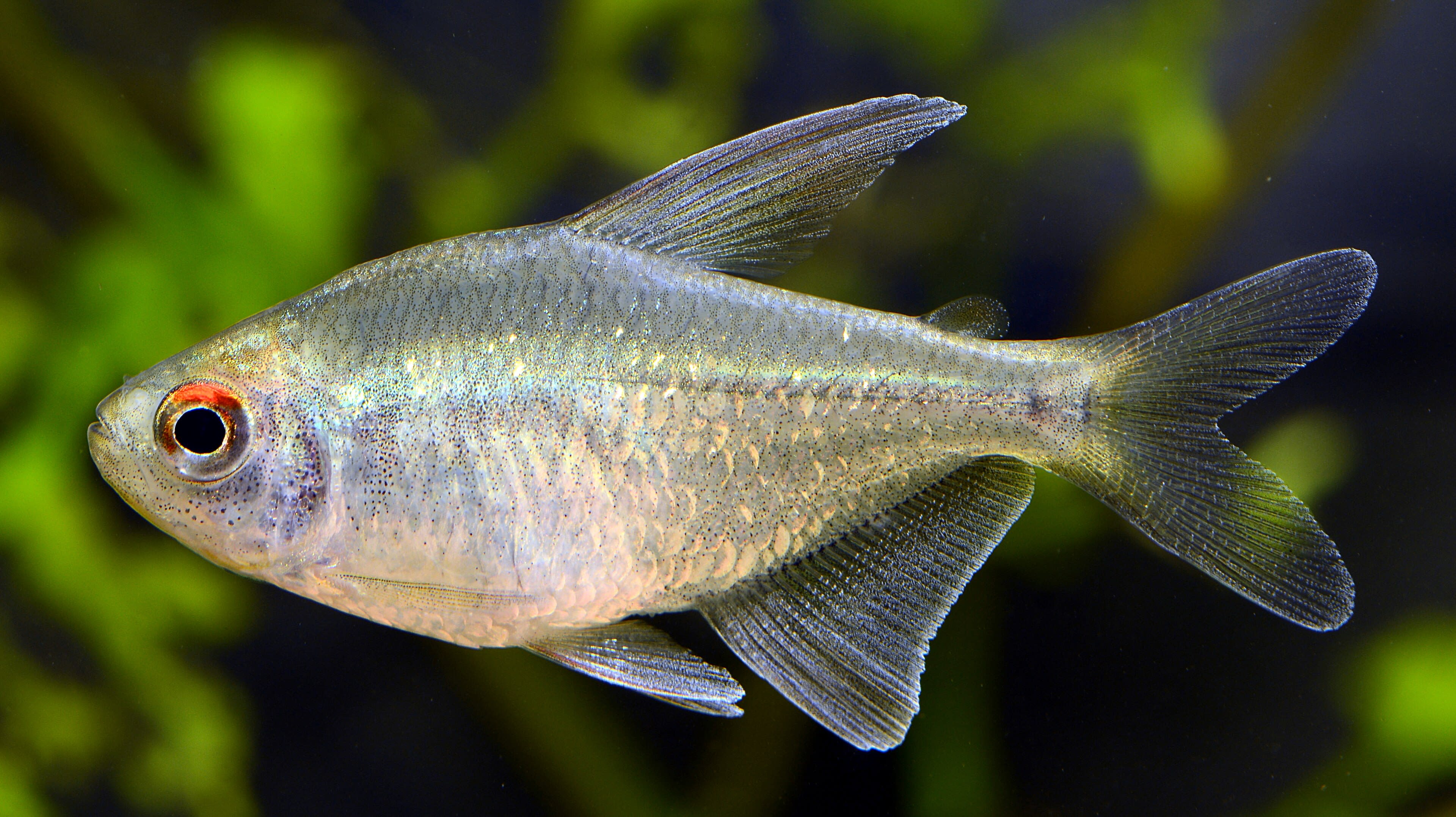
Diamond tetra
Moenkhausia pittieri
Parameter dashboard
24-28 °C
5.5-7
6 cm
5 years
Care guide
The diamond tetra is a stunning characid endemic to Lake Valencia and its surrounding waters in Venezuela. Adult males develop an intense iridescent sheen across their scales that catches the light like tiny gems, giving the species its common name. Reaching about 6 cm, males grow to an impressive size for a tetra and boast extended dorsal and anal fins. Sadly, the species' natural habitat has suffered significant degradation, and almost all fish in the trade are commercially bred on farms in Eastern Europe or the Far East.
Diamond tetras are adaptable but look their best in a well-planted aquarium with subdued lighting. A densely planted arrangement with plenty of swimming space suits them well. They also thrive in an Amazon-style biotope with a sandy substrate, twisted driftwood roots, and dried leaf litter that stains the water a tea-like colour. An aquarium measuring at least 60 cm x 37.5 cm x 30 cm (70 litres) is sufficient for a small shoal. Water conditions should be slightly acidic to neutral, with temperatures maintained between 24–28 °C.
Despite a reputation for occasional fin-nipping, this behaviour is easily managed by keeping the diamond tetra in a group of at least six to eight specimens. The squabbling then remains within the shoal, and rival males put on spectacular displays. They are peaceful towards other community fish and make excellent companions for livebearers, danionins, rasboras, Corydoras, and dwarf cichlids. Their diet is unfussy — quality flakes and granules supplemented with live and frozen foods such as bloodworm, Daphnia, and brine shrimp will bring out their best colours.
Source
Further reading on identification and aquarium care.
Tankmate compatibility (sample)
Pairwise screening against other species in the database (prioritizing the same family when data is available).
Review first (5)
Caution or avoid from automated rules — confirm before mixing.
| Species | Assessment | Notes |
|---|---|---|
| Ember tetra Hyphessobrycon amandae Caution | Caution | Fish 2x+ larger may eat smaller tankmates Open pair in Compare → |
| Black widow tetra Gymnocorymbus ternetzi Avoid | Avoid | Fin nippers should not be kept with long-finned species Open pair in Compare → |
| Buenos Aires tetra Hyphessobrycon anisitsi Avoid | Avoid | Fin nippers should not be kept with long-finned species Open pair in Compare → |
| Colombian Tetra Hyphessobrycon columbianus Avoid | Avoid | Fin nippers should not be kept with long-finned species Open pair in Compare → |
| Silvertip tetra Hasemania nana Avoid | Avoid | Fin nippers should not be kept with long-finned species Open pair in Compare → |
7 species with compatible assessment in this sampleCollapse to hide the list; use “Open pair in Compare” for the full matrix.
| Species | Assessment | Notes |
|---|---|---|
| Black phantom tetra Hyphessobrycon megalopterus Compatible | Compatible | No rule-based conflicts detected for this pair. Open pair in Compare → |
| Blackline penguinfish Thayeria boehlkei Compatible | Compatible | No rule-based conflicts detected for this pair. Open pair in Compare → |
| Cardinal tetra Paracheirodon axelrodi Compatible | Compatible | No rule-based conflicts detected for this pair. Open pair in Compare → |
| Lemon tetra Hyphessobrycon pulchripinnis Compatible | Compatible | No rule-based conflicts detected for this pair. Open pair in Compare → |
| Ornate tetra Hyphessobrycon bentosi Compatible | Compatible | No rule-based conflicts detected for this pair. Open pair in Compare → |
| Red phantom tetra Hyphessobrycon sweglesi Compatible | Compatible | No rule-based conflicts detected for this pair. Open pair in Compare → |
| Rummy-nose tetra Hemigrammus rhodostomus Compatible | Compatible | No rule-based conflicts detected for this pair. Open pair in Compare → |
Same rule engine as Compare. Not a substitute for observation, tank size, or acclimation.
Related species
Was this page useful? Spot anything wrong?