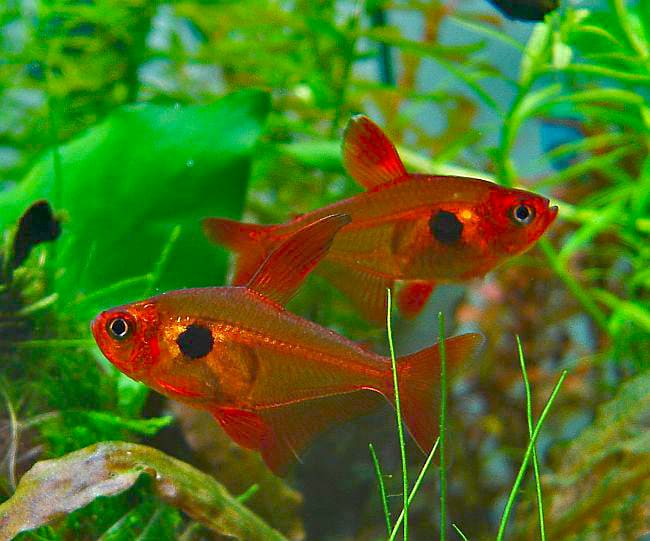
Red phantom tetra
Hyphessobrycon sweglesi
Parameter dashboard
20-28 °C
4.5-7.5
3.5 cm
5 years
Care guide
The red phantom tetra (Hyphessobrycon sweglesi) is a small, peaceful characin endemic to the upper and middle Orinoco River watershed in Colombia and Venezuela. It inhabits minor tributaries, smaller rivers, oxbows, and flooded forests rather than main river channels, occurring in both clearwater streams with sandy substrates and blackwater habitats stained by tannins. Males are particularly attractive with a bright red body colouration and extended dorsal and anal fins, while females are somewhat deeper-bodied and less intensely coloured. This species reaches a maximum standard length of 30 to 35 mm and should be maintained in groups of at least 8 to 10 specimens to encourage natural schooling behaviour and dominance hierarchies in which males display their best colours competing for female attention. The aquarium should be at least 80 cm in length with a base area equivalent to 80 × 30 cm (approximately 72 litres), furnished with a sandy substrate, driftwood roots and branches, and dried leaf litter that promotes beneficial microbe colonies. Water should be soft and acidic to neutral (pH 4.5 to 7.5) with temperatures between 20 and 28 °C. The red phantom tetra is very peaceful and makes an excellent community fish alongside similarly-sized characins, smaller catfishes, and dwarf cichlids. It is omnivorous and thrives on a varied diet of quality dried foods supplemented with live and frozen Daphnia, bloodworm, and mosquito larvae.
Sources
- seriouslyfish.com — https://www.seriouslyfish.com/species/hyphessobrycon-sweglesi/
- seriouslyfish.com — https://www.seriouslyfish.com/species/megalamphodus-sweglesi
Further reading on identification and aquarium care.
Tankmate compatibility (sample)
Pairwise screening against other species in the database (prioritizing the same family when data is available).
Review first (4)
Caution or avoid from automated rules — confirm before mixing.
| Species | Assessment | Notes |
|---|---|---|
| Black widow tetra Gymnocorymbus ternetzi Avoid | Avoid | Fin nippers should not be kept with long-finned species Open pair in Compare → |
| Buenos Aires tetra Hyphessobrycon anisitsi Avoid | Avoid | Fin nippers should not be kept with long-finned species Open pair in Compare → |
| Colombian Tetra Hyphessobrycon columbianus Avoid | Avoid | Fin nippers should not be kept with long-finned species Open pair in Compare → |
| Jewel tetra Hyphessobrycon eques Avoid | Avoid | Fin nippers should not be kept with long-finned species · close relatives, and one of them is territorial, so both claim the same kind of space Open pair in Compare → |
8 species with compatible assessment in this sampleCollapse to hide the list; use “Open pair in Compare” for the full matrix.
| Species | Assessment | Notes |
|---|---|---|
| Black phantom tetra Hyphessobrycon megalopterus Compatible | Compatible | No rule-based conflicts detected for this pair. Open pair in Compare → |
| Blackline penguinfish Thayeria boehlkei Compatible | Compatible | No rule-based conflicts detected for this pair. Open pair in Compare → |
| Bleeding-heart tetra Hyphessobrycon erythrostigma Compatible | Compatible | No rule-based conflicts detected for this pair. Open pair in Compare → |
| Diamond tetra Moenkhausia pittieri Compatible | Compatible | No rule-based conflicts detected for this pair. Open pair in Compare → |
| Glass bloodfin Prionobrama filigera Compatible | Compatible | No rule-based conflicts detected for this pair. Open pair in Compare → |
| Glowlight tetra Hemigrammus erythrozonus Compatible | Compatible | No rule-based conflicts detected for this pair. Open pair in Compare → |
| Head-and-taillight tetra Hemigrammus ocellifer Compatible | Compatible | No rule-based conflicts detected for this pair. Open pair in Compare → |
| Lemon tetra Hyphessobrycon pulchripinnis Compatible | Compatible | No rule-based conflicts detected for this pair. Open pair in Compare → |
Same rule engine as Compare. Not a substitute for observation, tank size, or acclimation.
Related species
Was this page useful? Spot anything wrong?