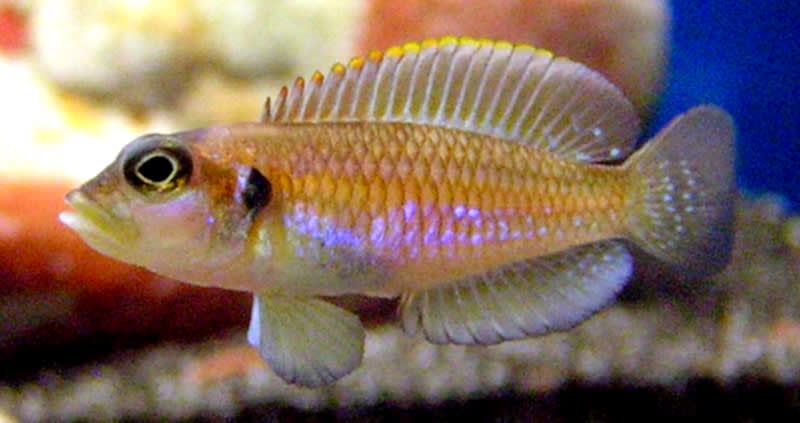
Gold Shell Dweller
Lamprologus ocellatus
Parameter dashboard
23-27 °C
7.5-9
6 cm
8 years
Care guide
The Gold Shell Dweller (Lamprologus ocellatus) is a small, charismatic cichlid endemic to Lake Tanganyika in East Africa, where it inhabits sandy, shell-littered areas along the shoreline. Reaching a maximum size of about 6 cm for males (females are much smaller at around 3.5 cm), this so-called "frog-faced" cichlid has a distinctive bulbous facial appearance and a golden-bronze body color with iridescent blue-green flecks. It is best known for its remarkable behavior of burying empty snail shells in the sand until only the entrance remains visible, creating a fortified burrow that it defends with surprising tenacity against any intruder many times its size.
Gold Shell Dwellers are territorial by nature and will vigorously defend the area around their chosen shell, making them better suited for a species-specific Tanganyikan biotope than a general community aquarium. They can be combined with other Lake Tanganyika inhabitants that occupy different zones, such as rock-dwelling Neolamprologus brichardi, smaller Julidochromis species, or open-water Cyprichromis. They are best maintained as a pair or a single male with two to three females, with plenty of empty snail shells (more shells than fish) spaced across a sandy substrate at least 5 cm deep to accommodate their enthusiastic digging instinct. Their diet should consist primarily of live and frozen foods such as brine shrimp, bloodworm, and Daphnia, though high-quality dried foods are also accepted.
As a Rift Lake cichlid, the Gold Shell Dweller requires hard, alkaline water with a pH of 7.5–9.0 and moderate to high hardness. A stable temperature of 23–27°C and a tank of around 40 liters is sufficient for a pair. Breeding is straightforward and fascinating to watch: the female lays her eggs inside a snail shell, and the male fertilizes them externally as she exits. The female then guards the shell entrance, fanning the eggs until they hatch in approximately three days, with the fry becoming free-swimming at around ten days. The young are large enough to accept brine shrimp nauplii and microworm immediately. While the parents rarely harm their own fry, other fish in a colony may eat them, so a separate rearing tank maximizes survival if desired.
Source
Further reading on identification and aquarium care.
Tankmate compatibility (sample)
Pairwise screening against other species in the database (prioritizing the same family when data is available).
Review first (12)
Caution or avoid from automated rules — confirm before mixing.
| Species | Assessment | Notes |
|---|---|---|
| Bolivian Ram Mikrogeophagus altispinosus Caution | Caution | Multiple territorial species in the same swim layer cause stress · Species with non-overlapping pH ranges may not thrive together · close relatives, and one of them is territorial, so both claim the same kind of space Open pair in Compare → |
| Cockatoo cichlid Apistogramma cacatuoides Caution | Caution | close relatives, and one of them is territorial, so both claim the same kind of space Open pair in Compare → |
| Fasciatus Shell Dweller Altolamprologus fasciatus Caution | Caution | Fish 2x+ larger may eat smaller tankmates · Multiple territorial species in the same swim layer cause stress · close relatives, and one of them is territorial, so both claim the same kind of space Open pair in Compare → |
| Gold Cap Caudopunctatus Neolamprologus caudopunctatus Caution | Caution | close relatives, and one of them is territorial, so both claim the same kind of space Open pair in Compare → |
| Greenstreaked eartheater Biotodoma cupido Caution | Caution | Multiple territorial species in the same swim layer cause stress · Species with non-overlapping pH ranges may not thrive together · close relatives, and one of them is territorial, so both claim the same kind of space Open pair in Compare → |
| Hump-head Cyrtocara moorii Caution | Caution | Fish 2x+ larger may eat smaller tankmates · close relatives, and one of them is territorial, so both claim the same kind of space Open pair in Compare → |
| Jewelfish Hemichromis bimaculatus Caution | Caution | Fish 2x+ larger may eat smaller tankmates · Species with non-overlapping pH ranges may not thrive together · close relatives, and one of them is territorial, so both claim the same kind of space Open pair in Compare → |
| Leleupi Cichlid Neolamprologus leleupi Caution | Caution | Multiple territorial species in the same swim layer cause stress · close relatives, and one of them is territorial, so both claim the same kind of space Open pair in Compare → |
| Malawi eyebiter Dimidiochromis compressiceps Caution | Caution | Fish 2x+ larger may eat smaller tankmates · Multiple territorial species in the same swim layer cause stress · close relatives, and one of them is territorial, so both claim the same kind of space Open pair in Compare → |
| Rainbow krib Pelvicachromis pulcher Caution | Caution | Multiple territorial species in the same swim layer cause stress · Species with non-overlapping pH ranges may not thrive together · close relatives, and one of them is territorial, so both claim the same kind of space Open pair in Compare → |
| Red Spotted Severum Heros efasciatus Caution | Caution | Fish 2x+ larger may eat smaller tankmates · Multiple territorial species in the same swim layer cause stress · Species with non-overlapping pH ranges may not thrive together · close relatives, and one of them is territorial, so both claim the same kind of space Open pair in Compare → |
| Temporaris Shell Dweller Telmatochromis temporalis Caution | Caution | Multiple territorial species in the same swim layer cause stress · close relatives, and one of them is territorial, so both claim the same kind of space Open pair in Compare → |
Same rule engine as Compare. Not a substitute for observation, tank size, or acclimation.
Related species
Was this page useful? Spot anything wrong?