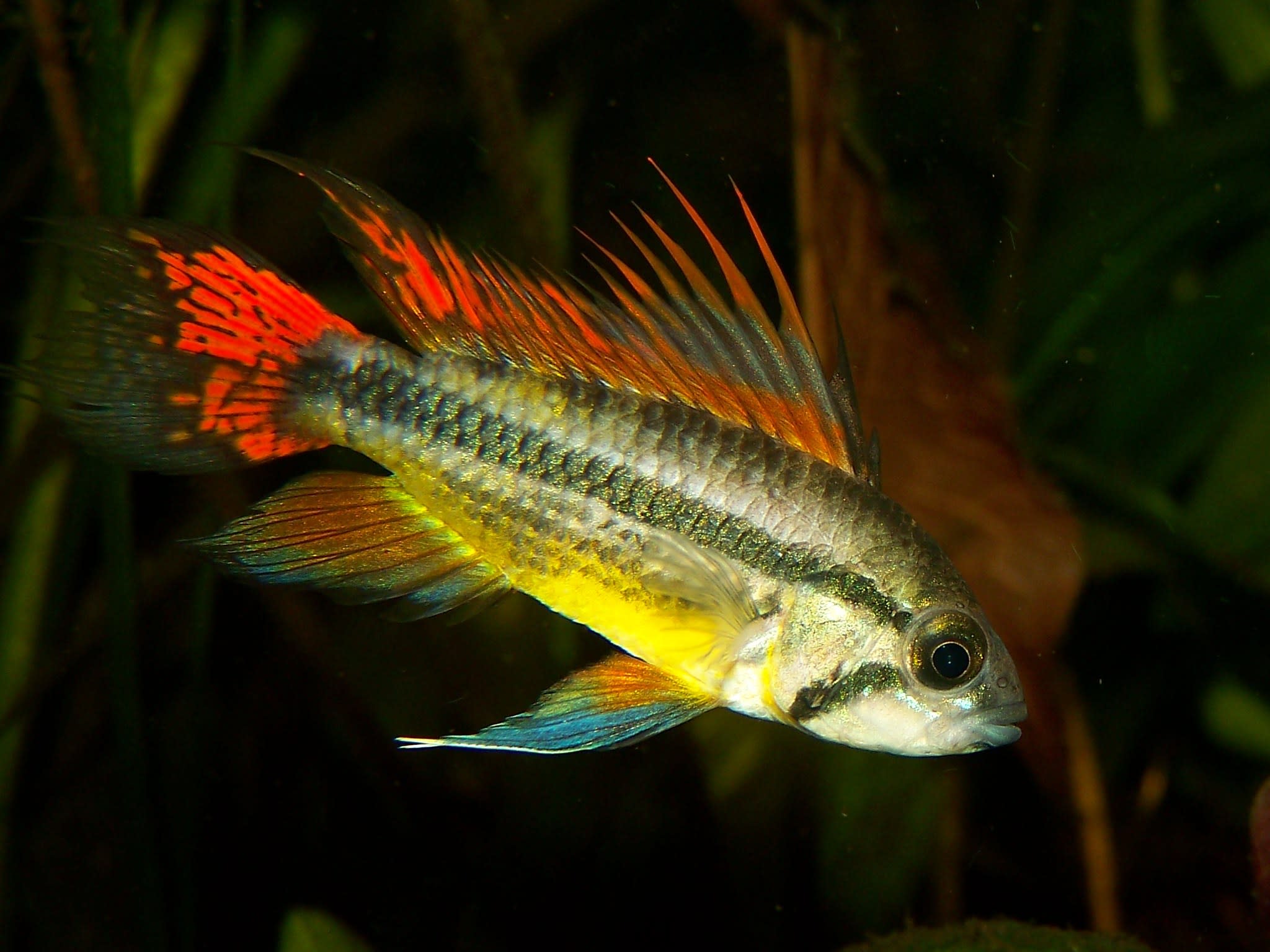
Cockatoo cichlid
Apistogramma cacatuoides
Parameter dashboard
22-29 °C
6-8
7.5 cm
5 years
Care guide
Apistogramma cacatuoides, the cockatoo cichlid, is the most widely kept dwarf cichlid in the hobby and the one most often recommended to newcomers. It is native to slow, shallow waters of the western Amazon in Peru, where it lives among leaf litter and submerged wood. The common name refers to the male's raised, comb-like first dorsal rays; males reach about 7.5 cm and aquarium lines have been selected for orange, red, and double-red fin markings, while females stay near 5 cm.
Its popularity rests on a forgiving nature, because unlike many blackwater dwarf cichlids it adapts to neutral and moderately hard tap water, which makes it far easier to keep and breed than its relatives. A male will hold a territory over the substrate and may court several females in a larger tank. It mixes well with small, peaceful dither fish that occupy the upper water, but it is a predator of dwarf shrimp and tiny fry. Feed it as a carnivore, with live or frozen bloodworm, daphnia, and brine shrimp supplemented by quality dried foods.
A planted tank from 60 litres with temperatures of 22 to 29 degrees Celsius, gentle flow, and several caves suits a pair or a small harem. The cockatoo cichlid is a cave spawner in which the female lays inside a shelter, then guards the eggs and leads the fry out to forage while she fends off anything that approaches. Spawnings are common even in community tanks, and the defending female adopts a vivid yellow warning colour, so an established group will readily produce young for the patient keeper.
Sources
- seriouslyfish.com — https://www.seriouslyfish.com/species/apistogramma-cacatuoides/
- fishbase.se — https://www.fishbase.se/summary/Apistogramma-cacatuoides.html
Further reading on identification and aquarium care.
Tankmate compatibility (sample)
Pairwise screening against other species in the database (prioritizing the same family when data is available).
Review first (11)
Caution or avoid from automated rules — confirm before mixing.
| Species | Assessment | Notes |
|---|---|---|
| Blue streak hap Labidochromis caeruleus Caution | Caution | Species with non-overlapping pH ranges may not thrive together · close relatives, and one of them is territorial, so both claim the same kind of space Open pair in Compare → |
| Convict cichlid Amatitlania nigrofasciata Caution | Caution | Fish 2x+ larger may eat smaller tankmates · close relatives, and one of them is territorial, so both claim the same kind of space · one is boisterous and the other a much smaller peaceful fish sharing the same floor, where it can be intimidated and outcompeted at feeding time Open pair in Compare → |
| Humphead cichlid Cyphotilapia frontosa Caution | Caution | Fish 2x+ larger may eat smaller tankmates · Species with non-overlapping pH ranges may not thrive together · close relatives, and one of them is territorial, so both claim the same kind of space Open pair in Compare → |
| Livingstonii Cichlid Nimbochromis livingstonii Caution | Caution | Fish 2x+ larger may eat smaller tankmates · close relatives, and one of them is territorial, so both claim the same kind of space Open pair in Compare → |
| Malawi eyebiter Dimidiochromis compressiceps Caution | Caution | Fish 2x+ larger may eat smaller tankmates · close relatives, and one of them is territorial, so both claim the same kind of space Open pair in Compare → |
| Moga Hypsophrys nicaraguensis Caution | Caution | Fish 2x+ larger may eat smaller tankmates · close relatives, and one of them is territorial, so both claim the same kind of space Open pair in Compare → |
| Panda Uaru Uaru fernandezyepezi Caution | Caution | Fish 2x+ larger may eat smaller tankmates · close relatives, and one of them is territorial, so both claim the same kind of space Open pair in Compare → |
| Redstriped eartheater Geophagus surinamensis Caution | Caution | Fish 2x+ larger may eat smaller tankmates · close relatives, and one of them is territorial, so both claim the same kind of space · one is boisterous and the other a much smaller peaceful fish sharing the same floor, where it can be intimidated and outcompeted at feeding time Open pair in Compare → |
| Temporaris Shell Dweller Telmatochromis temporalis Caution | Caution | Species with non-overlapping pH ranges may not thrive together · close relatives, and one of them is territorial, so both claim the same kind of space Open pair in Compare → |
| Venustus Cichlid Nimbochromis venustus Caution | Caution | Fish 2x+ larger may eat smaller tankmates · close relatives, and one of them is territorial, so both claim the same kind of space Open pair in Compare → |
| Yellow belly cichlid Cichlasoma salvini Caution | Caution | Fish 2x+ larger may eat smaller tankmates · close relatives, and one of them is territorial, so both claim the same kind of space Open pair in Compare → |
1 species with compatible assessment in this sampleCollapse to hide the list; use “Open pair in Compare” for the full matrix.
| Species | Assessment | Notes |
|---|---|---|
| Umbrella cichlid Apistogramma borellii Compatible | Compatible | No rule-based conflicts detected for this pair. Open pair in Compare → |
Same rule engine as Compare. Not a substitute for observation, tank size, or acclimation.
Related species
Was this page useful? Spot anything wrong?