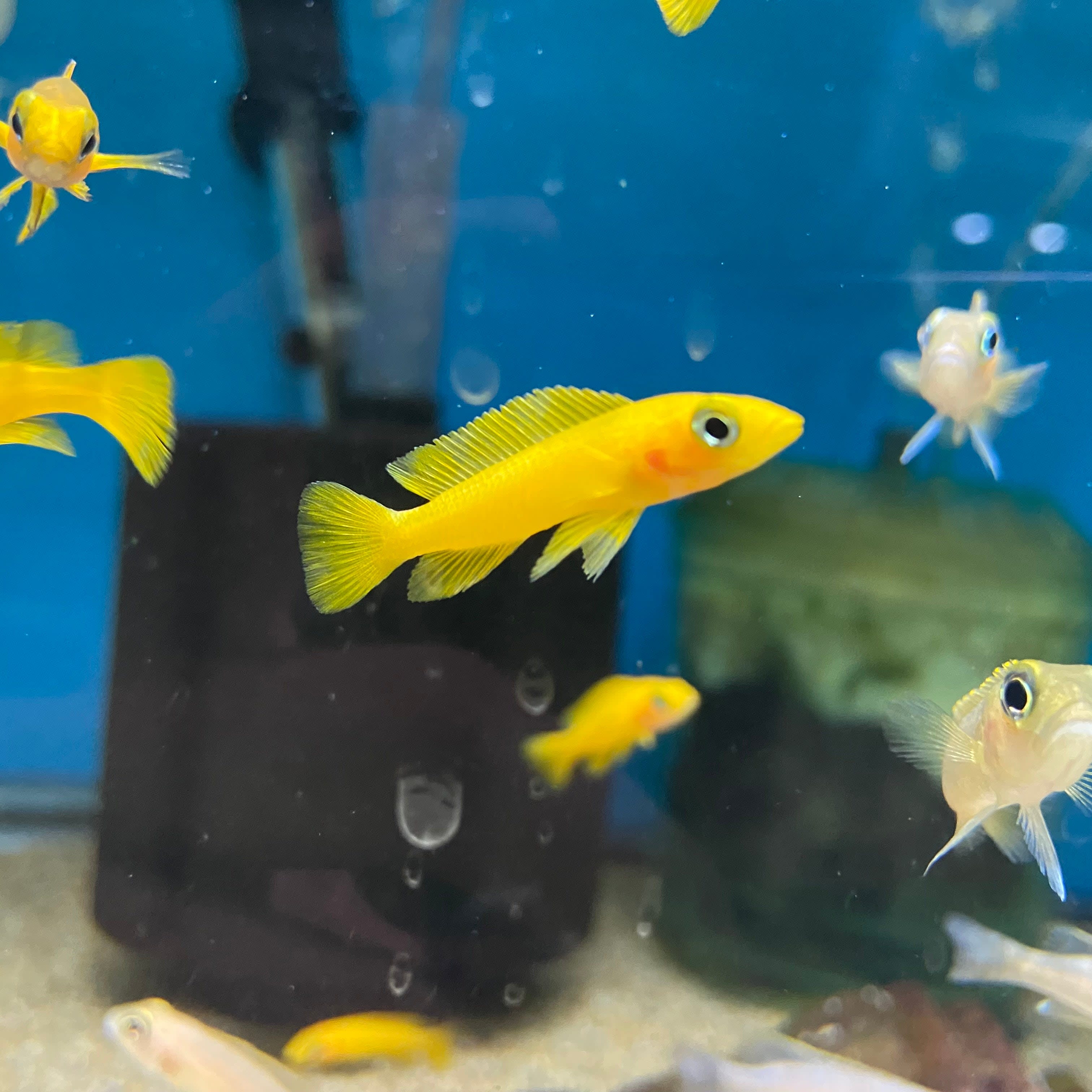
Leleupi Cichlid
Neolamprologus leleupi
Parameter dashboard
23-27 °C
7.5-9
10 cm
8 years
Care guide
The leleupi cichlid, also known as the lemon cichlid, is a brilliantly coloured Tanganyikan species that hails from the rocky shoreline habitats of Lake Tanganyika, East Africa. Its entire body glows in shades of bright yellow to deep orange, making it one of the most visually striking cichlids from the lake. This colour intensity can vary by population and is strongly influenced by diet and water chemistry. Leleupis are cave-dwellers by nature, spending much of their time weaving through rockwork in search of small invertebrates and crustaceans.
Despite their vivid appearance, leleupis have a complex temperament. They are moderately aggressive toward conspecifics and are best kept as a single mated pair unless the tank is very large and aquascaped with multiple visual barriers. With dissimilar Tanganyikan species — such as Cyprichromis, Synodontis catfish, or larger shell-dwellers — they can be reasonably peaceful. However, they should not be housed with mbuna or very small fish that may be bullied or eaten. In the wild they are primarily carnivorous, feeding on insect larvae and small crustaceans. In captivity, a varied diet of quality cichlid pellets, frozen mysis shrimp, brine shrimp, and bloodworms will keep them in top condition.
A pair requires a tank of at least 70 litres (18 US gallons) with a sandy substrate and generous piles of rocks forming caves and crevices. The water should be hard and alkaline — pH 7.5 to 9.0, with a temperature range of 23 to 27°C. Leleupis are biparental cave spawners: a bonded pair will lay up to 150 eggs on the roof or walls of a selected cave, with both parents guarding the clutch and later the free-swimming fry. Offer brine shrimp nauplii once the fry are free-swimming. They are sensitive to organic waste and do best with regular partial water changes and stable, clean conditions. Aquarium lifespan estimates are around 8 years with suitable care. Monitor the pair between spawning events, as the male may attack the female; provide separate retreats and be ready to separate them.
Sources
- seriouslyfish.com — https://www.seriouslyfish.com/species/Neolamprologus-leleupi
- fishkeeper.co.uk — https://www.fishkeeper.co.uk/fish/freshwater/cichlids/lemon-cichlid
Further reading on identification and aquarium care.
Tankmate compatibility (sample)
Pairwise screening against other species in the database (prioritizing the same family when data is available).
Review first (12)
Caution or avoid from automated rules — confirm before mixing.
| Species | Assessment | Notes |
|---|---|---|
| Agassiz's dwarf cichlid Apistogramma agassizii Caution | Caution | Species with non-overlapping pH ranges may not thrive together · close relatives, and one of them is territorial, so both claim the same kind of space Open pair in Compare → |
| Convict cichlid Amatitlania nigrofasciata Caution | Caution | close relatives, and one of them is territorial, so both claim the same kind of space Open pair in Compare → |
| Demon eartheater Satanoperca jurupari Caution | Caution | Species with non-overlapping pH ranges may not thrive together · close relatives, and one of them is territorial, so both claim the same kind of space Open pair in Compare → |
| Firemouth cichlid Thorichthys meeki Caution | Caution | close relatives, and one of them is territorial, so both claim the same kind of space Open pair in Compare → |
| Humphead cichlid Cyphotilapia frontosa Caution | Caution | Fish 2x+ larger may eat smaller tankmates · Multiple territorial species in the same swim layer cause stress · close relatives, and one of them is territorial, so both claim the same kind of space Open pair in Compare → |
| Moga Hypsophrys nicaraguensis Caution | Caution | Fish 2x+ larger may eat smaller tankmates · Multiple territorial species in the same swim layer cause stress · close relatives, and one of them is territorial, so both claim the same kind of space Open pair in Compare → |
| Multies Neolamprologus multifasciatus Caution | Caution | Fish 2x+ larger may eat smaller tankmates · Multiple territorial species in the same swim layer cause stress · close relatives, and one of them is territorial, so both claim the same kind of space Open pair in Compare → |
| Oscar Astronotus ocellatus Caution | Caution | Fish 2x+ larger may eat smaller tankmates · Multiple territorial species in the same swim layer cause stress · Species with non-overlapping pH ranges may not thrive together · close relatives, and one of them is territorial, so both claim the same kind of space Open pair in Compare → |
| Pearly calvus Altolamprologus calvus Caution | Caution | close relatives, and one of them is territorial, so both claim the same kind of space Open pair in Compare → |
| Red Spotted Severum Heros efasciatus Caution | Caution | Fish 2x+ larger may eat smaller tankmates · Multiple territorial species in the same swim layer cause stress · Species with non-overlapping pH ranges may not thrive together · close relatives, and one of them is territorial, so both claim the same kind of space Open pair in Compare → |
| Yellow belly cichlid Cichlasoma salvini Caution | Caution | Multiple territorial species in the same swim layer cause stress · close relatives, and one of them is territorial, so both claim the same kind of space Open pair in Compare → |
| Electric blue ram Mikrogeophagus ramirezi Avoid | Avoid | Fish 2x+ larger may eat smaller tankmates · Multiple territorial species in the same swim layer cause stress · Species with non-overlapping temperature ranges cannot coexist · Species with non-overlapping pH ranges may not thrive together · the two share only a narrow band of temperature, so one of them sits at the edge of its range · close relatives, and one of them is territorial, so both claim the same kind of space Open pair in Compare → |
Same rule engine as Compare. Not a substitute for observation, tank size, or acclimation.
Related species
Was this page useful? Spot anything wrong?