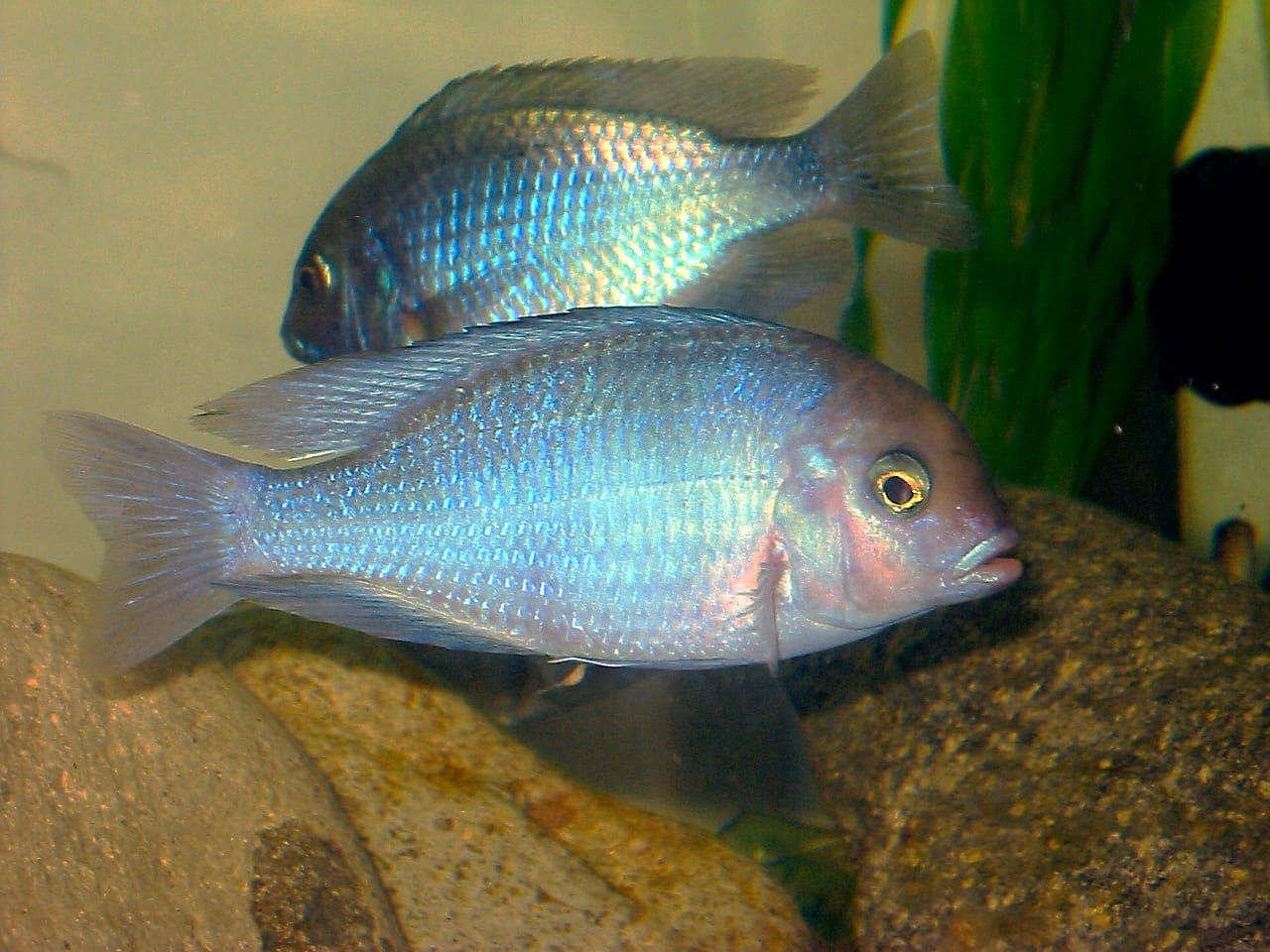
Hump-head
Cyrtocara moorii
Parameter dashboard
25-29 °C
7.5-8.8
25 cm
10 years
Care guide
Cyrtocara moorii, the blue dolphin or hump-head, is a haplochromine cichlid from Lake Malawi and neighbouring Lake Malombe. It ranges over shallow sandy floors and follows behind sand-sifting cichlids such as Fossorochromis rostratus, picking up the invertebrates their digging stirs into the water. Mature males grow a tall nuchal hump that, with the blunt face and metallic blue body, gives the fish its dolphin look. Males reach around 25 cm; females stay smaller, near 20 cm, and barely develop a hump.
For a big Malawi cichlid it is easygoing — a gentle giant that suits a community of other peaceful haplochromines and Synodontis rather than boisterous mbuna. It is a harem breeder, though, and should be kept as one male with several females rather than as a single pair, whose male would pester a lone female relentlessly. A group of four or more works; plan on at least a 250 litre tank.
It wants the hard, alkaline water of the rift lakes: 25–29 °C, pH 7.5–8.8, and a good mineral hardness. Give it a fine sand floor to sift and plenty of open water — the fish is easily startled and can hurt itself dashing about in a tank crowded with rock. Strong filtration keeps up with its size.
The blue colour is misleading: this is a micropredator, not an algae grazer, so feed a protein diet of quality cichlid pellets with frozen bloodworm, brine shrimp and mysis. The female is a mouthbrooder, carrying a clutch of up to about ninety eggs for roughly three weeks.
Sources
- seriouslyfish.com — https://www.seriouslyfish.com/species/cyrtocara-moorii/
- fishbase.se — https://www.fishbase.se/summary/Cyrtocara-moorii.html
Further reading on identification and aquarium care.
Tankmate compatibility (sample)
Pairwise screening against other species in the database (prioritizing the same family when data is available).
Review first (12)
Caution or avoid from automated rules — confirm before mixing.
| Species | Assessment | Notes |
|---|---|---|
| Blue acara Andinoacara pulcher Caution | Caution | close relatives, and one of them is territorial, so both claim the same kind of space Open pair in Compare → |
| Freshwater angelfish Pterophyllum scalare Caution | Caution | Species with non-overlapping pH ranges may not thrive together · close relatives, and one of them is territorial, so both claim the same kind of space Open pair in Compare → |
| Gold severum Heros efasciatus Caution | Caution | Species with non-overlapping pH ranges may not thrive together · close relatives, and one of them is territorial, so both claim the same kind of space Open pair in Compare → |
| Gold Shell Dweller Lamprologus ocellatus Caution | Caution | Fish 2x+ larger may eat smaller tankmates · close relatives, and one of them is territorial, so both claim the same kind of space Open pair in Compare → |
| Greenstreaked eartheater Biotodoma cupido Caution | Caution | Fish 2x+ larger may eat smaller tankmates · Species with non-overlapping pH ranges may not thrive together · close relatives, and one of them is territorial, so both claim the same kind of space Open pair in Compare → |
| Guayas cichlid Cichlasoma festae Caution | Caution | close relatives, and one of them is territorial, so both claim the same kind of space Open pair in Compare → |
| Humphead cichlid Cyphotilapia frontosa Caution | Caution | close relatives, and one of them is territorial, so both claim the same kind of space Open pair in Compare → |
| Multies Neolamprologus multifasciatus Caution | Caution | Fish 2x+ larger may eat smaller tankmates · close relatives, and one of them is territorial, so both claim the same kind of space Open pair in Compare → |
| Pearly calvus Altolamprologus calvus Caution | Caution | Multiple territorial species in the same swim layer cause stress · close relatives, and one of them is territorial, so both claim the same kind of space Open pair in Compare → |
| Rio Grande cichlid Herichthys cyanoguttatus Caution | Caution | Species with non-overlapping pH ranges may not thrive together · the two share only a narrow band of temperature, so one of them sits at the edge of its range · close relatives, and one of them is territorial, so both claim the same kind of space Open pair in Compare → |
| Yellow belly cichlid Cichlasoma salvini Caution | Caution | the two share only a narrow band of temperature, so one of them sits at the edge of its range · close relatives, and one of them is territorial, so both claim the same kind of space Open pair in Compare → |
| Green terror Andinoacara rivulatus Avoid | Avoid | Species with non-overlapping temperature ranges cannot coexist · the two share only a narrow band of temperature, so one of them sits at the edge of its range · close relatives, and one of them is territorial, so both claim the same kind of space Open pair in Compare → |
Same rule engine as Compare. Not a substitute for observation, tank size, or acclimation.
Related species
Was this page useful? Spot anything wrong?