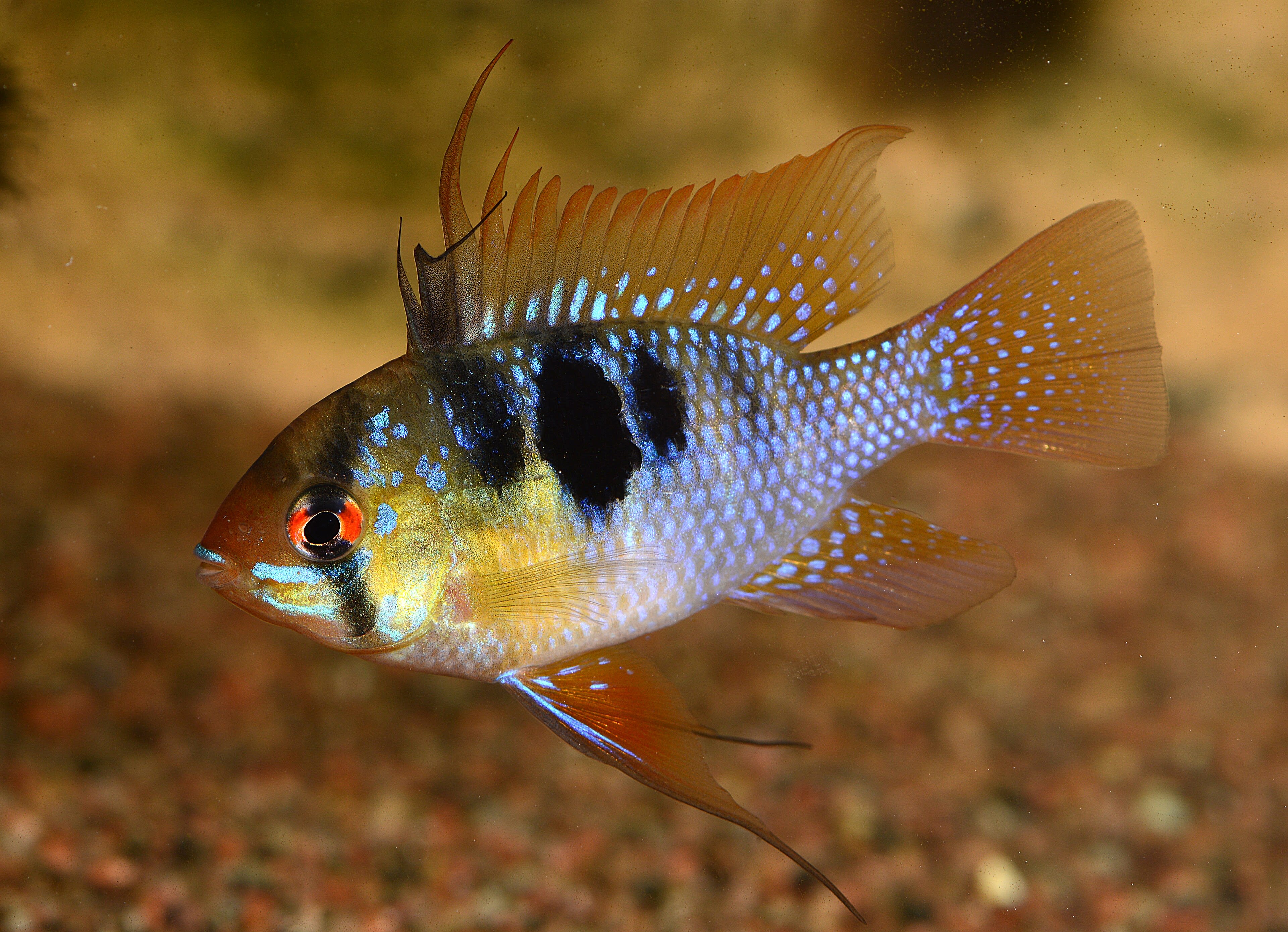
Ram cichlid
Mikrogeophagus ramirezi
Parameter dashboard
27-30 °C
4-7
4 cm
Care guide
The German blue ram (Mikrogeophagus ramirezi) is one of the most popular dwarf cichlids in the aquarium hobby, prized for its vivid blue and yellow coloration with iridescent spots and bold red eye. Native to the Venezuelan and Colombian llanos of the Rio Orinoco drainage, it inhabits warm, soft, acidic waters with sandy substrates and abundant cover. Reaching only 3.5 to 4 cm in standard length, it is a true dwarf cichlid well-suited to tanks with a base measuring 60 cm x 30 cm for a single pair. Despite being commonly marketed as a community fish, the ram is actually a poor competitor that requires pristine water conditions and warm temperatures of 27 to 30 °C, making it best suited to a dedicated setup or alongside peaceful, open-water characins like cardinal tetras. Juvenile specimens are gregarious, but adults form monogamous pairs that will defend a small breeding territory. They are benthophagous by nature, taking mouthfuls of substrate and sifting for edible items. A varied diet of live and frozen foods such as bloodworm, Artemia, and daphnia is essential for optimal health and colour. The ram is particularly susceptible to hole-in-the-head disease when kept in biologically immature aquaria or poor water conditions. Commercially produced strains are often genetically weak and short-lived compared to wild specimens.
Source
Further reading on identification and aquarium care.
Tankmate compatibility (sample)
Pairwise screening against other species in the database (prioritizing the same family when data is available).
Review first (12)
Caution or avoid from automated rules — confirm before mixing.
| Species | Assessment | Notes |
|---|---|---|
| Agassiz's dwarf cichlid Apistogramma agassizii Caution | Caution | close relatives, and one of them is territorial, so both claim the same kind of space Open pair in Compare → |
| Blue acara Andinoacara pulcher Caution | Caution | Fish 2x+ larger may eat smaller tankmates · Multiple territorial species in the same swim layer cause stress · the two share only a narrow band of temperature, so one of them sits at the edge of its range · close relatives, and one of them is territorial, so both claim the same kind of space Open pair in Compare → |
| Gold severum Heros efasciatus Caution | Caution | Fish 2x+ larger may eat smaller tankmates · Multiple territorial species in the same swim layer cause stress · the two share only a narrow band of temperature, so one of them sits at the edge of its range · close relatives, and one of them is territorial, so both claim the same kind of space Open pair in Compare → |
| Greenstreaked eartheater Biotodoma cupido Caution | Caution | Fish 2x+ larger may eat smaller tankmates · Multiple territorial species in the same swim layer cause stress · the two share only a narrow band of temperature, so one of them sits at the edge of its range · close relatives, and one of them is territorial, so both claim the same kind of space Open pair in Compare → |
| Mendezs Dwarf Cichlid Apistogramma mendezi Caution | Caution | close relatives, and one of them is territorial, so both claim the same kind of space Open pair in Compare → |
| Panda Uaru Uaru fernandezyepezi Caution | Caution | Fish 2x+ larger may eat smaller tankmates · Multiple territorial species in the same swim layer cause stress · close relatives, and one of them is territorial, so both claim the same kind of space Open pair in Compare → |
| Venustus Cichlid Nimbochromis venustus Caution | Caution | Fish 2x+ larger may eat smaller tankmates · Multiple territorial species in the same swim layer cause stress · Species with non-overlapping pH ranges may not thrive together · the two share only a narrow band of temperature, so one of them sits at the edge of its range · close relatives, and one of them is territorial, so both claim the same kind of space Open pair in Compare → |
| Bolivian Ram Mikrogeophagus altispinosus Avoid | Avoid | Fish 2x+ larger may eat smaller tankmates · Multiple territorial species in the same swim layer cause stress · the two share only a narrow band of temperature, so one of them sits at the edge of its range · close relatives, and one of them is territorial, so both claim the same kind of space · each profile says to keep its species away from most other cichlids, which includes the other, and their temperatures meet across a single degree at the top of what the Bolivian ram tolerates Open pair in Compare → |
| Freshwater angelfish Pterophyllum scalare Avoid | Avoid | Fish 2x+ larger may eat smaller tankmates · Multiple territorial species in the same swim layer cause stress · close relatives, and one of them is territorial, so both claim the same kind of space · rams are poor competitors that belong away from most other cichlids, and a spawning angelfish is a territorial cichlid several times their size Open pair in Compare → |
| Gold Shell Dweller Lamprologus ocellatus Avoid | Avoid | Multiple territorial species in the same swim layer cause stress · Species with non-overlapping temperature ranges cannot coexist · Species with non-overlapping pH ranges may not thrive together · the two share only a narrow band of temperature, so one of them sits at the edge of its range · close relatives, and one of them is territorial, so both claim the same kind of space Open pair in Compare → |
| Haitian cichlid Nandopsis haitiensis Avoid | Avoid | Fish 2x+ larger may eat smaller tankmates · Species with non-overlapping temperature ranges cannot coexist · Species with non-overlapping pH ranges may not thrive together · the two share only a narrow band of temperature, so one of them sits at the edge of its range · close relatives, and one of them is territorial, so both claim the same kind of space Open pair in Compare → |
| Rainbow krib Pelvicachromis pulcher Avoid | Avoid | Fish 2x+ larger may eat smaller tankmates · Multiple territorial species in the same swim layer cause stress · Species with non-overlapping temperature ranges cannot coexist · the two share only a narrow band of temperature, so one of them sits at the edge of its range · close relatives, and one of them is territorial, so both claim the same kind of space Open pair in Compare → |
Same rule engine as Compare. Not a substitute for observation, tank size, or acclimation.
Related species
Was this page useful? Spot anything wrong?