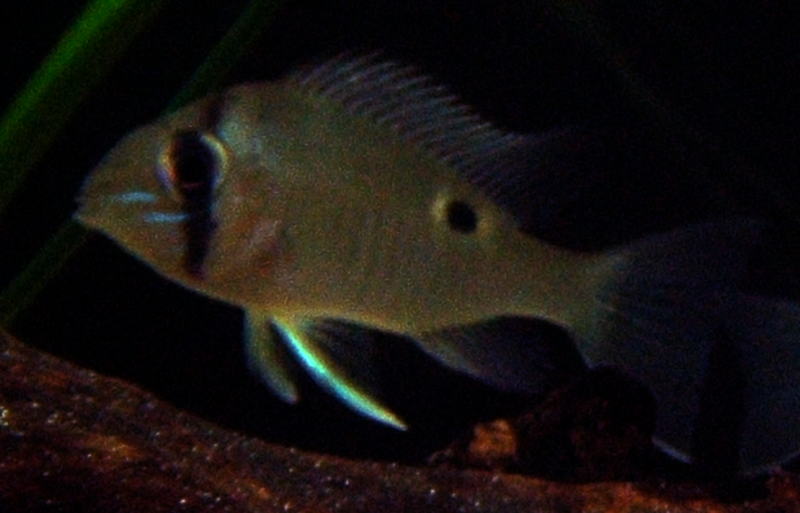
Greenstreaked eartheater
Biotodoma cupido
Parameter dashboard
23-28 °C
5-7
11.7 cm
8 years
Care guide
The greenstreaked eartheater, known in the trade as the cupid cichlid, is a graceful South American cichlid from the soft, acidic waters of the Amazon, Orinoco, and Essequibo river basins across Peru, Brazil, Bolivia, and Guyana. Its body is a subtle blend of silver, gold, and olive, illuminated by iridescent green-blue horizontal streaks across the flank — a pattern that intensifies with maturity and mood. A prominent dark spot sits high on the flank just below the dorsal fin, and the elongated rays of the dorsal fin stream back elegantly in dominant males. FishBase records a maximum of 11.7 cm standard length, which excludes the tail, with males larger and more colourful than females.
Biotodoma cupido is a gregarious eartheater cichlid — unlike many cichlids, it does best in groups of five to eight individuals, where a natural hierarchy forms and fish display their best colours. They are generally peaceful for cichlids, though spawning pairs can become territorial. Their common name comes from their feeding behaviour: they take mouthfuls of sand, sift through their gill rakers for edible bits, and expel the rest through the gill openings. This constant sifting means a sand substrate is mandatory — gravel will injure their delicate gill filaments. Suitable tankmates include other peaceful South American cichlids, larger tetras, Corydoras catfish, and plecos. Their diet should be primarily carnivorous, with high-quality sinking cichlid pellets, frozen bloodworms, brine shrimp, mysis, and occasional vegetable matter.
A group of greenstreaked eartheaters requires a spacious tank of at least 300 litres for a group, though a single pair can manage in a 114-litre setup. The water must be soft and acidic — pH 5.0 to 7.0, with a temperature of 23 to 28°C. They are sensitive to water quality and require excellent filtration with regular partial water changes. Fine sand substrate is essential for their natural sifting behaviour. In the aquarium, they are substrate spawners: a bonded pair will clear a flat stone or depression in the sand and spawn on it, with both parents guarding the eggs and later the free-swimming fry. Once free-swimming, the fry can be offered baby brine shrimp. Aquarium lifespan estimates are around 8 years with suitable care.
Sources
- fishkeeper.co.uk — https://www.fishkeeper.co.uk/fish/freshwater/cichlids/cupid-cichlid
- fishbase.org.au — https://www.fishbase.org.au/summary/SpeciesSummary.php?ID=12291
- fishbase.se — https://www.fishbase.se/summary/biotodoma_cupido.html
Further reading on identification and aquarium care.
Tankmate compatibility (sample)
Pairwise screening against other species in the database (prioritizing the same family when data is available).
Review first (12)
Caution or avoid from automated rules — confirm before mixing.
| Species | Assessment | Notes |
|---|---|---|
| Biajaca Nandopsis tetracanthus Caution | Caution | Multiple territorial species in the same swim layer cause stress · Species with non-overlapping pH ranges may not thrive together · close relatives, and one of them is territorial, so both claim the same kind of space Open pair in Compare → |
| Chessboard cichlid Dicrossus filamentosus Caution | Caution | the two share only a narrow band of temperature, so one of them sits at the edge of its range · close relatives, and one of them is territorial, so both claim the same kind of space Open pair in Compare → |
| Electric blue ram Mikrogeophagus ramirezi Caution | Caution | Fish 2x+ larger may eat smaller tankmates · Multiple territorial species in the same swim layer cause stress · the two share only a narrow band of temperature, so one of them sits at the edge of its range · close relatives, and one of them is territorial, so both claim the same kind of space Open pair in Compare → |
| Gold Cap Caudopunctatus Neolamprologus caudopunctatus Caution | Caution | Species with non-overlapping pH ranges may not thrive together · close relatives, and one of them is territorial, so both claim the same kind of space Open pair in Compare → |
| Gold severum Heros efasciatus Caution | Caution | Fish 2x+ larger may eat smaller tankmates · Multiple territorial species in the same swim layer cause stress · close relatives, and one of them is territorial, so both claim the same kind of space Open pair in Compare → |
| Guayas cichlid Cichlasoma festae Caution | Caution | Fish 2x+ larger may eat smaller tankmates · Multiple territorial species in the same swim layer cause stress · Species with non-overlapping pH ranges may not thrive together · close relatives, and one of them is territorial, so both claim the same kind of space Open pair in Compare → |
| Haitian cichlid Nandopsis haitiensis Caution | Caution | Species with non-overlapping pH ranges may not thrive together · close relatives, and one of them is territorial, so both claim the same kind of space Open pair in Compare → |
| Malawi eyebiter Dimidiochromis compressiceps Caution | Caution | Fish 2x+ larger may eat smaller tankmates · Multiple territorial species in the same swim layer cause stress · Species with non-overlapping pH ranges may not thrive together · close relatives, and one of them is territorial, so both claim the same kind of space Open pair in Compare → |
| Multies Neolamprologus multifasciatus Caution | Caution | Fish 2x+ larger may eat smaller tankmates · Multiple territorial species in the same swim layer cause stress · Species with non-overlapping pH ranges may not thrive together · close relatives, and one of them is territorial, so both claim the same kind of space Open pair in Compare → |
| Ram cichlid Mikrogeophagus ramirezi Caution | Caution | Fish 2x+ larger may eat smaller tankmates · Multiple territorial species in the same swim layer cause stress · the two share only a narrow band of temperature, so one of them sits at the edge of its range · close relatives, and one of them is territorial, so both claim the same kind of space Open pair in Compare → |
| Red Spotted Severum Heros efasciatus Caution | Caution | Fish 2x+ larger may eat smaller tankmates · Multiple territorial species in the same swim layer cause stress · close relatives, and one of them is territorial, so both claim the same kind of space Open pair in Compare → |
| Rio Grande cichlid Herichthys cyanoguttatus Caution | Caution | Fish 2x+ larger may eat smaller tankmates · Multiple territorial species in the same swim layer cause stress · close relatives, and one of them is territorial, so both claim the same kind of space Open pair in Compare → |
Same rule engine as Compare. Not a substitute for observation, tank size, or acclimation.
Related species
Was this page useful? Spot anything wrong?