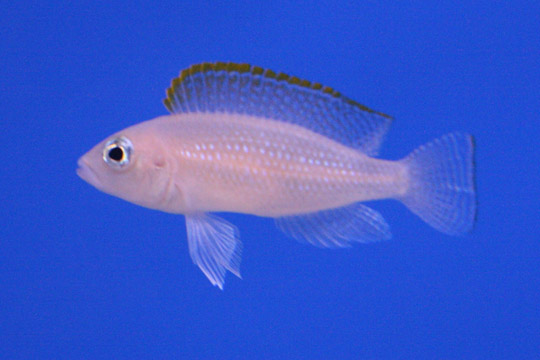
Gold Cap Caudopunctatus
Neolamprologus caudopunctatus
Parameter dashboard
23-25 °C
7.5-8.5
6.5 cm
6 years
Care guide
Neolamprologus caudopunctatus is a small cichlid from the Zambian shore of Lake Tanganyika, living where rocky shoreline meets open sand. Through the day it rises a little off the bottom to pick zooplankton from the water, dropping back to the rocks for cover. The 'gold cap' or red-fin form is the one usually sold: a pale, pearly body set off by a tall dorsal fin that runs from gold to orange-red when the fish displays. FishBase records a maximum of about 6.5 cm total length; that is not a standard-length measurement.
It is one of the easier Tanganyikans to keep, which makes it a good first rift-lake cichlid. Provide sand and rock caves; large shells may also be used for spawning. The water needs to be hard, alkaline and, above all, stable — pH 7.5–8.5 and 23–25 °C.
In the lake it feeds on plankton, so in captivity it takes small carnivore foods readily: quality cichlid pellets and flakes with frozen brine shrimp, mysis and daphnia. Sand and sheltered spawning sites should be available, and territorial behaviour must be watched as fish settle or breed. FishBase describes a protective group of nonbreeding fish around a breeding community and the use of sand to make a nest.
Source
Further reading on identification and aquarium care.
Tankmate compatibility (sample)
Pairwise screening against other species in the database (prioritizing the same family when data is available).
Review first (12)
Caution or avoid from automated rules — confirm before mixing.
| Species | Assessment | Notes |
|---|---|---|
| Bolivian Ram Mikrogeophagus altispinosus Caution | Caution | Species with non-overlapping pH ranges may not thrive together · the two share only a narrow band of temperature, so one of them sits at the edge of its range · close relatives, and one of them is territorial, so both claim the same kind of space Open pair in Compare → |
| Fasciatus Shell Dweller Altolamprologus fasciatus Caution | Caution | Fish 2x+ larger may eat smaller tankmates · the two share only a narrow band of temperature, so one of them sits at the edge of its range · close relatives, and one of them is territorial, so both claim the same kind of space Open pair in Compare → |
| Green terror Andinoacara rivulatus Caution | Caution | Fish 2x+ larger may eat smaller tankmates · the two share only a narrow band of temperature, so one of them sits at the edge of its range · close relatives, and one of them is territorial, so both claim the same kind of space Open pair in Compare → |
| Greenstreaked eartheater Biotodoma cupido Caution | Caution | Species with non-overlapping pH ranges may not thrive together · close relatives, and one of them is territorial, so both claim the same kind of space Open pair in Compare → |
| Haitian cichlid Nandopsis haitiensis Caution | Caution | Fish 2x+ larger may eat smaller tankmates · Multiple territorial species in the same swim layer cause stress · the two share only a narrow band of temperature, so one of them sits at the edge of its range · close relatives, and one of them is territorial, so both claim the same kind of space Open pair in Compare → |
| Humphead cichlid Cyphotilapia frontosa Caution | Caution | Fish 2x+ larger may eat smaller tankmates · close relatives, and one of them is territorial, so both claim the same kind of space Open pair in Compare → |
| Jack Dempsey Rocio octofasciata Caution | Caution | Fish 2x+ larger may eat smaller tankmates · Multiple territorial species in the same swim layer cause stress · close relatives, and one of them is territorial, so both claim the same kind of space Open pair in Compare → |
| Livingstonii Cichlid Nimbochromis livingstonii Caution | Caution | Fish 2x+ larger may eat smaller tankmates · the two share only a narrow band of temperature, so one of them sits at the edge of its range · close relatives, and one of them is territorial, so both claim the same kind of space Open pair in Compare → |
| Malawi eyebiter Dimidiochromis compressiceps Caution | Caution | Fish 2x+ larger may eat smaller tankmates · close relatives, and one of them is territorial, so both claim the same kind of space Open pair in Compare → |
| Moga Hypsophrys nicaraguensis Caution | Caution | Fish 2x+ larger may eat smaller tankmates · close relatives, and one of them is territorial, so both claim the same kind of space Open pair in Compare → |
| Redhump eartheater Geophagus steindachneri Caution | Caution | Fish 2x+ larger may eat smaller tankmates · Species with non-overlapping pH ranges may not thrive together · close relatives, and one of them is territorial, so both claim the same kind of space Open pair in Compare → |
| Hump-head Cyrtocara moorii Avoid | Avoid | Fish 2x+ larger may eat smaller tankmates · Multiple territorial species in the same swim layer cause stress · Species with non-overlapping temperature ranges cannot coexist · the two share only a narrow band of temperature, so one of them sits at the edge of its range · close relatives, and one of them is territorial, so both claim the same kind of space Open pair in Compare → |
Same rule engine as Compare. Not a substitute for observation, tank size, or acclimation.
Related species
Was this page useful? Spot anything wrong?