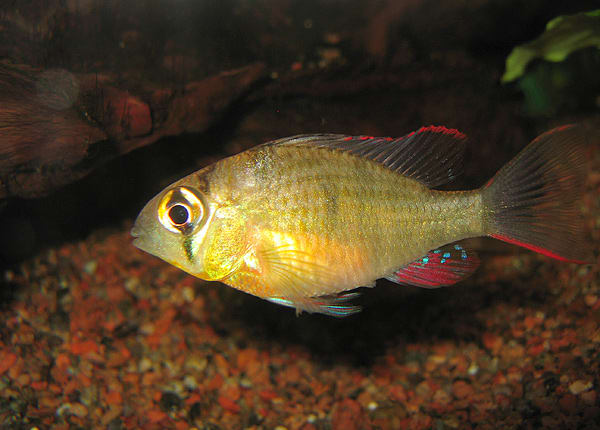
Bolivian Ram
Mikrogeophagus altispinosus
Parameter dashboard
24-28 °C
6-7.5
8 cm
5 years
Care guide
The Bolivian ram (Mikrogeophagus altispinosus) is a relatively large and hardy dwarf cichlid endemic to the upper Rio Madeira basin in Bolivia and Brazil. Reaching a standard length of 7–8 cm, it is noticeably bigger and less intensely colored than its better-known congener Mikrogeophagus ramirezi (the German blue ram), displaying a subtle beauty of golden-brown flanks, iridescent blue-green spotting on the upper body, and elongated dorsal fin rays with a dark trailing edge. It is also known by the trade names 'hi-fin ram', 'Bolivian butterfly', and 'ruby crown cichlid', and is widely considered a better choice for less-experienced aquarists than the more demanding M. ramirezi.
Despite being commonly sold as a community fish, the Bolivian ram requires pristine water quality and is a poor competitor for food and space, so tankmates should be chosen with care. It is best housed with peaceful open-water characins (which help reduce its natural shyness by signaling the absence of danger), small Corydoras catfish, and similarly mild-mannered species. It is a relatively gregarious cichlid and ideally should be maintained in a mixed-sex group of 6–8 or more in a spacious aquarium (120 cm in length or larger); in confined quarters males can become territorial. In nature it is a benthophagous 'eartheater' that takes mouthfuls of substrate and sifts edible items from it, expelling the remainder via the gills. In the aquarium it should be offered a varied diet of live and frozen bloodworm, Artemia, and Daphnia, supplemented with high-quality sinking dried foods.
The single most important requirement is a soft, sandy substrate that allows natural sifting behavior — coarse gravel can damage gill filaments or be ingested with potentially fatal consequences. Décor of driftwood, roots, and flat stones provides shade, territories, and potential spawning sites. Aquatic plants such as Microsorum, Taxiphyllum, Cryptocoryne, and Anubias can be attached to the hardscape. Recommended water parameters include a temperature of 24–28°C, pH 6.0–7.5, and hardness 18–179 ppm. The species is a biparental substrate spawner; eggs are laid on a flat surface and both parents share brood care.
Source
Further reading on identification and aquarium care.
Tankmate compatibility (sample)
Pairwise screening against other species in the database (prioritizing the same family when data is available).
Review first (12)
Caution or avoid from automated rules — confirm before mixing.
| Species | Assessment | Notes |
|---|---|---|
| Blue streak hap Labidochromis caeruleus Caution | Caution | Multiple territorial species in the same swim layer cause stress · Species with non-overlapping pH ranges may not thrive together · close relatives, and one of them is territorial, so both claim the same kind of space Open pair in Compare → |
| Cockatoo cichlid Apistogramma cacatuoides Caution | Caution | close relatives, and one of them is territorial, so both claim the same kind of space Open pair in Compare → |
| Freshwater angelfish Pterophyllum scalare Caution | Caution | Multiple territorial species in the same swim layer cause stress · close relatives, and one of them is territorial, so both claim the same kind of space Open pair in Compare → |
| Gold Cap Caudopunctatus Neolamprologus caudopunctatus Caution | Caution | Species with non-overlapping pH ranges may not thrive together · the two share only a narrow band of temperature, so one of them sits at the edge of its range · close relatives, and one of them is territorial, so both claim the same kind of space Open pair in Compare → |
| Gold severum Heros efasciatus Caution | Caution | Fish 2x+ larger may eat smaller tankmates · Multiple territorial species in the same swim layer cause stress · close relatives, and one of them is territorial, so both claim the same kind of space Open pair in Compare → |
| Jack Dempsey Rocio octofasciata Caution | Caution | Fish 2x+ larger may eat smaller tankmates · close relatives, and one of them is territorial, so both claim the same kind of space Open pair in Compare → |
| Moga Hypsophrys nicaraguensis Caution | Caution | Fish 2x+ larger may eat smaller tankmates · Multiple territorial species in the same swim layer cause stress · close relatives, and one of them is territorial, so both claim the same kind of space Open pair in Compare → |
| Oscar Astronotus ocellatus Caution | Caution | Fish 2x+ larger may eat smaller tankmates · Multiple territorial species in the same swim layer cause stress · close relatives, and one of them is territorial, so both claim the same kind of space Open pair in Compare → |
| Rainbow krib Pelvicachromis pulcher Caution | Caution | Multiple territorial species in the same swim layer cause stress · close relatives, and one of them is territorial, so both claim the same kind of space Open pair in Compare → |
| Rio Grande cichlid Herichthys cyanoguttatus Caution | Caution | Fish 2x+ larger may eat smaller tankmates · Multiple territorial species in the same swim layer cause stress · close relatives, and one of them is territorial, so both claim the same kind of space Open pair in Compare → |
| Venustus Cichlid Nimbochromis venustus Caution | Caution | Fish 2x+ larger may eat smaller tankmates · Multiple territorial species in the same swim layer cause stress · Species with non-overlapping pH ranges may not thrive together · close relatives, and one of them is territorial, so both claim the same kind of space Open pair in Compare → |
| Ram cichlid Mikrogeophagus ramirezi Avoid | Avoid | Fish 2x+ larger may eat smaller tankmates · Multiple territorial species in the same swim layer cause stress · the two share only a narrow band of temperature, so one of them sits at the edge of its range · close relatives, and one of them is territorial, so both claim the same kind of space · each profile says to keep its species away from most other cichlids, which includes the other, and their temperatures meet across a single degree at the top of what the Bolivian ram tolerates Open pair in Compare → |
Same rule engine as Compare. Not a substitute for observation, tank size, or acclimation.
Related species
Was this page useful? Spot anything wrong?