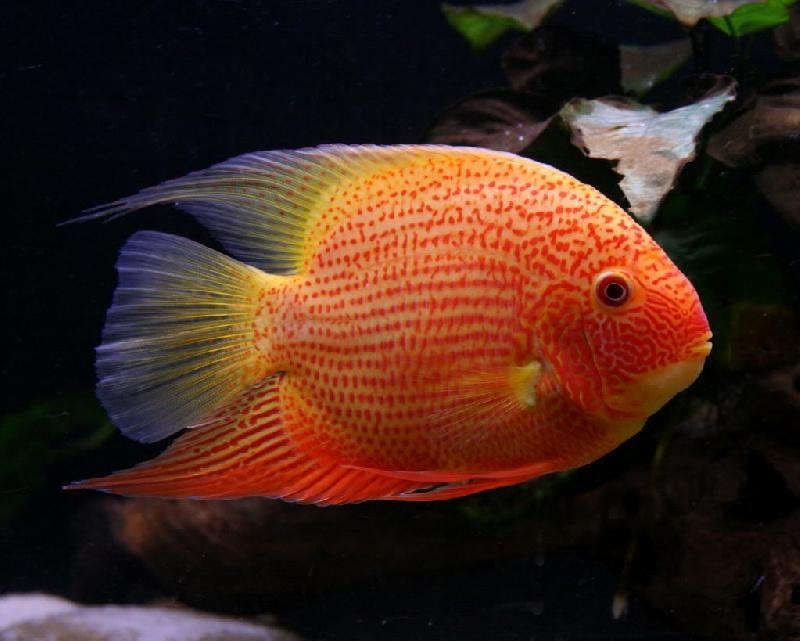
Red Spotted Severum
Heros efasciatus
Parameter dashboard
22.2-28.9 °C
5.5-7
30 cm
10 years
Care guide
The red-spotted severum is a selectively bred color form of Heros efasciatus, the Amazonian cichlid usually just called the severum. Breeders have fixed a pattern of red speckling over the body in place of the wild fish's olive-green, barred look, but the animal underneath is the same large, disc-shaped riverine cichlid. Adults can reach 30 cm standard length.
For its size the severum is surprisingly even-tempered, which is part of its appeal. Outside of breeding it is fairly mild and works well in a community of other large, peaceful South American fish, such as bigger tetras, peaceful catfish and similarly calm cichlids. It is not safe with anything small enough to swallow, including shrimp and dwarf fish. A lone severum kept with no company of its own kind can turn moody as it matures, so a bonded pair or a settled group usually behaves better than a single fish.
Severums are omnivores that should receive vegetable foods alongside the meaty and prepared foods described in the species profile, so a good diet pairs quality pellets with vegetable foods like blanched greens and peas. Provide a base of at least 120 by 45 cm, about 243 litres, with more space for a pair or group. Use soft water at 22.2 to 28.9°C and pH 5.5–7.0. Pairs spawn on a cleaned flat rock or broad leaf and guard the eggs and fry together, which makes a mature pair one of the more rewarding large cichlids to watch over time.
Source
Further reading on identification and aquarium care.
Tankmate compatibility (sample)
Pairwise screening against other species in the database (prioritizing the same family when data is available).
Review first (12)
Caution or avoid from automated rules — confirm before mixing.
| Species | Assessment | Notes |
|---|---|---|
| Biajaca Nandopsis tetracanthus Caution | Caution | Multiple territorial species in the same swim layer cause stress · Species with non-overlapping pH ranges may not thrive together · close relatives, and one of them is territorial, so both claim the same kind of space Open pair in Compare → |
| Electric blue ram Mikrogeophagus ramirezi Caution | Caution | Fish 2x+ larger may eat smaller tankmates · Multiple territorial species in the same swim layer cause stress · the two share only a narrow band of temperature, so one of them sits at the edge of its range · close relatives, and one of them is territorial, so both claim the same kind of space Open pair in Compare → |
| Firemouth cichlid Thorichthys meeki Caution | Caution | Fish 2x+ larger may eat smaller tankmates · close relatives, and one of them is territorial, so both claim the same kind of space Open pair in Compare → |
| Gold Shell Dweller Lamprologus ocellatus Caution | Caution | Fish 2x+ larger may eat smaller tankmates · Multiple territorial species in the same swim layer cause stress · Species with non-overlapping pH ranges may not thrive together · close relatives, and one of them is territorial, so both claim the same kind of space Open pair in Compare → |
| Hump-head Cyrtocara moorii Caution | Caution | Species with non-overlapping pH ranges may not thrive together · close relatives, and one of them is territorial, so both claim the same kind of space Open pair in Compare → |
| Jewelfish Hemichromis bimaculatus Caution | Caution | Fish 2x+ larger may eat smaller tankmates · close relatives, and one of them is territorial, so both claim the same kind of space Open pair in Compare → |
| Malawi eyebiter Dimidiochromis compressiceps Caution | Caution | Multiple territorial species in the same swim layer cause stress · Species with non-overlapping pH ranges may not thrive together · close relatives, and one of them is territorial, so both claim the same kind of space Open pair in Compare → |
| Pearly calvus Altolamprologus calvus Caution | Caution | Fish 2x+ larger may eat smaller tankmates · Species with non-overlapping pH ranges may not thrive together · close relatives, and one of them is territorial, so both claim the same kind of space Open pair in Compare → |
| Princess of Burundi Neolamprologus brichardi Caution | Caution | Fish 2x+ larger may eat smaller tankmates · Multiple territorial species in the same swim layer cause stress · Species with non-overlapping pH ranges may not thrive together · close relatives, and one of them is territorial, so both claim the same kind of space Open pair in Compare → |
| Redstriped eartheater Geophagus surinamensis Caution | Caution | close relatives, and one of them is territorial, so both claim the same kind of space Open pair in Compare → |
| Venustus Cichlid Nimbochromis venustus Caution | Caution | Multiple territorial species in the same swim layer cause stress · Species with non-overlapping pH ranges may not thrive together · close relatives, and one of them is territorial, so both claim the same kind of space Open pair in Compare → |
| Yellow belly cichlid Cichlasoma salvini Caution | Caution | Fish 2x+ larger may eat smaller tankmates · Multiple territorial species in the same swim layer cause stress · close relatives, and one of them is territorial, so both claim the same kind of space Open pair in Compare → |
Same rule engine as Compare. Not a substitute for observation, tank size, or acclimation.
Related species
Was this page useful? Spot anything wrong?