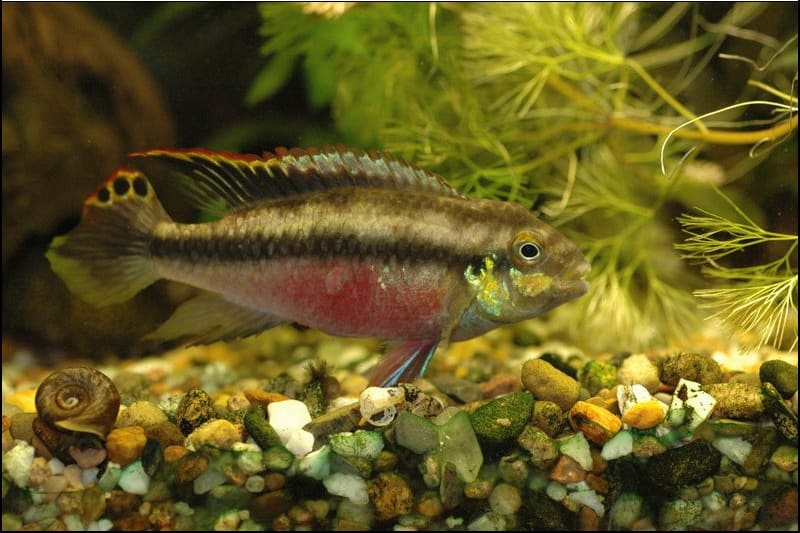
Rainbow krib
Pelvicachromis pulcher
Parameter dashboard
24-27 °C
5-7.5
10 cm
5 years
Care guide
The kribensis or rainbow krib (Pelvicachromis pulcher) is a small, colourful cichlid native to the still and slow-moving waters of Nigeria and Cameroon in West Africa. In the wild it inhabits heavily vegetated shallow waters, with some populations even occurring in brackish conditions. First introduced to the aquarium hobby in the 1950s, the kribensis remains one of the most popular and widely kept cichlid species, valued for its manageable size, attractive colouration, and ease of breeding. The vast majority of specimens in the trade today are captive-bred and are notably more adaptable and less aggressive than wild fish.
Males of this species reach up to 10 cm (4 in) in length while females are smaller at around 7.5 cm (3 in), with males developing pointed dorsal, caudal, and anal fins. Females display a characteristic deep purple belly when in spawning condition, making sex determination straightforward. Kribs are monogamous cave spawners that form strong pair bonds and are often the first cichlid bred by newcomers to the hobby. A breeding pair will fiercely defend their chosen cave and territory, though their aggression is usually limited to the immediate vicinity of the spawning site.
In the aquarium, kribs should be kept as a pair in a tank of at least 80 L (21 gal) with plenty of hiding places formed by clay pots, driftwood roots, and rock caves. Monitor the pair and separate them if one persistently attacks the other; buying a male and female does not ensure compatibility. A sand or fine gravel substrate is appreciated as the fish excavate pits when breeding. They accept a wide variety of foods, with a quality cichlid pellet as staple supplemented by live and frozen offerings. Water temperature should be 24–27°C, pH 5.0–7.5, with soft to moderately hard water. Good tankmates include small characins, barbs, danios, rasboras, Corydoras, gouramis, and Loricariids.
Sources
- seriouslyfish.com — https://www.seriouslyfish.com/species/pelvicachromis-pulcher/
- fishbase.se — https://www.fishbase.se/summary/Pelvicachromis-pulcher.html
Further reading on identification and aquarium care.
Tankmate compatibility (sample)
Pairwise screening against other species in the database (prioritizing the same family when data is available).
Review first (12)
Caution or avoid from automated rules — confirm before mixing.
| Species | Assessment | Notes |
|---|---|---|
| Fasciatus Shell Dweller Altolamprologus fasciatus Caution | Caution | Multiple territorial species in the same swim layer cause stress · Species with non-overlapping pH ranges may not thrive together · close relatives, and one of them is territorial, so both claim the same kind of space Open pair in Compare → |
| Freshwater angelfish Pterophyllum scalare Caution | Caution | Multiple territorial species in the same swim layer cause stress · close relatives, and one of them is territorial, so both claim the same kind of space Open pair in Compare → |
| Gold severum Heros efasciatus Caution | Caution | Fish 2x+ larger may eat smaller tankmates · Multiple territorial species in the same swim layer cause stress · close relatives, and one of them is territorial, so both claim the same kind of space Open pair in Compare → |
| Jewelfish Hemichromis bimaculatus Caution | Caution | close relatives, and one of them is territorial, so both claim the same kind of space Open pair in Compare → |
| Leleupi Cichlid Neolamprologus leleupi Caution | Caution | Multiple territorial species in the same swim layer cause stress · Species with non-overlapping pH ranges may not thrive together · close relatives, and one of them is territorial, so both claim the same kind of space Open pair in Compare → |
| Mendezs Dwarf Cichlid Apistogramma mendezi Caution | Caution | close relatives, and one of them is territorial, so both claim the same kind of space Open pair in Compare → |
| Moga Hypsophrys nicaraguensis Caution | Caution | Fish 2x+ larger may eat smaller tankmates · Multiple territorial species in the same swim layer cause stress · close relatives, and one of them is territorial, so both claim the same kind of space Open pair in Compare → |
| Rio Grande cichlid Herichthys cyanoguttatus Caution | Caution | Fish 2x+ larger may eat smaller tankmates · Multiple territorial species in the same swim layer cause stress · close relatives, and one of them is territorial, so both claim the same kind of space Open pair in Compare → |
| Threespot eartheater Satanoperca daemon Caution | Caution | Fish 2x+ larger may eat smaller tankmates · close relatives, and one of them is territorial, so both claim the same kind of space Open pair in Compare → |
| Umbrella cichlid Apistogramma borellii Caution | Caution | close relatives, and one of them is territorial, so both claim the same kind of space Open pair in Compare → |
| Chessboard cichlid Dicrossus filamentosus Avoid | Avoid | Species with non-overlapping temperature ranges cannot coexist · the two share only a narrow band of temperature, so one of them sits at the edge of its range · close relatives, and one of them is territorial, so both claim the same kind of space Open pair in Compare → |
| Panda Uaru Uaru fernandezyepezi Avoid | Avoid | Multiple territorial species in the same swim layer cause stress · Species with non-overlapping temperature ranges cannot coexist · the two share only a narrow band of temperature, so one of them sits at the edge of its range · close relatives, and one of them is territorial, so both claim the same kind of space Open pair in Compare → |
Same rule engine as Compare. Not a substitute for observation, tank size, or acclimation.
Related species
Was this page useful? Spot anything wrong?