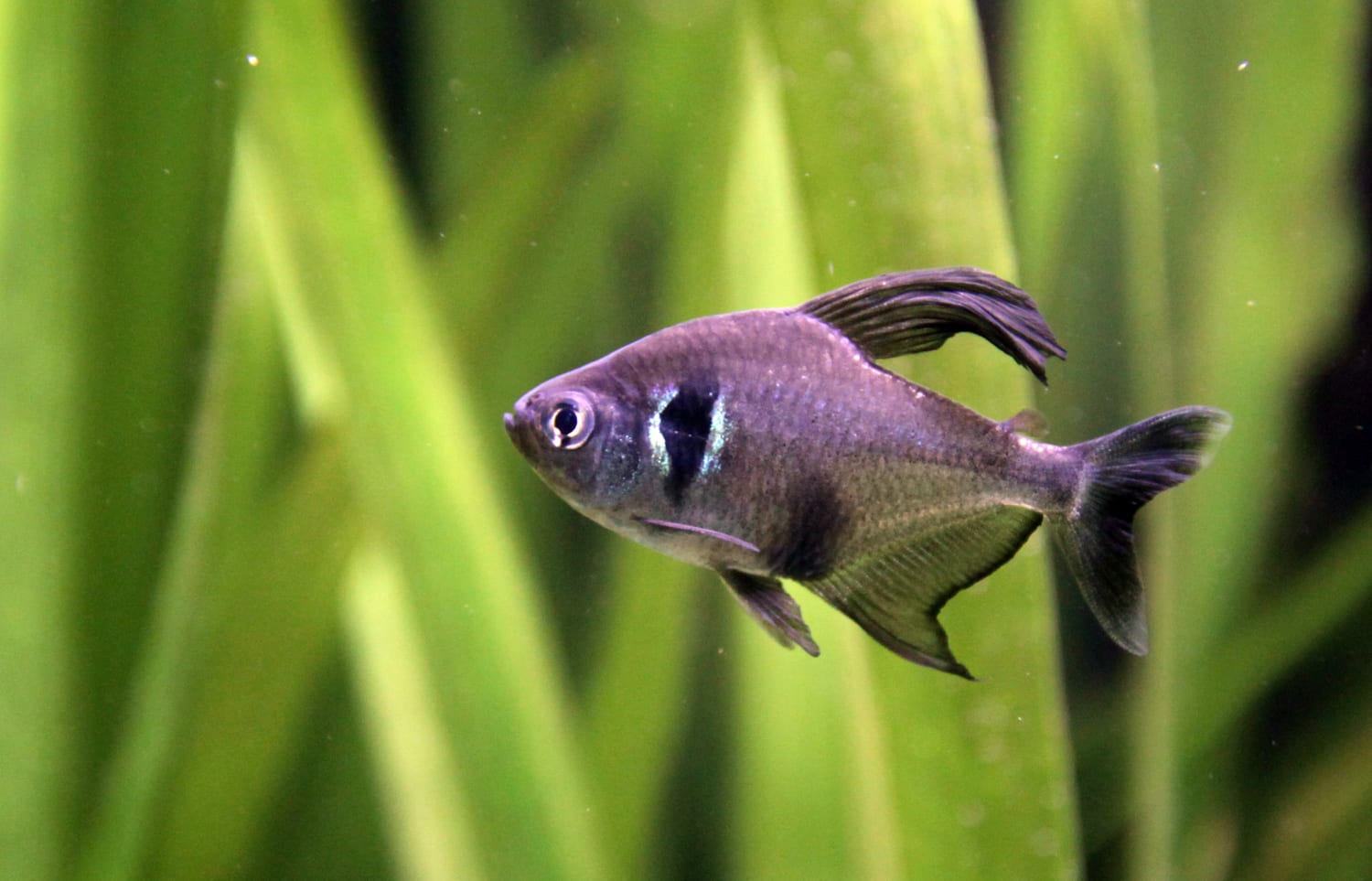
Black phantom tetra
Hyphessobrycon megalopterus
Parameter dashboard
20-28 °C
5-7
3.6 cm
5 years
Care guide
The black phantom tetra inhabits the clear, plant-rich waters of the upper Madeira basin in Bolivia and western Brazil, with populations also found in the Pantanal wetlands. At just 3.6 cm standard length it is one of the smaller Hyphessobrycon species but makes up for its size with a dramatic colour pattern: the male's enlarged dorsal, pelvic and anal fins are jet black, while the female shows reddish fins and a deeper body. A long-finned ornamental strain is occasionally available.
Housing a group of eight to ten requires a tank with a footprint of at least 80 × 30 cm (72 litres). The water can range from 20–28 °C and pH 5.0–7.0, with the softer, more acidic end preferred for breeding. They show best colour in a dimly lit tank with dark substrate, floating plants and some leaf litter that encourages microbe colonies — a useful bonus if fry appear. They are not difficult to keep and adapt to a range of conditions as long as the water is clean and mature.
These tetras are omnivorous, accepting quality flakes and granules as a staple but needing live and frozen foods such as bloodworm, Daphnia and Moina for peak condition and colour. They are very peaceful and ideal for a well-researched community aquarium. Suitable tankmates include similarly-sized characins, hatchetfish, pencilfish, small corydoras and non-predatory cichlids.
Males form temporary dominance hierarchies and display more intensely in a group setting. The species is an egg-scatterer with no parental care. In a mature, planted tank small numbers of fry may appear spontaneously. For controlled breeding, set up a dimly lit spawning tank with a mesh bottom or fine-leaved plants, slightly acidic water and a slightly elevated temperature.
Source
Further reading on identification and aquarium care.
Tankmate compatibility (sample)
Pairwise screening against other species in the database (prioritizing the same family when data is available).
Review first (3)
Caution or avoid from automated rules — confirm before mixing.
| Species | Assessment | Notes |
|---|---|---|
| Black widow tetra Gymnocorymbus ternetzi Avoid | Avoid | Fin nippers should not be kept with long-finned species Open pair in Compare → |
| Colombian Tetra Hyphessobrycon columbianus Avoid | Avoid | Fin nippers should not be kept with long-finned species Open pair in Compare → |
| Jewel tetra Hyphessobrycon eques Avoid | Avoid | Fin nippers should not be kept with long-finned species · close relatives, and one of them is territorial, so both claim the same kind of space Open pair in Compare → |
9 species with compatible assessment in this sampleCollapse to hide the list; use “Open pair in Compare” for the full matrix.
| Species | Assessment | Notes |
|---|---|---|
| Bleeding-heart tetra Hyphessobrycon erythrostigma Compatible | Compatible | No rule-based conflicts detected for this pair. Open pair in Compare → |
| Cardinal tetra Paracheirodon axelrodi Compatible | Compatible | No rule-based conflicts detected for this pair. Open pair in Compare → |
| Diamond tetra Moenkhausia pittieri Compatible | Compatible | No rule-based conflicts detected for this pair. Open pair in Compare → |
| Glass bloodfin Prionobrama filigera Compatible | Compatible | No rule-based conflicts detected for this pair. Open pair in Compare → |
| Glowlight tetra Hemigrammus erythrozonus Compatible | Compatible | No rule-based conflicts detected for this pair. Open pair in Compare → |
| Neon tetra Paracheirodon innesi Compatible | Compatible | No rule-based conflicts detected for this pair. Open pair in Compare → |
| Ornate tetra Hyphessobrycon bentosi Compatible | Compatible | No rule-based conflicts detected for this pair. Open pair in Compare → |
| Red phantom tetra Hyphessobrycon sweglesi Compatible | Compatible | No rule-based conflicts detected for this pair. Open pair in Compare → |
| Rummy-nose tetra Hemigrammus rhodostomus Compatible | Compatible | No rule-based conflicts detected for this pair. Open pair in Compare → |
Same rule engine as Compare. Not a substitute for observation, tank size, or acclimation.
Related species
Was this page useful? Spot anything wrong?