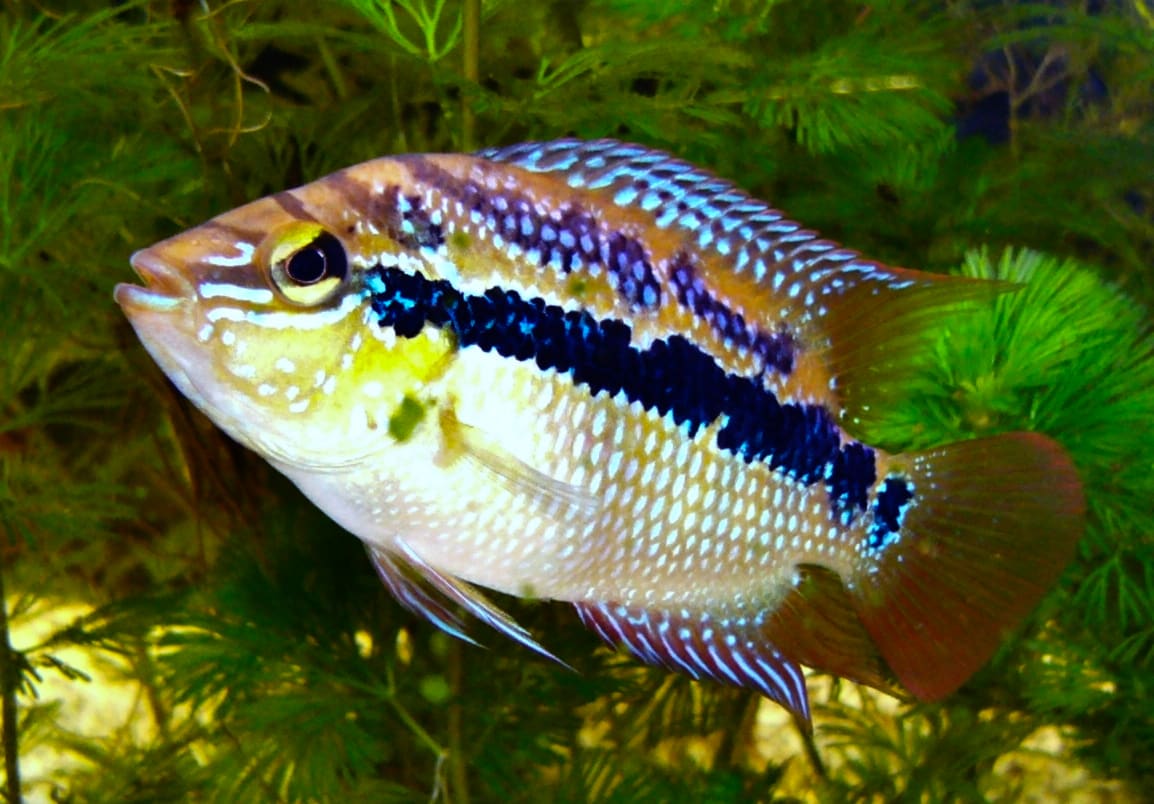
Yellow belly cichlid
Cichlasoma salvini
Parameter dashboard
22-26 °C
6.5-8
15 cm
10 years
Care guide
The yellow belly cichlid, or Salvini, is a moderately sized Central American cichlid from the Atlantic drainages of Mexico, Guatemala, and Belize. Males reach about 15 cm while females stay smaller, and both sexes carry a vivid yellow belly that intensifies during breeding. A tank of at least 150 litres decorated with rockwork and robust plants gives them the structure they need to establish territories. Temperature should be 22°C to 26°C with a pH of 6.5 to 8.0, matching the moderately hard, alkaline water of their native rivers. This species is highly territorial and will aggressively defend its space, especially when paired and spawning, so tankmates must be chosen with care — larger robust cichlids such as Jack Dempseys can work but the Salvini is best kept as a single pair in a dedicated setup. It is omnivorous and accepts a wide range of foods — quality cichlid pellets as staple, varied with live and frozen foods, plus occasional vegetable or spirulina flake. The female lays up to 500 eggs across several flat surfaces, and both parents guard the fry with intense dedication for at least a month. Grow out a group of six juveniles together to allow a compatible pair to form naturally. Aquarium lifespan estimates are around ten years with suitable care.
Source
Further reading on identification and aquarium care.
Tankmate compatibility (sample)
Pairwise screening against other species in the database (prioritizing the same family when data is available).
Review first (12)
Caution or avoid from automated rules — confirm before mixing.
| Species | Assessment | Notes |
|---|---|---|
| Demon eartheater Satanoperca jurupari Caution | Caution | close relatives, and one of them is territorial, so both claim the same kind of space Open pair in Compare → |
| Fasciatus Shell Dweller Altolamprologus fasciatus Caution | Caution | Multiple territorial species in the same swim layer cause stress · Species with non-overlapping pH ranges may not thrive together · close relatives, and one of them is territorial, so both claim the same kind of space Open pair in Compare → |
| Gold severum Heros efasciatus Caution | Caution | Fish 2x+ larger may eat smaller tankmates · Multiple territorial species in the same swim layer cause stress · close relatives, and one of them is territorial, so both claim the same kind of space Open pair in Compare → |
| Hump-head Cyrtocara moorii Caution | Caution | the two share only a narrow band of temperature, so one of them sits at the edge of its range · close relatives, and one of them is territorial, so both claim the same kind of space Open pair in Compare → |
| Malawi eyebiter Dimidiochromis compressiceps Caution | Caution | Multiple territorial species in the same swim layer cause stress · close relatives, and one of them is territorial, so both claim the same kind of space Open pair in Compare → |
| Moga Hypsophrys nicaraguensis Caution | Caution | Multiple territorial species in the same swim layer cause stress · close relatives, and one of them is territorial, so both claim the same kind of space Open pair in Compare → |
| Multies Neolamprologus multifasciatus Caution | Caution | Fish 2x+ larger may eat smaller tankmates · Multiple territorial species in the same swim layer cause stress · close relatives, and one of them is territorial, so both claim the same kind of space Open pair in Compare → |
| Oscar Astronotus ocellatus Caution | Caution | Fish 2x+ larger may eat smaller tankmates · Multiple territorial species in the same swim layer cause stress · close relatives, and one of them is territorial, so both claim the same kind of space Open pair in Compare → |
| Red Spotted Severum Heros efasciatus Caution | Caution | Fish 2x+ larger may eat smaller tankmates · Multiple territorial species in the same swim layer cause stress · close relatives, and one of them is territorial, so both claim the same kind of space Open pair in Compare → |
| Rio Grande cichlid Herichthys cyanoguttatus Caution | Caution | Multiple territorial species in the same swim layer cause stress · close relatives, and one of them is territorial, so both claim the same kind of space Open pair in Compare → |
| Freshwater angelfish Pterophyllum scalare Avoid | Avoid | Fin nippers should not be kept with long-finned species · Multiple territorial species in the same swim layer cause stress · close relatives, and one of them is territorial, so both claim the same kind of space Open pair in Compare → |
| Panda Uaru Uaru fernandezyepezi Avoid | Avoid | Multiple territorial species in the same swim layer cause stress · Species with non-overlapping temperature ranges cannot coexist · Species with non-overlapping pH ranges may not thrive together · the two share only a narrow band of temperature, so one of them sits at the edge of its range · close relatives, and one of them is territorial, so both claim the same kind of space Open pair in Compare → |
Same rule engine as Compare. Not a substitute for observation, tank size, or acclimation.
Related species
Was this page useful? Spot anything wrong?