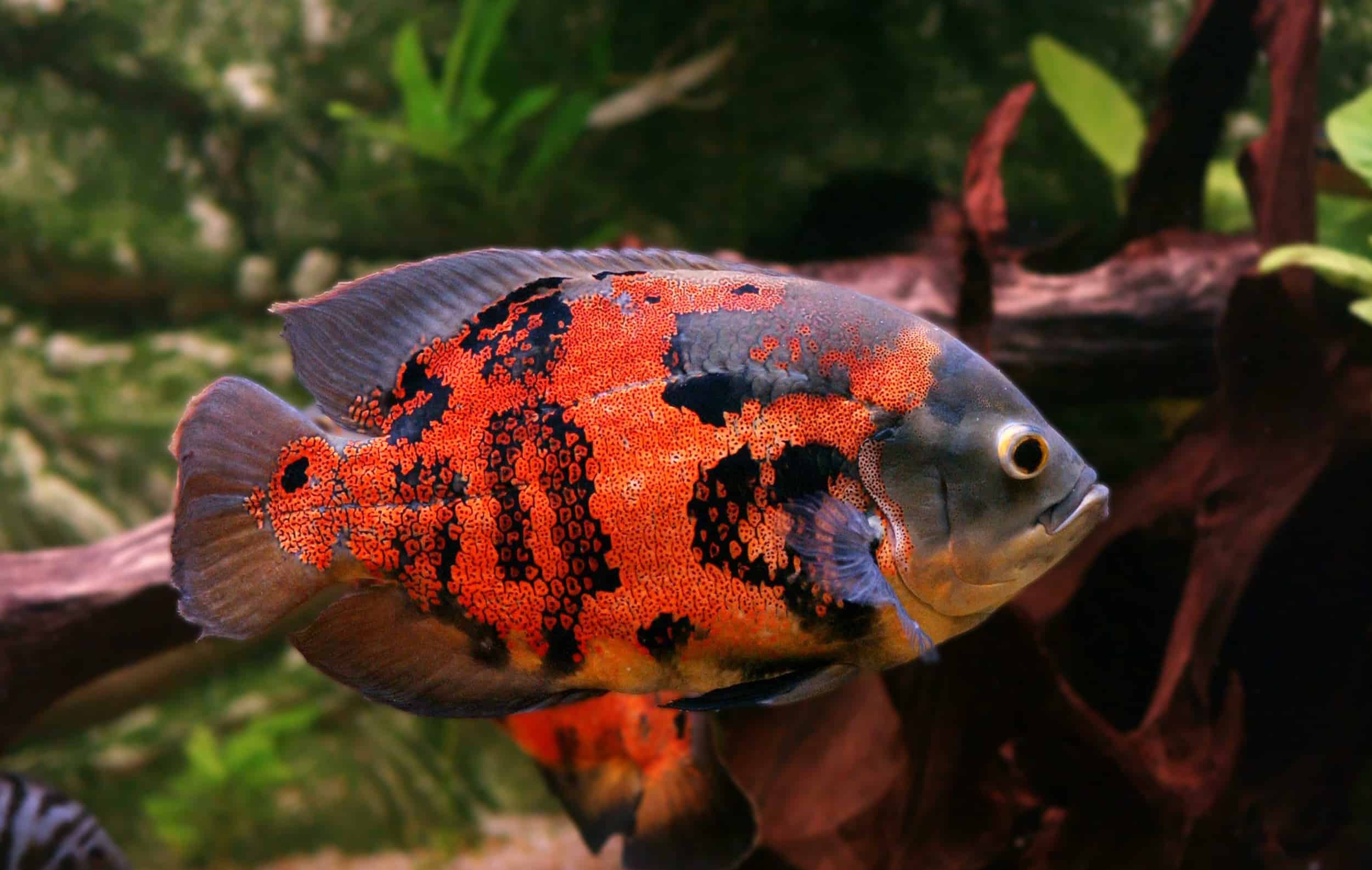
Oscar
Astronotus ocellatus
Parameter dashboard
20-28 °C
6-7.5
35 cm
15 years
Care guide
The Oscar (Astronotus ocellatus) is one of the most recognisable and popular cichlids in the aquarium hobby, widely distributed across the Amazon and Orinoco river basins of South America. It occurs in Colombia, Venezuela, Bolivia, Ecuador, Peru, Brazil, French Guiana, Paraguay, Uruguay, and Argentina, with feral populations also established in Singapore and the United States. In nature it inhabits the shallows of slow-moving or still waters in forested areas, favouring silt-laden white water habitats where it associates with submerged tree roots and marginal vegetation. The species is also known as the velvet cichlid, tiger oscar, or marble cichlid.
Aquarium lifespan estimates are around 15 years with suitable care. They are generalised omnivores that in the wild feed on smaller fish, insects, crustaceans, and zooplankton, and have even been observed using a 'playing dead' thanatosis strategy to hunt. A single adult requires an aquarium with a base footprint of at least 150 × 60 cm (approximately 540 L / 143 gal). They are notoriously messy eaters requiring efficient filtration and weekly water changes of 30–50%. Oscars are known for their interactive, personable behaviour and ability to recognise their owners.
In the aquarium, Oscars thrive on a varied diet featuring a quality cichlid pellet as staple, supplemented with live earthworms, prawns, river shrimp, and similar meaty foods. They should not be fed mammalian or avian meat such as beef heart. While not especially aggressive for a cichlid of their size, their predatory nature dictates they should not be combined with much smaller fish. Suitable tankmates include larger characins, anostomids, other large cichlids, and larger loricariid or doradid catfishes. Water temperature should be 20–28°C, pH 6.0–7.5, with hardness of 90–357 ppm. Numerous ornamental strains exist including tiger, red, albino, and long-finned varieties.
Sources
- seriouslyfish.com — https://www.seriouslyfish.com/species/astronotus-ocellatus/
- fishbase.se — https://www.fishbase.se/summary/Astronotus-ocellatus.html
Further reading on identification and aquarium care.
Tankmate compatibility (sample)
Pairwise screening against other species in the database (prioritizing the same family when data is available).
Review first (12)
Caution or avoid from automated rules — confirm before mixing.
| Species | Assessment | Notes |
|---|---|---|
| Agassiz's dwarf cichlid Apistogramma agassizii Caution | Caution | Fish 2x+ larger may eat smaller tankmates · close relatives, and one of them is territorial, so both claim the same kind of space Open pair in Compare → |
| Blue acara Andinoacara pulcher Caution | Caution | Fish 2x+ larger may eat smaller tankmates · Multiple territorial species in the same swim layer cause stress · close relatives, and one of them is territorial, so both claim the same kind of space Open pair in Compare → |
| Cockatoo cichlid Apistogramma cacatuoides Caution | Caution | Fish 2x+ larger may eat smaller tankmates · close relatives, and one of them is territorial, so both claim the same kind of space Open pair in Compare → |
| Demon eartheater Satanoperca jurupari Caution | Caution | close relatives, and one of them is territorial, so both claim the same kind of space Open pair in Compare → |
| Gold Shell Dweller Lamprologus ocellatus Caution | Caution | Fish 2x+ larger may eat smaller tankmates · Multiple territorial species in the same swim layer cause stress · Species with non-overlapping pH ranges may not thrive together · close relatives, and one of them is territorial, so both claim the same kind of space Open pair in Compare → |
| Greenstreaked eartheater Biotodoma cupido Caution | Caution | Fish 2x+ larger may eat smaller tankmates · Multiple territorial species in the same swim layer cause stress · close relatives, and one of them is territorial, so both claim the same kind of space Open pair in Compare → |
| Humphead cichlid Cyphotilapia frontosa Caution | Caution | Multiple territorial species in the same swim layer cause stress · Species with non-overlapping pH ranges may not thrive together · close relatives, and one of them is territorial, so both claim the same kind of space Open pair in Compare → |
| Jack Dempsey Rocio octofasciata Caution | Caution | close relatives, and one of them is territorial, so both claim the same kind of space Open pair in Compare → |
| Jewelfish Hemichromis bimaculatus Caution | Caution | Fish 2x+ larger may eat smaller tankmates · close relatives, and one of them is territorial, so both claim the same kind of space Open pair in Compare → |
| Princess of Burundi Neolamprologus brichardi Caution | Caution | Fish 2x+ larger may eat smaller tankmates · Multiple territorial species in the same swim layer cause stress · Species with non-overlapping pH ranges may not thrive together · close relatives, and one of them is territorial, so both claim the same kind of space Open pair in Compare → |
| Rio Grande cichlid Herichthys cyanoguttatus Caution | Caution | Multiple territorial species in the same swim layer cause stress · close relatives, and one of them is territorial, so both claim the same kind of space Open pair in Compare → |
| Yellow belly cichlid Cichlasoma salvini Caution | Caution | Fish 2x+ larger may eat smaller tankmates · Multiple territorial species in the same swim layer cause stress · close relatives, and one of them is territorial, so both claim the same kind of space Open pair in Compare → |
Same rule engine as Compare. Not a substitute for observation, tank size, or acclimation.
Related species
Was this page useful? Spot anything wrong?