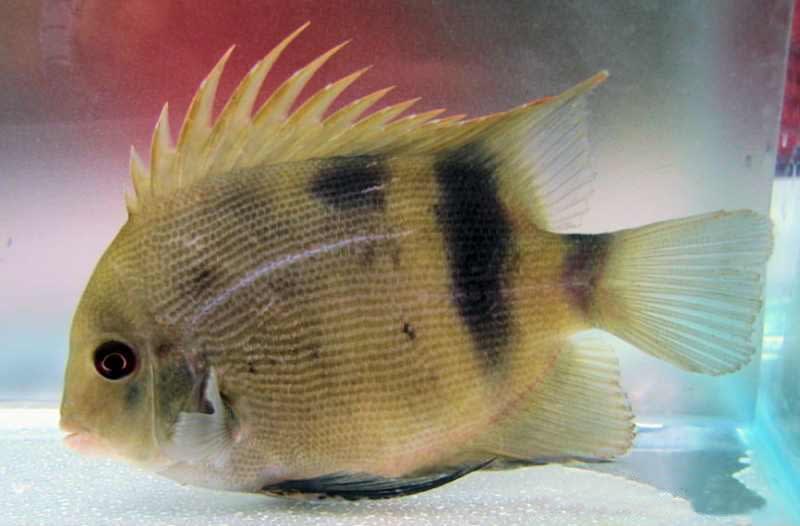
Panda Uaru
Uaru fernandezyepezi
Parameter dashboard
27-30 °C
5-6.5
19 cm
12 years
Care guide
The panda uaru (Uaru fernandezyepezi) is a distinctive South American cichlid endemic to the Orinoco River basin in Colombia and Venezuela. It was described scientifically in 1989 by Rainer Stawikowski and reaches a standard length of approximately 19 cm. Unlike its more famous congener Uaru amphiacanthoides, the panda uaru exhibits a striking dark body with lighter patches, giving it a panda-like appearance from which its common name derives. It inhabits blackwater rivers and floodplain lakes within the vast llanos region, where the water is soft, acidic, and tannin-stained. This species is a relatively peaceful cichlid by large-cichlid standards and can be maintained in groups when provided with spacious accommodation of at least 350 litres. The aquarium should be heavily decorated with driftwood, root tangles, and robust plants such as Anubias and Java fern that can tolerate the warm, acidic conditions. The panda uaru is omnivorous with a strong preference for vegetable matter in nature, and in captivity should be offered a varied diet of quality cichlid pellets, fresh vegetables, and occasional protein-rich foods. Breeding occurs on a cleared flat surface, with both parents demonstrating extensive brood care. The species is listed as Vulnerable on the IUCN Red List, threatened by mining activities within the Orinoco Mining Arc in Venezuela.
Sources
- fishbase.se — https://www.fishbase.se/summary/51972
- en.wikipedia.org — https://en.wikipedia.org/wiki/Uaru_fernandezyepezi
Further reading on identification and aquarium care.
Tankmate compatibility (sample)
Pairwise screening against other species in the database (prioritizing the same family when data is available).
Review first (12)
Caution or avoid from automated rules — confirm before mixing.
| Species | Assessment | Notes |
|---|---|---|
| Bluegray mbuna Melanochromis johannii Caution | Caution | Species with non-overlapping pH ranges may not thrive together · the two share only a narrow band of temperature, so one of them sits at the edge of its range · close relatives, and one of them is territorial, so both claim the same kind of space Open pair in Compare → |
| Bolivian Ram Mikrogeophagus altispinosus Caution | Caution | Fish 2x+ larger may eat smaller tankmates · Multiple territorial species in the same swim layer cause stress · the two share only a narrow band of temperature, so one of them sits at the edge of its range · close relatives, and one of them is territorial, so both claim the same kind of space Open pair in Compare → |
| Chessboard cichlid Dicrossus filamentosus Caution | Caution | close relatives, and one of them is territorial, so both claim the same kind of space Open pair in Compare → |
| Guayas cichlid Cichlasoma festae Caution | Caution | Multiple territorial species in the same swim layer cause stress · Species with non-overlapping pH ranges may not thrive together · close relatives, and one of them is territorial, so both claim the same kind of space Open pair in Compare → |
| Jack Dempsey Rocio octofasciata Caution | Caution | Species with non-overlapping pH ranges may not thrive together · close relatives, and one of them is territorial, so both claim the same kind of space Open pair in Compare → |
| Ram cichlid Mikrogeophagus ramirezi Caution | Caution | Fish 2x+ larger may eat smaller tankmates · Multiple territorial species in the same swim layer cause stress · close relatives, and one of them is territorial, so both claim the same kind of space Open pair in Compare → |
| Fasciatus Shell Dweller Altolamprologus fasciatus Avoid | Avoid | Multiple territorial species in the same swim layer cause stress · Species with non-overlapping temperature ranges cannot coexist · Species with non-overlapping pH ranges may not thrive together · the two share only a narrow band of temperature, so one of them sits at the edge of its range · close relatives, and one of them is territorial, so both claim the same kind of space Open pair in Compare → |
| Haitian cichlid Nandopsis haitiensis Avoid | Avoid | Species with non-overlapping temperature ranges cannot coexist · Species with non-overlapping pH ranges may not thrive together · the two share only a narrow band of temperature, so one of them sits at the edge of its range · close relatives, and one of them is territorial, so both claim the same kind of space Open pair in Compare → |
| Humphead cichlid Cyphotilapia frontosa Avoid | Avoid | Multiple territorial species in the same swim layer cause stress · Species with non-overlapping temperature ranges cannot coexist · Species with non-overlapping pH ranges may not thrive together · the two share only a narrow band of temperature, so one of them sits at the edge of its range · close relatives, and one of them is territorial, so both claim the same kind of space Open pair in Compare → |
| Leleupi Cichlid Neolamprologus leleupi Avoid | Avoid | Multiple territorial species in the same swim layer cause stress · Species with non-overlapping temperature ranges cannot coexist · Species with non-overlapping pH ranges may not thrive together · the two share only a narrow band of temperature, so one of them sits at the edge of its range · close relatives, and one of them is territorial, so both claim the same kind of space Open pair in Compare → |
| Princess of Burundi Neolamprologus brichardi Avoid | Avoid | Fish 2x+ larger may eat smaller tankmates · Multiple territorial species in the same swim layer cause stress · Species with non-overlapping temperature ranges cannot coexist · Species with non-overlapping pH ranges may not thrive together · the two share only a narrow band of temperature, so one of them sits at the edge of its range · close relatives, and one of them is territorial, so both claim the same kind of space Open pair in Compare → |
| Rainbow krib Pelvicachromis pulcher Avoid | Avoid | Multiple territorial species in the same swim layer cause stress · Species with non-overlapping temperature ranges cannot coexist · the two share only a narrow band of temperature, so one of them sits at the edge of its range · close relatives, and one of them is territorial, so both claim the same kind of space Open pair in Compare → |
Same rule engine as Compare. Not a substitute for observation, tank size, or acclimation.
Related species
Was this page useful? Spot anything wrong?