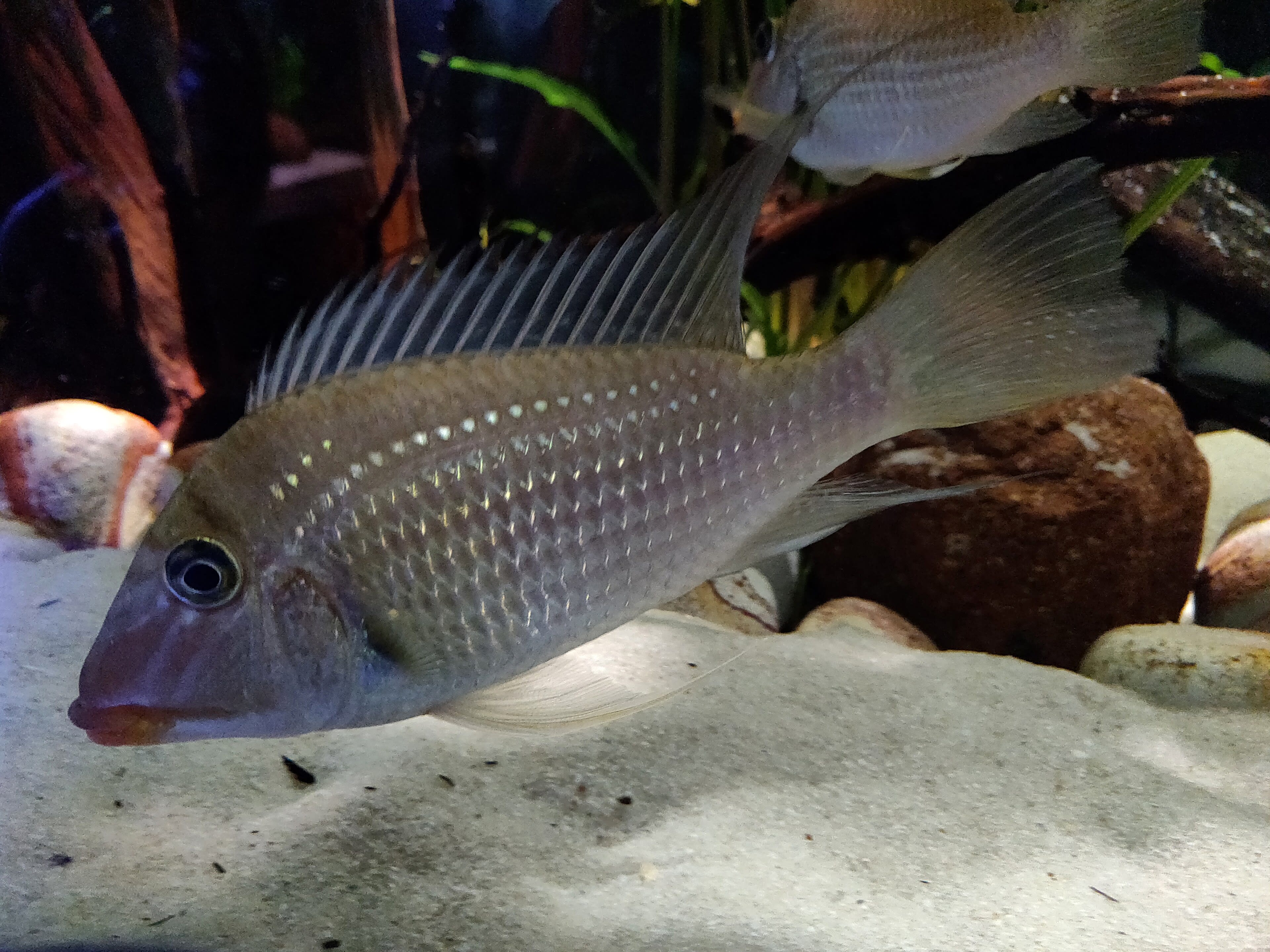
Demon eartheater
Satanoperca jurupari
Parameter dashboard
20-28 °C
5.5-7.5
18.5 cm
10 years
Care guide
Satanoperca jurupari is an Amazonian eartheater, found over sand and mud in slow stretches of river and floodplain lake from Peru and Ecuador across to Brazil and Bolivia. The 'demon' in its name is a Tupi forest spirit, not a comment on its manners — in the tank it is one of the calmer large cichlids and will not bother anything it cannot fit in its mouth. It grows to about 18.5 cm.
The detail that decides whether this fish thrives is the substrate. It feeds by taking mouthfuls of sand, sifting out insect larvae, small crustaceans, seeds and detritus, and passing the grit back out through its gills. Coarse gravel blocks that behaviour and can wear down the gill rakers, so a deep bed of soft sand is essential. Beyond that it wants dim light, some driftwood and open floor space.
Keep it as a group of five to eight; in ones and twos, weaker fish get bullied and the group stays nervy. A footprint of roughly 756 litres suits a group. These cichlids are unusually sensitive to nitrate and prone to head-and-lateral-line erosion, so this is a fish for a mature tank with 50–70% weekly water changes, held at 20–28 °C and pH 5.5–7.5.
Feed several small portions a day rather than one big meal — fine sinking foods, frozen bloodworm and brine shrimp, plus something with vegetable content. It is an ovophilous maternal mouthbrooder: the female collects the fertilised eggs and carries the brood in her mouth until the fry are free swimming.
Sources
- seriouslyfish.com — https://www.seriouslyfish.com/species/satanoperca-jurupari/
- fishbase.se — https://www.fishbase.se/summary/Satanoperca-jurupari.html
Further reading on identification and aquarium care.
Tankmate compatibility (sample)
Pairwise screening against other species in the database (prioritizing the same family when data is available).
Review first (12)
Caution or avoid from automated rules — confirm before mixing.
| Species | Assessment | Notes |
|---|---|---|
| Blue acara Andinoacara pulcher Caution | Caution | close relatives, and one of them is territorial, so both claim the same kind of space Open pair in Compare → |
| Convict cichlid Amatitlania nigrofasciata Caution | Caution | Multiple territorial species in the same swim layer cause stress · close relatives, and one of them is territorial, so both claim the same kind of space Open pair in Compare → |
| Fasciatus Shell Dweller Altolamprologus fasciatus Caution | Caution | Species with non-overlapping pH ranges may not thrive together · close relatives, and one of them is territorial, so both claim the same kind of space Open pair in Compare → |
| Firemouth cichlid Thorichthys meeki Caution | Caution | Multiple territorial species in the same swim layer cause stress · close relatives, and one of them is territorial, so both claim the same kind of space Open pair in Compare → |
| Green terror Andinoacara rivulatus Caution | Caution | close relatives, and one of them is territorial, so both claim the same kind of space Open pair in Compare → |
| Greenstreaked eartheater Biotodoma cupido Caution | Caution | close relatives, and one of them is territorial, so both claim the same kind of space Open pair in Compare → |
| Humphead cichlid Cyphotilapia frontosa Caution | Caution | Species with non-overlapping pH ranges may not thrive together · close relatives, and one of them is territorial, so both claim the same kind of space Open pair in Compare → |
| Jack Dempsey Rocio octofasciata Caution | Caution | Multiple territorial species in the same swim layer cause stress · close relatives, and one of them is territorial, so both claim the same kind of space Open pair in Compare → |
| Jewelfish Hemichromis bimaculatus Caution | Caution | Multiple territorial species in the same swim layer cause stress · close relatives, and one of them is territorial, so both claim the same kind of space Open pair in Compare → |
| Pearly calvus Altolamprologus calvus Caution | Caution | Multiple territorial species in the same swim layer cause stress · Species with non-overlapping pH ranges may not thrive together · close relatives, and one of them is territorial, so both claim the same kind of space Open pair in Compare → |
| Temporaris Shell Dweller Telmatochromis temporalis Caution | Caution | Fish 2x+ larger may eat smaller tankmates · Species with non-overlapping pH ranges may not thrive together · close relatives, and one of them is territorial, so both claim the same kind of space Open pair in Compare → |
| Yellow belly cichlid Cichlasoma salvini Caution | Caution | close relatives, and one of them is territorial, so both claim the same kind of space Open pair in Compare → |
Same rule engine as Compare. Not a substitute for observation, tank size, or acclimation.
Related species
Was this page useful? Spot anything wrong?