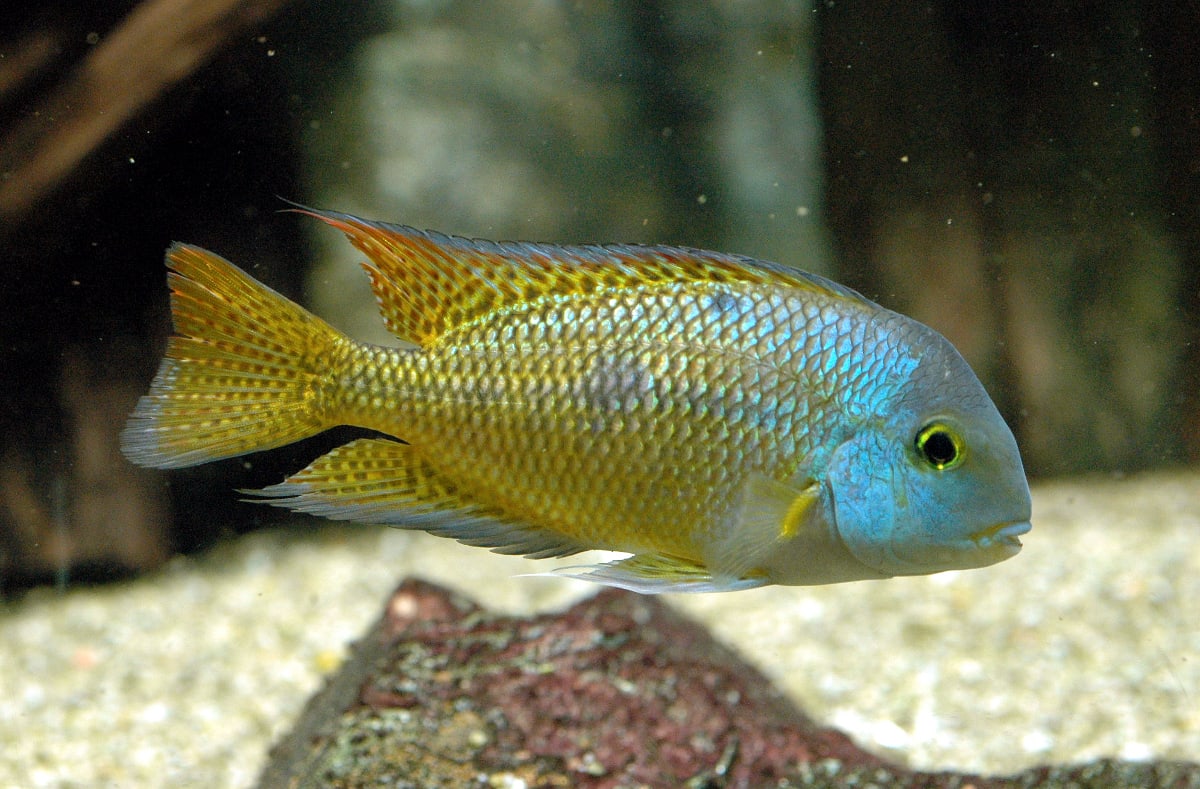
Moga
Hypsophrys nicaraguensis
Parameter dashboard
23-28 °C
7-8
25 cm
8 years
Care guide
The Nicaragua cichlid or moga (Hypsophrys nicaraguensis) is a large, attractive Central American cichlid endemic to Nicaragua and Costa Rica, where it inhabits lakes and slow-moving rivers. It is also known locally as the spilotum and has been the subject of taxonomic confusion, having previously been placed in the genera Cichlasoma, Copora, Theraps, and even Heros before its current classification was established. This species exists in several colour forms depending on collection locality and has been hybridised with the convict cichlid (Archocentrus nigrofasciatus), though this practice is not encouraged.
Males reach up to 25 cm (10 in) in length while females are smaller at around 20 cm (8 in), with males developing a small nuchal hump as they mature. Females retain a striking black lateral stripe throughout life, whereas this fades to a single spot on the flank of males. The body is typically golden-yellow with iridescent blue scaling on the flanks. A single adult or pair requires an aquarium with base dimensions of at least 120 × 45 × 45 cm (243 L / 64 gal). The tank should provide plenty of cover via rocks, bogwood, and flowerpots arranged to form caves, with a sand or fine gravel substrate to accommodate their digging behaviour.
Despite its size, this species is relatively peaceful for a Central American cichlid, though it becomes noticeably territorial during breeding. It can be maintained as a mated pair and will form long-term pair bonds. The diet should be varied, including quality dried pellets and flakes alongside frozen foods such as bloodworm and prawn, live earthworm treats, and green vegetables such as blanched spinach or spirulina-based foods. Water temperature should be 23–28°C, pH 7.0–8.0—it will not do well in acidic conditions—with moderately hard water of 8–20°H. Suitable tankmates include larger barbs, characins, catfish, and Loricariids.
Sources
- seriouslyfish.com — https://www.seriouslyfish.com/species/hypsophrys-nicaraguensis/
- fishbase.se — https://www.fishbase.se/summary/Hypsophrys-nicaraguensis.html
Further reading on identification and aquarium care.
Tankmate compatibility (sample)
Pairwise screening against other species in the database (prioritizing the same family when data is available).
Review first (12)
Caution or avoid from automated rules — confirm before mixing.
| Species | Assessment | Notes |
|---|---|---|
| Bolivian Ram Mikrogeophagus altispinosus Caution | Caution | Fish 2x+ larger may eat smaller tankmates · Multiple territorial species in the same swim layer cause stress · close relatives, and one of them is territorial, so both claim the same kind of space Open pair in Compare → |
| Electric blue ram Mikrogeophagus ramirezi Caution | Caution | Fish 2x+ larger may eat smaller tankmates · Multiple territorial species in the same swim layer cause stress · Species with non-overlapping pH ranges may not thrive together · the two share only a narrow band of temperature, so one of them sits at the edge of its range · close relatives, and one of them is territorial, so both claim the same kind of space Open pair in Compare → |
| Fasciatus Shell Dweller Altolamprologus fasciatus Caution | Caution | Multiple territorial species in the same swim layer cause stress · Species with non-overlapping pH ranges may not thrive together · close relatives, and one of them is territorial, so both claim the same kind of space Open pair in Compare → |
| Firemouth cichlid Thorichthys meeki Caution | Caution | Fish 2x+ larger may eat smaller tankmates · close relatives, and one of them is territorial, so both claim the same kind of space Open pair in Compare → |
| Gold Cap Caudopunctatus Neolamprologus caudopunctatus Caution | Caution | Fish 2x+ larger may eat smaller tankmates · close relatives, and one of them is territorial, so both claim the same kind of space Open pair in Compare → |
| Green terror Andinoacara rivulatus Caution | Caution | Multiple territorial species in the same swim layer cause stress · the two share only a narrow band of temperature, so one of them sits at the edge of its range · close relatives, and one of them is territorial, so both claim the same kind of space Open pair in Compare → |
| Guayas cichlid Cichlasoma festae Caution | Caution | Multiple territorial species in the same swim layer cause stress · close relatives, and one of them is territorial, so both claim the same kind of space Open pair in Compare → |
| Jewelfish Hemichromis bimaculatus Caution | Caution | close relatives, and one of them is territorial, so both claim the same kind of space Open pair in Compare → |
| Mendezs Dwarf Cichlid Apistogramma mendezi Caution | Caution | Fish 2x+ larger may eat smaller tankmates · Species with non-overlapping pH ranges may not thrive together · close relatives, and one of them is territorial, so both claim the same kind of space Open pair in Compare → |
| Oscar Astronotus ocellatus Caution | Caution | Multiple territorial species in the same swim layer cause stress · close relatives, and one of them is territorial, so both claim the same kind of space Open pair in Compare → |
| Redstriped eartheater Geophagus surinamensis Caution | Caution | close relatives, and one of them is territorial, so both claim the same kind of space Open pair in Compare → |
| Threespot eartheater Satanoperca daemon Caution | Caution | Species with non-overlapping pH ranges may not thrive together · close relatives, and one of them is territorial, so both claim the same kind of space Open pair in Compare → |
Same rule engine as Compare. Not a substitute for observation, tank size, or acclimation.
Related species
Was this page useful? Spot anything wrong?