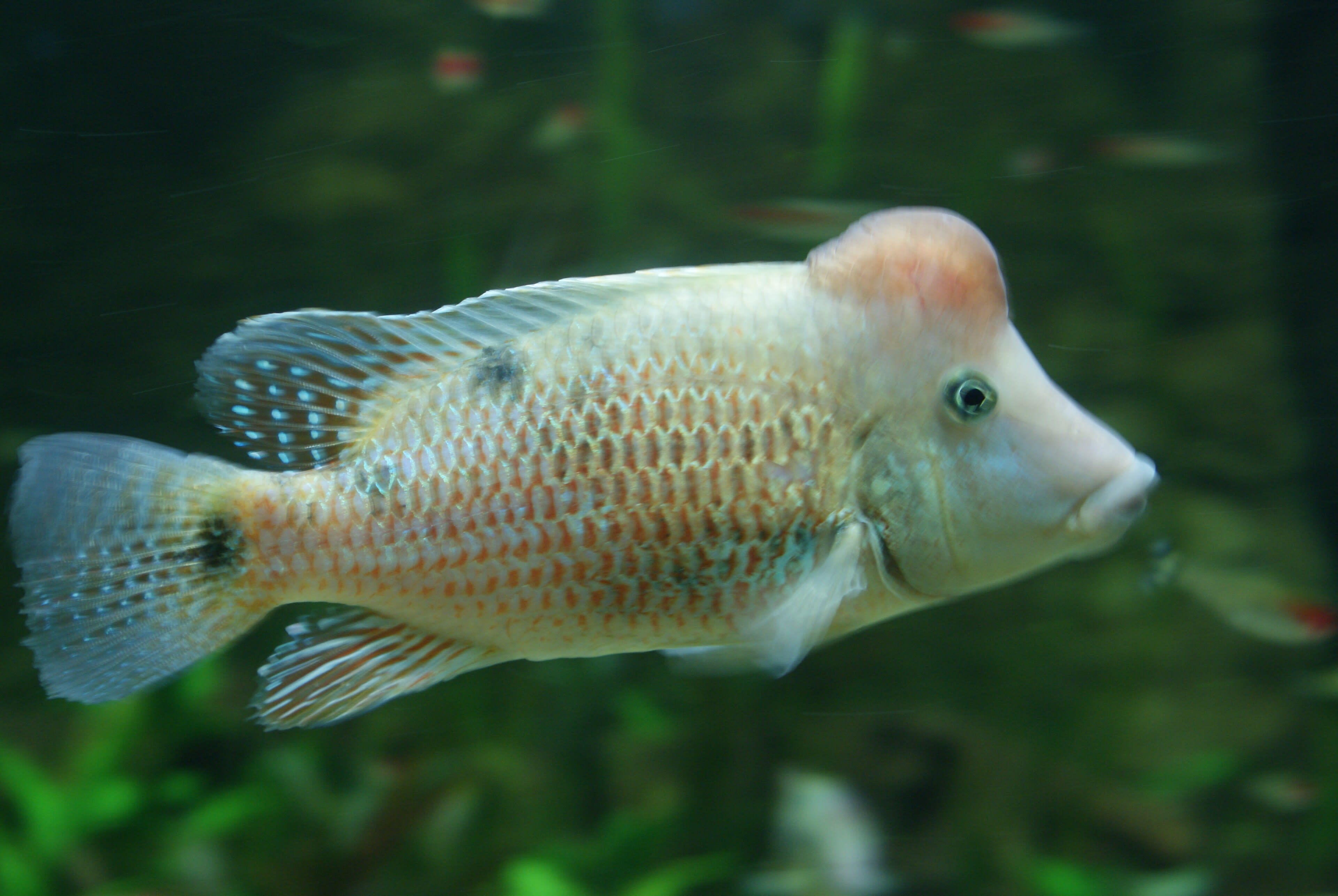
Redhump eartheater
Geophagus steindachneri
Parameter dashboard
20-30 °C
6-7.5
15 cm
10 years
Care guide
The red hump eartheater is a distinctive South American cichlid from the Río Magdalena drainage in Colombia and the Río Limón basin in northwestern Venezuela. It is named for the prominent nuchal hump that develops on the forehead of dominant males as they mature, coupled with a rich golden-bronze body that intensifies during breeding. The species epithet honours the Austrian zoologist Franz Steindachner. Unlike many cichlids, these fish are benthophagous by nature — they take mouthfuls of substrate, sift through it for edible matter, and expel the remaining material through the gills and mouth, a fascinating behaviour to observe.
Eartheaters require very large aquaria: a minimum base dimension of 120 × 45 cm (equating to roughly 240 litres) is necessary for a group, as adult males reach 130–150 mm and need territory. The single most important element of the setup is a soft, sandy substrate several centimetres deep to allow natural foraging behaviour — gravel will damage their gills and can be ingested with potentially fatal consequences. Additional furnishings can include driftwood branches, a few flat rocks for potential spawning sites, and relatively dim lighting. These cichlids are susceptible to deteriorating water quality, so powerful filtration and minimum weekly water changes of 40–70% are essential. Temperature should range from 20–30°C, with a pH of 6.0–7.5, and hardness of 36–215 ppm.
Male red hump eartheaters are territorial towards rival males, especially when breeding, and only a single male should be housed in all but the largest aquaria. Providing the male with three or more females helps disperse aggression. They are omnivorous and need a varied diet of fine-grade prepared foods plus small live or frozen chironomid larvae (bloodworm), Tubifex, Artemia, and mosquito larvae. Rather than one large meal, offer three to four smaller portions daily to allow natural browsing behaviour. Ideal tankmates include pelagic characins, while aggressive or territorial bottom-dwelling species are best avoided. Spawning is possible in captivity: the female lays small batches of eggs on a hard surface and collects them in her mouth before fertilisation; she then mouthbroods the eggs and fry. Aquarium lifespan estimates are around 10 years with suitable care.
Sources
- seriouslyfish.com — https://www.seriouslyfish.com/species/geophagus-steindachneri/
- fishbase.se — https://www.fishbase.se/summary/Geophagus-steindachneri.html
Further reading on identification and aquarium care.
Tankmate compatibility (sample)
Pairwise screening against other species in the database (prioritizing the same family when data is available).
Review first (12)
Caution or avoid from automated rules — confirm before mixing.
| Species | Assessment | Notes |
|---|---|---|
| Fasciatus Shell Dweller Altolamprologus fasciatus Caution | Caution | Multiple territorial species in the same swim layer cause stress · Species with non-overlapping pH ranges may not thrive together · close relatives, and one of them is territorial, so both claim the same kind of space Open pair in Compare → |
| Firemouth cichlid Thorichthys meeki Caution | Caution | close relatives, and one of them is territorial, so both claim the same kind of space Open pair in Compare → |
| Guayas cichlid Cichlasoma festae Caution | Caution | Multiple territorial species in the same swim layer cause stress · close relatives, and one of them is territorial, so both claim the same kind of space Open pair in Compare → |
| Haitian cichlid Nandopsis haitiensis Caution | Caution | close relatives, and one of them is territorial, so both claim the same kind of space Open pair in Compare → |
| Hump-head Cyrtocara moorii Caution | Caution | Species with non-overlapping pH ranges may not thrive together · close relatives, and one of them is territorial, so both claim the same kind of space Open pair in Compare → |
| Malawi eyebiter Dimidiochromis compressiceps Caution | Caution | Multiple territorial species in the same swim layer cause stress · Species with non-overlapping pH ranges may not thrive together · close relatives, and one of them is territorial, so both claim the same kind of space Open pair in Compare → |
| Oscar Astronotus ocellatus Caution | Caution | Fish 2x+ larger may eat smaller tankmates · Multiple territorial species in the same swim layer cause stress · close relatives, and one of them is territorial, so both claim the same kind of space Open pair in Compare → |
| Ram cichlid Mikrogeophagus ramirezi Caution | Caution | Fish 2x+ larger may eat smaller tankmates · Multiple territorial species in the same swim layer cause stress · close relatives, and one of them is territorial, so both claim the same kind of space Open pair in Compare → |
| Red Spotted Severum Heros efasciatus Caution | Caution | Fish 2x+ larger may eat smaller tankmates · Multiple territorial species in the same swim layer cause stress · close relatives, and one of them is territorial, so both claim the same kind of space Open pair in Compare → |
| Redstriped eartheater Geophagus surinamensis Caution | Caution | close relatives, and one of them is territorial, so both claim the same kind of space Open pair in Compare → |
| Venustus Cichlid Nimbochromis venustus Caution | Caution | Multiple territorial species in the same swim layer cause stress · Species with non-overlapping pH ranges may not thrive together · close relatives, and one of them is territorial, so both claim the same kind of space Open pair in Compare → |
| Yellow belly cichlid Cichlasoma salvini Caution | Caution | Multiple territorial species in the same swim layer cause stress · close relatives, and one of them is territorial, so both claim the same kind of space Open pair in Compare → |
Same rule engine as Compare. Not a substitute for observation, tank size, or acclimation.
Related species
Was this page useful? Spot anything wrong?