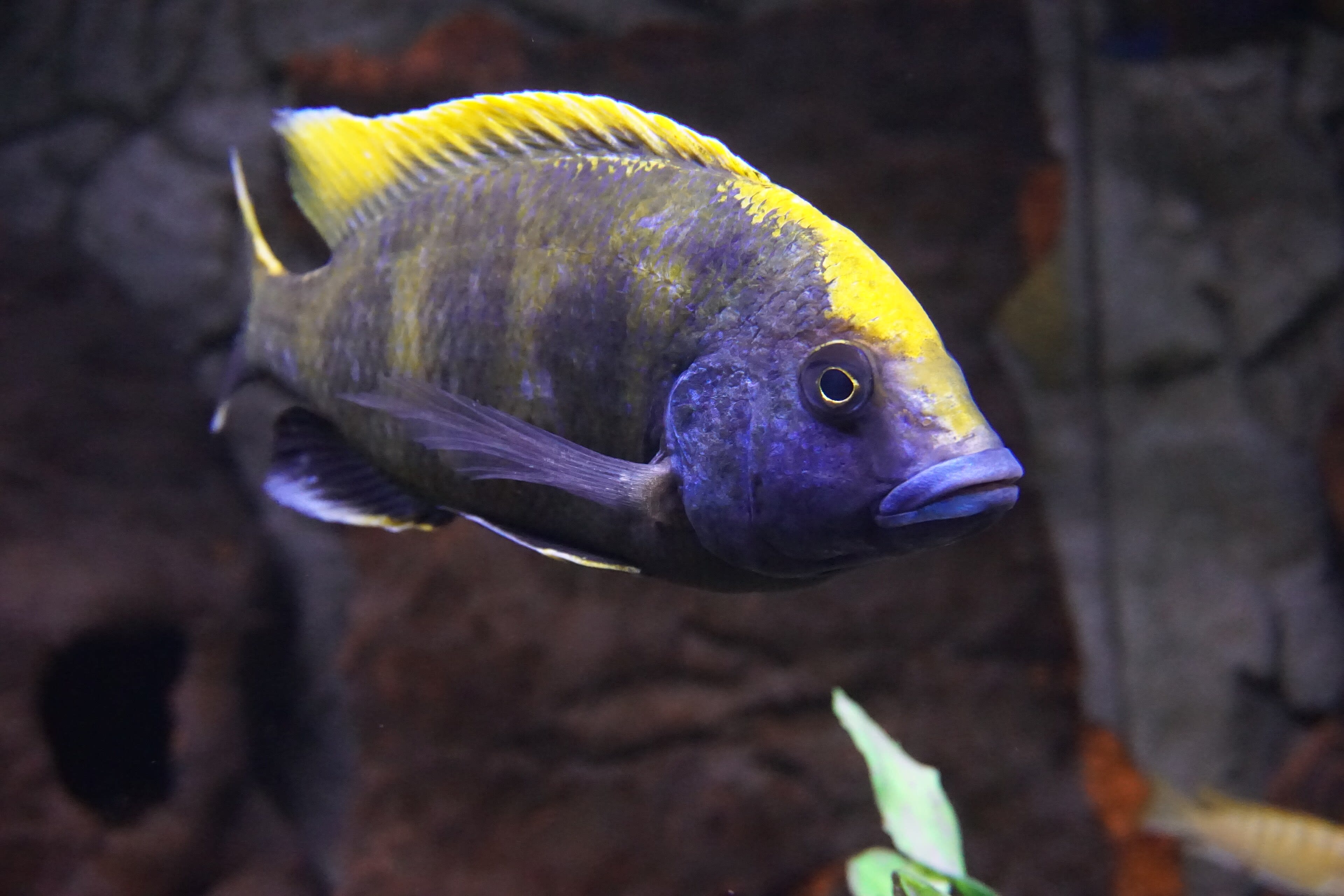
Venustus Cichlid
Nimbochromis venustus
Parameter dashboard
24-28 °C
7.6-8.8
25 cm
10 years
Care guide
The venustus cichlid or giraffe hap (Nimbochromis venustus) is a large, predatory cichlid endemic to Lake Malawi. It is fairly widespread throughout the lake, typically found in relatively shallow water of 15 metres or less, in both rocky habitats and areas with soft substrates of mud or sand. Males reach a standard length of approximately 25 cm and develop spectacular blue and yellow breeding coloration, while females and juveniles exhibit the species' distinctive irregular dark blotches over a pale background — the 'giraffe' pattern that gives the fish its common name. Like its congener Nimbochromis livingstonii, this species employs the hunting strategy of thanatosis, lying motionless on the substrate to ambush unsuspecting prey. It is an exclusive piscivore in nature that accepts dead meaty foods in the aquarium, such as prawns, lancefish, and whitebait, and should never be fed mammalian or avian meats. A minimum tank size of 200 litres with a sandy substrate, rockwork forming caves, and open swimming areas is recommended. Males are intolerant of one another and should be kept singly or as a harem with multiple females. Breeding is a polygamous maternal mouthbrooding process with the female carrying up to 120 eggs for approximately three weeks.
Source
Further reading on identification and aquarium care.
Tankmate compatibility (sample)
Pairwise screening against other species in the database (prioritizing the same family when data is available).
Review first (12)
Caution or avoid from automated rules — confirm before mixing.
| Species | Assessment | Notes |
|---|---|---|
| Blue streak hap Labidochromis caeruleus Caution | Caution | Fish 2x+ larger may eat smaller tankmates · Multiple territorial species in the same swim layer cause stress · close relatives, and one of them is territorial, so both claim the same kind of space Open pair in Compare → |
| Chessboard cichlid Dicrossus filamentosus Caution | Caution | Fish 2x+ larger may eat smaller tankmates · Species with non-overlapping pH ranges may not thrive together · the two share only a narrow band of temperature, so one of them sits at the edge of its range · close relatives, and one of them is territorial, so both claim the same kind of space Open pair in Compare → |
| Convict cichlid Amatitlania nigrofasciata Caution | Caution | close relatives, and one of them is territorial, so both claim the same kind of space Open pair in Compare → |
| Firemouth cichlid Thorichthys meeki Caution | Caution | Fish 2x+ larger may eat smaller tankmates · close relatives, and one of them is territorial, so both claim the same kind of space Open pair in Compare → |
| Haitian cichlid Nandopsis haitiensis Caution | Caution | close relatives, and one of them is territorial, so both claim the same kind of space Open pair in Compare → |
| Humphead cichlid Cyphotilapia frontosa Caution | Caution | Multiple territorial species in the same swim layer cause stress · close relatives, and one of them is territorial, so both claim the same kind of space Open pair in Compare → |
| Moga Hypsophrys nicaraguensis Caution | Caution | Multiple territorial species in the same swim layer cause stress · close relatives, and one of them is territorial, so both claim the same kind of space Open pair in Compare → |
| Multies Neolamprologus multifasciatus Caution | Caution | Fish 2x+ larger may eat smaller tankmates · Multiple territorial species in the same swim layer cause stress · close relatives, and one of them is territorial, so both claim the same kind of space Open pair in Compare → |
| Panda Uaru Uaru fernandezyepezi Caution | Caution | Multiple territorial species in the same swim layer cause stress · Species with non-overlapping pH ranges may not thrive together · the two share only a narrow band of temperature, so one of them sits at the edge of its range · close relatives, and one of them is territorial, so both claim the same kind of space Open pair in Compare → |
| Redstriped eartheater Geophagus surinamensis Caution | Caution | Species with non-overlapping pH ranges may not thrive together · close relatives, and one of them is territorial, so both claim the same kind of space Open pair in Compare → |
| Threespot eartheater Satanoperca daemon Caution | Caution | Species with non-overlapping pH ranges may not thrive together · close relatives, and one of them is territorial, so both claim the same kind of space Open pair in Compare → |
| Green terror Andinoacara rivulatus Avoid | Avoid | Multiple territorial species in the same swim layer cause stress · Species with non-overlapping temperature ranges cannot coexist · the two share only a narrow band of temperature, so one of them sits at the edge of its range · close relatives, and one of them is territorial, so both claim the same kind of space Open pair in Compare → |
Same rule engine as Compare. Not a substitute for observation, tank size, or acclimation.
Related species
Was this page useful? Spot anything wrong?