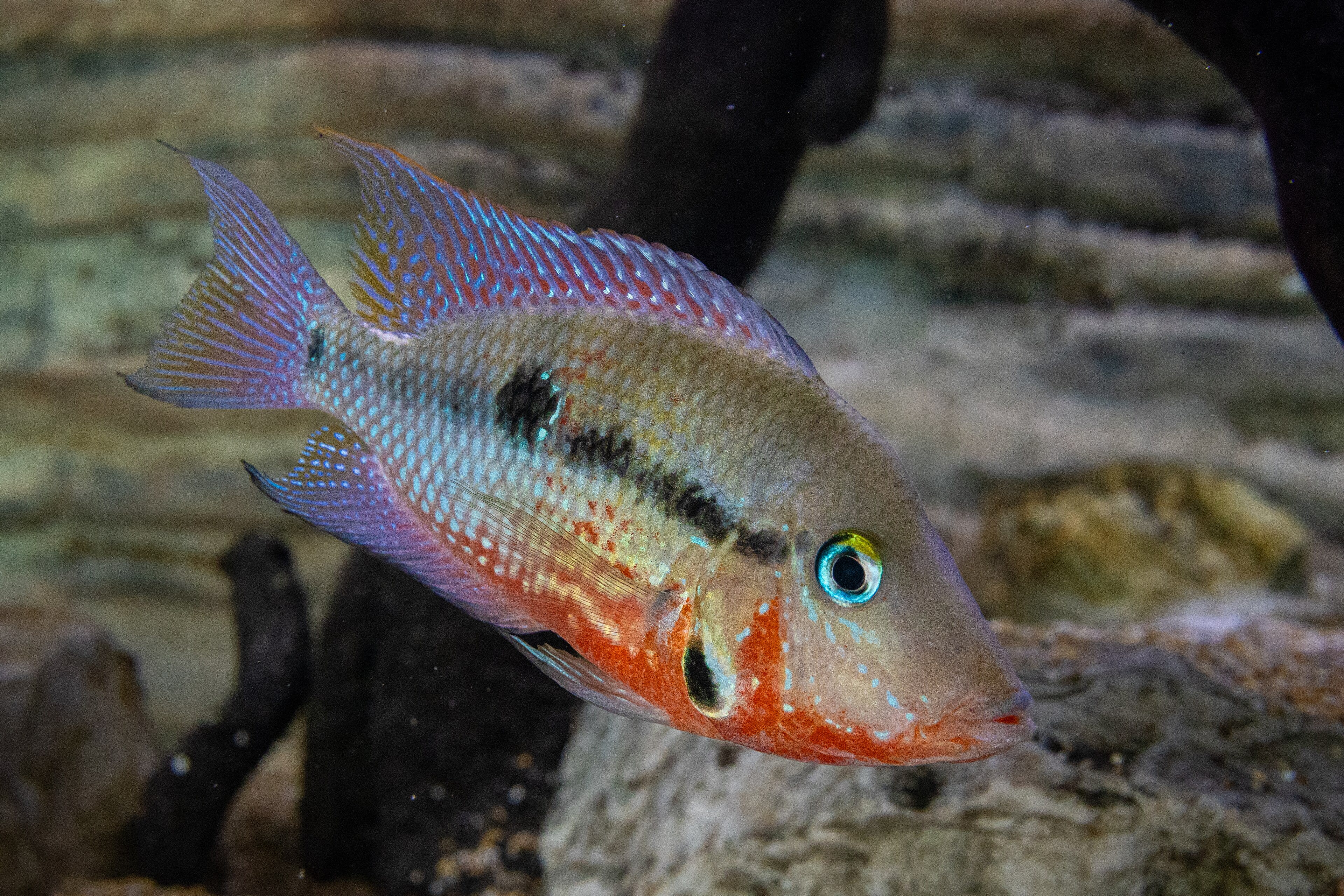
Firemouth cichlid
Thorichthys meeki
Parameter dashboard
20-32 °C
6.5-8.5
12 cm
10 years
Care guide
The firemouth cichlid is a popular Central American cichlid renowned for its spectacular threat display — the fish flairs its gill covers forward, revealing a brilliant fiery-red throat that gives it its common name. Its natural range extends from the Río Tonalá system near Coatzacoalcos, Mexico, eastward through the Yucatán Peninsula and into northern Belize and Guatemala. It inhabits a remarkable range of lowland biotopes from clear cenotes and lagoons to muddy roadside pools and slightly brackish coastal ditches. Males reach 10-12 cm standard length (up to 17 cm total length), with females slightly smaller.
Firemouths are benthophagous omnivores: they take mouthfuls of substrate, sift out edible items such as crustaceans, molluscs, and organic detritus, and expel the remaining material through their gills. In the aquarium they accept a varied diet of quality dried foods supplemented with live and frozen fare. A pair requires a tank of at least 120 cm in length (approximately 120 litres) with a soft, sandy substrate — sharp gravel will damage their gills during sifting. Décor should include smooth rocks, driftwood roots, and planting, with flowerpots or caves provided as potential spawning sites. They are moderately territorial, particularly during breeding, but mix well with other robust Central American cichlids in a suitably large aquarium.
Water parameters: 20-32°C, pH 6.5-8.5, with hardness from soft to hard. The eggs are deposited on a flat stone or other surface after cleaning, and both parents guard the clutch intensively. Fry hatch in 3-4 days and are free-swimming within a week. Firemouths have also established naturalised populations in Hawaii and Puerto Rico. Their hardiness, relatively peaceful demeanour for a cichlid, and spectacular display behaviour make them a rewarding species for both novice and experienced cichlid keepers.
Sources
- seriouslyfish.com — https://www.seriouslyfish.com/species/thorichthys-meeki/
- fishbase.de — https://www.fishbase.de/summary/Thorichthys-meeki.html
Further reading on identification and aquarium care.
Tankmate compatibility (sample)
Pairwise screening against other species in the database (prioritizing the same family when data is available).
Review first (12)
Caution or avoid from automated rules — confirm before mixing.
| Species | Assessment | Notes |
|---|---|---|
| Biajaca Nandopsis tetracanthus Caution | Caution | close relatives, and one of them is territorial, so both claim the same kind of space Open pair in Compare → |
| Blue acara Andinoacara pulcher Caution | Caution | close relatives, and one of them is territorial, so both claim the same kind of space Open pair in Compare → |
| Bolivian Ram Mikrogeophagus altispinosus Caution | Caution | close relatives, and one of them is territorial, so both claim the same kind of space Open pair in Compare → |
| Cockatoo cichlid Apistogramma cacatuoides Caution | Caution | close relatives, and one of them is territorial, so both claim the same kind of space · one is boisterous and the other a much smaller peaceful fish sharing the same floor, where it can be intimidated and outcompeted at feeding time Open pair in Compare → |
| Convict cichlid Amatitlania nigrofasciata Caution | Caution | Multiple territorial species in the same swim layer cause stress · close relatives, and one of them is territorial, so both claim the same kind of space Open pair in Compare → |
| Haitian cichlid Nandopsis haitiensis Caution | Caution | Multiple territorial species in the same swim layer cause stress · close relatives, and one of them is territorial, so both claim the same kind of space Open pair in Compare → |
| Humphead cichlid Cyphotilapia frontosa Caution | Caution | Fish 2x+ larger may eat smaller tankmates · close relatives, and one of them is territorial, so both claim the same kind of space Open pair in Compare → |
| Princess of Burundi Neolamprologus brichardi Caution | Caution | close relatives, and one of them is territorial, so both claim the same kind of space Open pair in Compare → |
| Ram cichlid Mikrogeophagus ramirezi Caution | Caution | Fish 2x+ larger may eat smaller tankmates · close relatives, and one of them is territorial, so both claim the same kind of space Open pair in Compare → |
| Redstriped eartheater Geophagus surinamensis Caution | Caution | Multiple territorial species in the same swim layer cause stress · close relatives, and one of them is territorial, so both claim the same kind of space Open pair in Compare → |
| Temporaris Shell Dweller Telmatochromis temporalis Caution | Caution | Fish 2x+ larger may eat smaller tankmates · Species with non-overlapping pH ranges may not thrive together · close relatives, and one of them is territorial, so both claim the same kind of space Open pair in Compare → |
| Yellow belly cichlid Cichlasoma salvini Caution | Caution | close relatives, and one of them is territorial, so both claim the same kind of space Open pair in Compare → |
Same rule engine as Compare. Not a substitute for observation, tank size, or acclimation.
Related species
Was this page useful? Spot anything wrong?