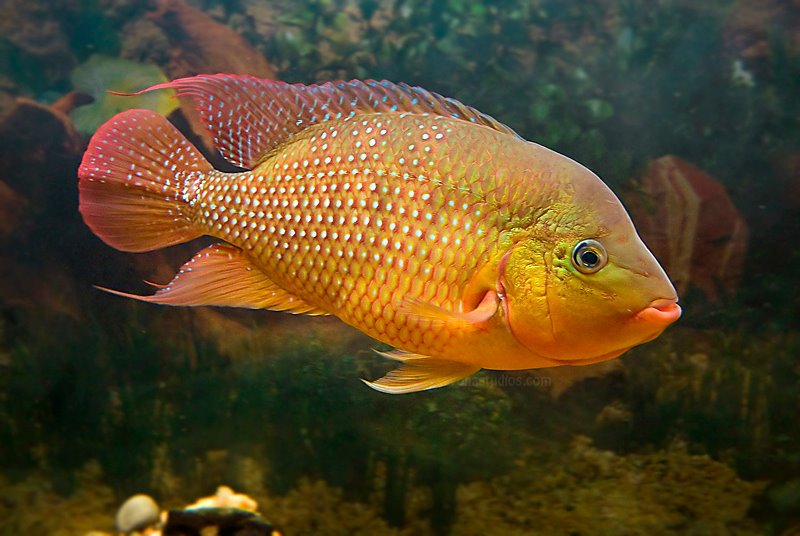
Guayas cichlid
Cichlasoma festae
Parameter dashboard
25-29 °C
7-8
25 cm
12 years
Care guide
The Guayas cichlid, better known in the hobby as the red terror, is a large, aggressive cichlid from the Pacific drainages of Ecuador and Peru. Males can reach 25 cm or more in total length, with bright red and orange body colour that deepens during dominance displays. Females are smaller and keep a more subdued gold-and-red pattern. A tank of 500 litres or more is necessary, decorated with heavy rockwork, driftwood, and a sandy substrate that allows these fish to dig and rearrange their surroundings. Temperature between 25°C and 29°C with pH from 7.0 to 8.0 and moderate hardness matches their natural habitat. These fish are aggressively territorial and are best kept as a single pair in a species-only setup; they will attack and often kill tankmates that cannot defend themselves. The diet should be omnivorous with a strong protein component, including cichlid pellets, whole prawns, earthworms, and occasional vegetable matter. They are powerful eaters that produce a heavy bioload, so oversized external filtration is mandatory. Breeding involves the pair selecting a flat stone and jointly defending hundreds of eggs and later the free-swimming fry. The female is the more diligent parent, while the male patrols the perimeter. Aquarium lifespan estimates are around 12 years with suitable care.
Source
Further reading on identification and aquarium care.
Tankmate compatibility (sample)
Pairwise screening against other species in the database (prioritizing the same family when data is available).
Review first (12)
Caution or avoid from automated rules — confirm before mixing.
| Species | Assessment | Notes |
|---|---|---|
| Agassiz's dwarf cichlid Apistogramma agassizii Caution | Caution | Fish 2x+ larger may eat smaller tankmates · Species with non-overlapping pH ranges may not thrive together · close relatives, and one of them is territorial, so both claim the same kind of space Open pair in Compare → |
| Biajaca Nandopsis tetracanthus Caution | Caution | Multiple territorial species in the same swim layer cause stress · close relatives, and one of them is territorial, so both claim the same kind of space Open pair in Compare → |
| Blue streak hap Labidochromis caeruleus Caution | Caution | Fish 2x+ larger may eat smaller tankmates · Multiple territorial species in the same swim layer cause stress · Species with non-overlapping pH ranges may not thrive together · close relatives, and one of them is territorial, so both claim the same kind of space Open pair in Compare → |
| Bluegray mbuna Melanochromis johannii Caution | Caution | Fish 2x+ larger may eat smaller tankmates · close relatives, and one of them is territorial, so both claim the same kind of space Open pair in Compare → |
| Bolivian Ram Mikrogeophagus altispinosus Caution | Caution | Fish 2x+ larger may eat smaller tankmates · Multiple territorial species in the same swim layer cause stress · close relatives, and one of them is territorial, so both claim the same kind of space Open pair in Compare → |
| Electric blue ram Mikrogeophagus ramirezi Caution | Caution | Fish 2x+ larger may eat smaller tankmates · Multiple territorial species in the same swim layer cause stress · Species with non-overlapping pH ranges may not thrive together · close relatives, and one of them is territorial, so both claim the same kind of space Open pair in Compare → |
| Firemouth cichlid Thorichthys meeki Caution | Caution | Fish 2x+ larger may eat smaller tankmates · close relatives, and one of them is territorial, so both claim the same kind of space Open pair in Compare → |
| Pearly calvus Altolamprologus calvus Caution | Caution | close relatives, and one of them is territorial, so both claim the same kind of space Open pair in Compare → |
| Redstriped eartheater Geophagus surinamensis Caution | Caution | close relatives, and one of them is territorial, so both claim the same kind of space Open pair in Compare → |
| Threespot eartheater Satanoperca daemon Caution | Caution | Species with non-overlapping pH ranges may not thrive together · close relatives, and one of them is territorial, so both claim the same kind of space Open pair in Compare → |
| Gold Cap Caudopunctatus Neolamprologus caudopunctatus Avoid | Avoid | Fish 2x+ larger may eat smaller tankmates · Species with non-overlapping temperature ranges cannot coexist · the two share only a narrow band of temperature, so one of them sits at the edge of its range · close relatives, and one of them is territorial, so both claim the same kind of space Open pair in Compare → |
| Princess of Burundi Neolamprologus brichardi Avoid | Avoid | Fin nippers should not be kept with long-finned species · Fish 2x+ larger may eat smaller tankmates · Multiple territorial species in the same swim layer cause stress · Species with non-overlapping pH ranges may not thrive together · close relatives, and one of them is territorial, so both claim the same kind of space Open pair in Compare → |
Same rule engine as Compare. Not a substitute for observation, tank size, or acclimation.
Related species
Was this page useful? Spot anything wrong?