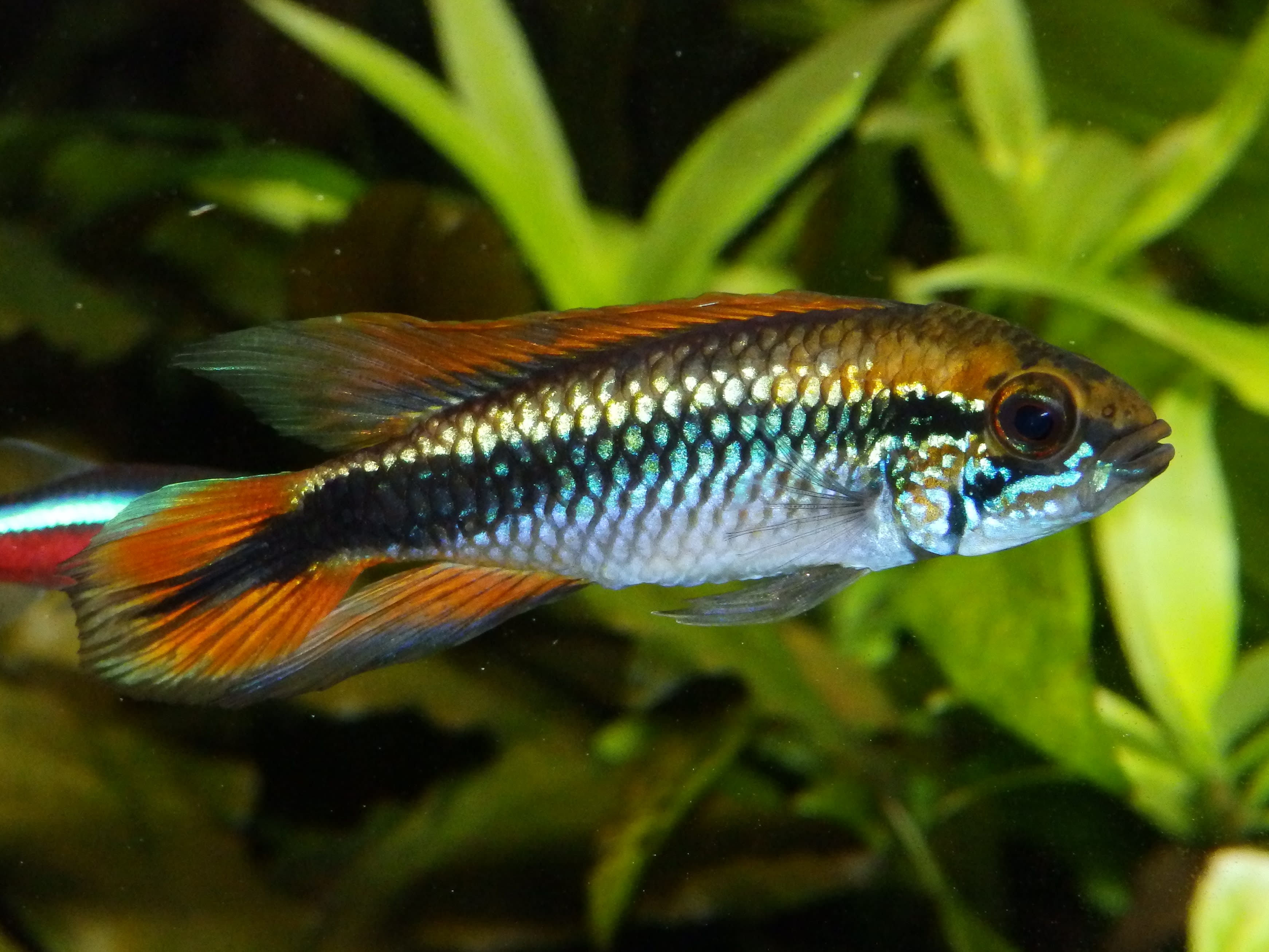
Agassiz's dwarf cichlid
Apistogramma agassizii
Parameter dashboard
22-29 °C
5-7
7.5 cm
5 years
Care guide
Apistogramma agassizii, Agassiz's dwarf cichlid, is one of the most widely distributed dwarf cichlids in the Amazon basin, recorded from clear, black, and white water tributaries across Brazil, Peru, and neighbouring countries. Males grow to about 7.5 cm and carry a spade-shaped tail and trailing fins, while females stay near 5 cm. Aquarium strains have been line-bred into red, gold, and blue colour forms, but all share the same temperament and care needs.
In the aquarium this is a bottom-oriented fish that claims a small territory around a cave or root and patrols it rather than roaming open water. Captive-bred stock settles well into a soft-water community alongside small, peaceful dither fish such as pencilfish or tetras, which coax the cichlids into the open and reduce shyness. Avoid housing two males in a small tank, and do not mix it with other Apistogramma unless the aquarium is large and heavily broken up. It feeds mainly on benthic invertebrates in nature, so offer live or frozen Artemia, daphnia, and bloodworm; most specimens also learn to take quality dried foods.
A planted tank from 60 litres suits a single pair, with soft, acidic water between 22 and 29 degrees Celsius, gentle filtration, and leaf litter or driftwood for cover. Agassiz's dwarf cichlid is a cave spawner: the female lays on the roof of a small cave, then guards the eggs and shepherds the free-swimming fry while the male defends the wider territory. A guarding female turns bright yellow and becomes strikingly bold for her size, so a community pair will often raise a brood without intervention.
Sources
- seriouslyfish.com — https://www.seriouslyfish.com/species/apistogramma-agassizii/
- fishbase.se — https://www.fishbase.se/summary/Apistogramma-agassizii.html
Further reading on identification and aquarium care.
Tankmate compatibility (sample)
Pairwise screening against other species in the database (prioritizing the same family when data is available).
Review first (11)
Caution or avoid from automated rules — confirm before mixing.
| Species | Assessment | Notes |
|---|---|---|
| Blue acara Andinoacara pulcher Caution | Caution | Fish 2x+ larger may eat smaller tankmates · close relatives, and one of them is territorial, so both claim the same kind of space Open pair in Compare → |
| Demon eartheater Satanoperca jurupari Caution | Caution | Fish 2x+ larger may eat smaller tankmates · close relatives, and one of them is territorial, so both claim the same kind of space · one is boisterous and the other a much smaller peaceful fish sharing the same floor, where it can be intimidated and outcompeted at feeding time Open pair in Compare → |
| Freshwater angelfish Pterophyllum scalare Caution | Caution | Fish 2x+ larger may eat smaller tankmates · close relatives, and one of them is territorial, so both claim the same kind of space Open pair in Compare → |
| Haitian cichlid Nandopsis haitiensis Caution | Caution | Fish 2x+ larger may eat smaller tankmates · Species with non-overlapping pH ranges may not thrive together · close relatives, and one of them is territorial, so both claim the same kind of space · one is boisterous and the other a much smaller peaceful fish sharing the same floor, where it can be intimidated and outcompeted at feeding time Open pair in Compare → |
| Hump-head Cyrtocara moorii Caution | Caution | Fish 2x+ larger may eat smaller tankmates · Species with non-overlapping pH ranges may not thrive together · close relatives, and one of them is territorial, so both claim the same kind of space · one is boisterous and the other a much smaller peaceful fish sharing the same floor, where it can be intimidated and outcompeted at feeding time Open pair in Compare → |
| Jewelfish Hemichromis bimaculatus Caution | Caution | Fish 2x+ larger may eat smaller tankmates · close relatives, and one of them is territorial, so both claim the same kind of space · one is boisterous and the other a much smaller peaceful fish sharing the same floor, where it can be intimidated and outcompeted at feeding time Open pair in Compare → |
| Livingstonii Cichlid Nimbochromis livingstonii Caution | Caution | Fish 2x+ larger may eat smaller tankmates · Species with non-overlapping pH ranges may not thrive together · close relatives, and one of them is territorial, so both claim the same kind of space Open pair in Compare → |
| Moga Hypsophrys nicaraguensis Caution | Caution | Fish 2x+ larger may eat smaller tankmates · Species with non-overlapping pH ranges may not thrive together · close relatives, and one of them is territorial, so both claim the same kind of space Open pair in Compare → |
| Multies Neolamprologus multifasciatus Caution | Caution | Species with non-overlapping pH ranges may not thrive together · close relatives, and one of them is territorial, so both claim the same kind of space Open pair in Compare → |
| Ram cichlid Mikrogeophagus ramirezi Caution | Caution | close relatives, and one of them is territorial, so both claim the same kind of space Open pair in Compare → |
| Yellow belly cichlid Cichlasoma salvini Caution | Caution | Fish 2x+ larger may eat smaller tankmates · close relatives, and one of them is territorial, so both claim the same kind of space Open pair in Compare → |
1 species with compatible assessment in this sampleCollapse to hide the list; use “Open pair in Compare” for the full matrix.
| Species | Assessment | Notes |
|---|---|---|
| Umbrella cichlid Apistogramma borellii Compatible | Compatible | No rule-based conflicts detected for this pair. Open pair in Compare → |
Same rule engine as Compare. Not a substitute for observation, tank size, or acclimation.
Related species
Was this page useful? Spot anything wrong?