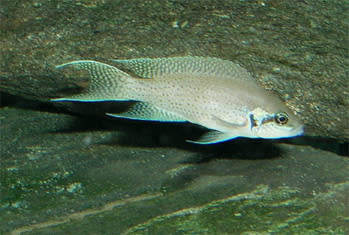
Princess of Burundi
Neolamprologus brichardi
Parameter dashboard
23-27 °C
8-9
9 cm
10 years
Care guide
Neolamprologus brichardi (also classified as Neolamprologus pulcher), known commonly as the Princess of Burundi, fairy cichlid, or lyretail cichlid, is a graceful Tanganyikan cichlid endemic to rocky shorelines throughout Lake Tanganyika in East Africa. It reaches 7-9 cm (2.8-3.5 in) in length and is distinguished by its elegant elongated dorsal and caudal fin filaments, a cream to beige body with subtle yellow and blue iridescence, and a distinctive dark marking just behind the gill cover. It is deservedly one of the most popular Rift Lake cichlids for both beginners and experienced keepers.
Despite being aggressively territorial when protecting fry, brichardi are relatively easy to keep in a Tanganyika biotope aquarium of at least 100 L (26 gal) with a sandy substrate and extensive piles of rocks forming caves and crevices. Water should be hard and alkaline at pH 8.0-9.0, temperature 23-27C (73-81F), with high carbonate hardness. They thrive on a varied diet of live and frozen foods such as Daphnia, Artemia, and bloodworm, supplemented with spirulina and blanched vegetables; dried foods should be offered less frequently.
Brichardi exhibit one of the most advanced social structures among aquarium fish: cooperative brood care. A bonded pair spawns in a cave, the female tending the eggs while the male guards the territory, and the fry from previous spawns actively help defend and raise the next generation. Several generations can coexist peacefully, forming a sizeable colony in a large tank. Males grow slightly larger with more elongated fins. Aquarium lifespan estimates are around 10 years with suitable care.
Sources
- seriouslyfish.com — https://www.seriouslyfish.com/species/neolamprologus-brichardi/
- en.wikipedia.org — https://en.wikipedia.org/wiki/Neolamprologus_brichardi
Further reading on identification and aquarium care.
Tankmate compatibility (sample)
Pairwise screening against other species in the database (prioritizing the same family when data is available).
Review first (12)
Caution or avoid from automated rules — confirm before mixing.
| Species | Assessment | Notes |
|---|---|---|
| Blue acara Andinoacara pulcher Caution | Caution | Multiple territorial species in the same swim layer cause stress · Species with non-overlapping pH ranges may not thrive together · close relatives, and one of them is territorial, so both claim the same kind of space Open pair in Compare → |
| Freshwater angelfish Pterophyllum scalare Caution | Caution | Multiple territorial species in the same swim layer cause stress · Species with non-overlapping pH ranges may not thrive together · close relatives, and one of them is territorial, so both claim the same kind of space Open pair in Compare → |
| Green terror Andinoacara rivulatus Caution | Caution | Fish 2x+ larger may eat smaller tankmates · Multiple territorial species in the same swim layer cause stress · Species with non-overlapping pH ranges may not thrive together · the two share only a narrow band of temperature, so one of them sits at the edge of its range · close relatives, and one of them is territorial, so both claim the same kind of space Open pair in Compare → |
| Humphead cichlid Cyphotilapia frontosa Caution | Caution | Fish 2x+ larger may eat smaller tankmates · Multiple territorial species in the same swim layer cause stress · close relatives, and one of them is territorial, so both claim the same kind of space Open pair in Compare → |
| Jack Dempsey Rocio octofasciata Caution | Caution | Fish 2x+ larger may eat smaller tankmates · Species with non-overlapping pH ranges may not thrive together · close relatives, and one of them is territorial, so both claim the same kind of space Open pair in Compare → |
| Malawi eyebiter Dimidiochromis compressiceps Caution | Caution | Fish 2x+ larger may eat smaller tankmates · Multiple territorial species in the same swim layer cause stress · close relatives, and one of them is territorial, so both claim the same kind of space Open pair in Compare → |
| Pearly calvus Altolamprologus calvus Caution | Caution | close relatives, and one of them is territorial, so both claim the same kind of space Open pair in Compare → |
| Convict cichlid Amatitlania nigrofasciata Avoid | Avoid | Fin nippers should not be kept with long-finned species · Species with non-overlapping pH ranges may not thrive together · close relatives, and one of them is territorial, so both claim the same kind of space Open pair in Compare → |
| Guayas cichlid Cichlasoma festae Avoid | Avoid | Fin nippers should not be kept with long-finned species · Fish 2x+ larger may eat smaller tankmates · Multiple territorial species in the same swim layer cause stress · Species with non-overlapping pH ranges may not thrive together · close relatives, and one of them is territorial, so both claim the same kind of space Open pair in Compare → |
| Panda Uaru Uaru fernandezyepezi Avoid | Avoid | Fish 2x+ larger may eat smaller tankmates · Multiple territorial species in the same swim layer cause stress · Species with non-overlapping temperature ranges cannot coexist · Species with non-overlapping pH ranges may not thrive together · the two share only a narrow band of temperature, so one of them sits at the edge of its range · close relatives, and one of them is territorial, so both claim the same kind of space Open pair in Compare → |
| Ram cichlid Mikrogeophagus ramirezi Avoid | Avoid | Fish 2x+ larger may eat smaller tankmates · Multiple territorial species in the same swim layer cause stress · Species with non-overlapping temperature ranges cannot coexist · Species with non-overlapping pH ranges may not thrive together · the two share only a narrow band of temperature, so one of them sits at the edge of its range · close relatives, and one of them is territorial, so both claim the same kind of space Open pair in Compare → |
| Yellow belly cichlid Cichlasoma salvini Avoid | Avoid | Fin nippers should not be kept with long-finned species · Multiple territorial species in the same swim layer cause stress · Species with non-overlapping pH ranges may not thrive together · close relatives, and one of them is territorial, so both claim the same kind of space Open pair in Compare → |
Same rule engine as Compare. Not a substitute for observation, tank size, or acclimation.
Related species
Was this page useful? Spot anything wrong?