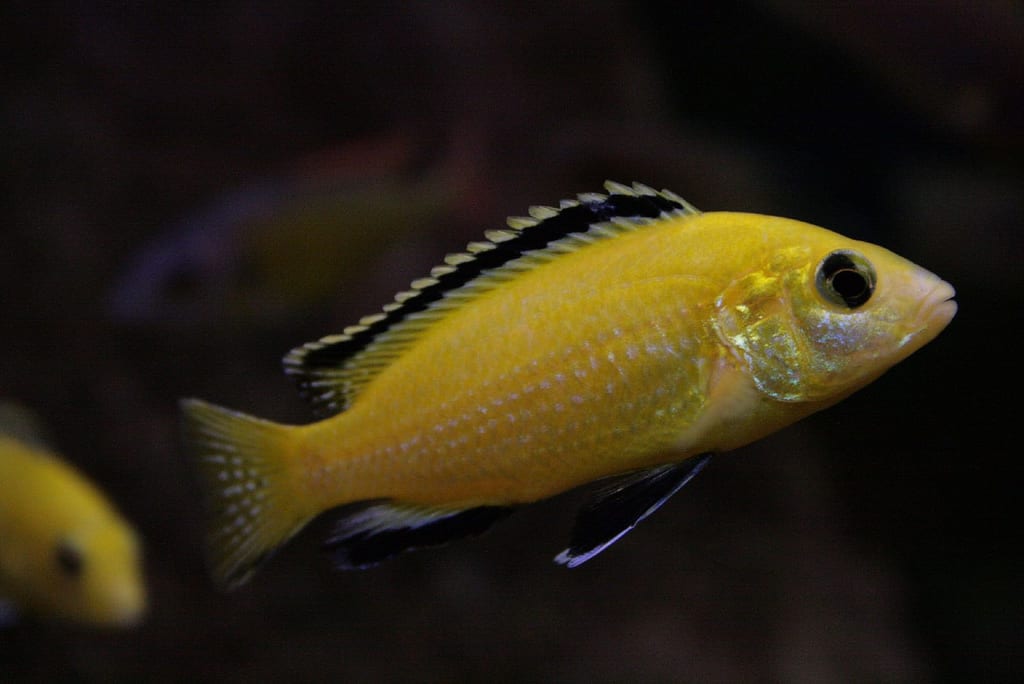
Blue streak hap
Labidochromis caeruleus
Parameter dashboard
24-28 °C
7.7-8.6
10 cm
10 years
Care guide
The electric yellow lab, also known as the blue streak hap, is a dazzling Malawi cichlid from the rocky habitats of Lake Malawi, East Africa. While the blue-and-white morph is more widespread in the wild, the brilliant 'electric yellow' form — found naturally only between Charo and Lion's Cove — has become one of the most popular Mbuna in the aquarium trade. Males typically exhibit the deepest yellow, with jet-black dorsal and ventral fins edged in electric blue, while females are generally paler but still vividly coloured. Their bold, outgoing personality matches their bright appearance.
Unlike many Mbuna, electric yellows are comparatively mild-mannered — though 'mild' by Malawi standards still means semi-aggressive. They do best in a species group with one male and at least three females, which spreads male attention and reduces harassment. Suitable tankmates include other moderately peaceful Malawi cichlids of similar size, but avoid overly aggressive Mbuna or very meek species that would be bullied. They are omnivorous, feeding primarily on insect larvae and small crustaceans in the wild, with some plant matter. A quality cichlid pellet or flake as a staple, supplemented with frozen brine shrimp, mysis, and spirulina, provides balanced nutrition.
A minimum tank of 160 litres is recommended for a small group, decorated with rock piles that form caves and crevices alongside open swimming areas. The water must be hard and alkaline — pH 7.7 to 8.6, temperature 24 to 28°C, with a hardness of 10 to 25°H. Labidochromis caeruleus is a maternal mouthbrooder: the female incubates fertilised eggs in her buccal cavity for about three weeks before releasing fully independent fry. Aquarium lifespan estimates are around 10 years with suitable care.
Sources
- seriouslyfish.com — https://seriouslyfish.com/species/Labidochromis-caeruleus
- tfhmagazine.com — https://www.tfhmagazine.com/articles/freshwater/labidochromis-caeruleus
Further reading on identification and aquarium care.
Tankmate compatibility (sample)
Pairwise screening against other species in the database (prioritizing the same family when data is available).
Review first (12)
Caution or avoid from automated rules — confirm before mixing.
| Species | Assessment | Notes |
|---|---|---|
| Biajaca Nandopsis tetracanthus Caution | Caution | Fish 2x+ larger may eat smaller tankmates · Multiple territorial species in the same swim layer cause stress · Species with non-overlapping pH ranges may not thrive together · close relatives, and one of them is territorial, so both claim the same kind of space Open pair in Compare → |
| Bluegray mbuna Melanochromis johannii Caution | Caution | close relatives, and one of them is territorial, so both claim the same kind of space Open pair in Compare → |
| Bolivian Ram Mikrogeophagus altispinosus Caution | Caution | Multiple territorial species in the same swim layer cause stress · Species with non-overlapping pH ranges may not thrive together · close relatives, and one of them is territorial, so both claim the same kind of space Open pair in Compare → |
| Demon eartheater Satanoperca jurupari Caution | Caution | Species with non-overlapping pH ranges may not thrive together · close relatives, and one of them is territorial, so both claim the same kind of space Open pair in Compare → |
| Gold Cap Caudopunctatus Neolamprologus caudopunctatus Caution | Caution | the two share only a narrow band of temperature, so one of them sits at the edge of its range · close relatives, and one of them is territorial, so both claim the same kind of space Open pair in Compare → |
| Gold severum Heros efasciatus Caution | Caution | Fish 2x+ larger may eat smaller tankmates · Multiple territorial species in the same swim layer cause stress · Species with non-overlapping pH ranges may not thrive together · close relatives, and one of them is territorial, so both claim the same kind of space Open pair in Compare → |
| Greenstreaked eartheater Biotodoma cupido Caution | Caution | Multiple territorial species in the same swim layer cause stress · Species with non-overlapping pH ranges may not thrive together · close relatives, and one of them is territorial, so both claim the same kind of space Open pair in Compare → |
| Malawi eyebiter Dimidiochromis compressiceps Caution | Caution | Fish 2x+ larger may eat smaller tankmates · Multiple territorial species in the same swim layer cause stress · close relatives, and one of them is territorial, so both claim the same kind of space Open pair in Compare → |
| Ram cichlid Mikrogeophagus ramirezi Caution | Caution | Fish 2x+ larger may eat smaller tankmates · Multiple territorial species in the same swim layer cause stress · Species with non-overlapping pH ranges may not thrive together · the two share only a narrow band of temperature, so one of them sits at the edge of its range · close relatives, and one of them is territorial, so both claim the same kind of space Open pair in Compare → |
| Red Spotted Severum Heros efasciatus Caution | Caution | Fish 2x+ larger may eat smaller tankmates · Multiple territorial species in the same swim layer cause stress · Species with non-overlapping pH ranges may not thrive together · close relatives, and one of them is territorial, so both claim the same kind of space Open pair in Compare → |
| Umbrella cichlid Apistogramma borellii Caution | Caution | Species with non-overlapping pH ranges may not thrive together · close relatives, and one of them is territorial, so both claim the same kind of space Open pair in Compare → |
| Mendezs Dwarf Cichlid Apistogramma mendezi Avoid | Avoid | Fin nippers should not be kept with long-finned species · Species with non-overlapping pH ranges may not thrive together · close relatives, and one of them is territorial, so both claim the same kind of space Open pair in Compare → |
Same rule engine as Compare. Not a substitute for observation, tank size, or acclimation.
Related species
Was this page useful? Spot anything wrong?