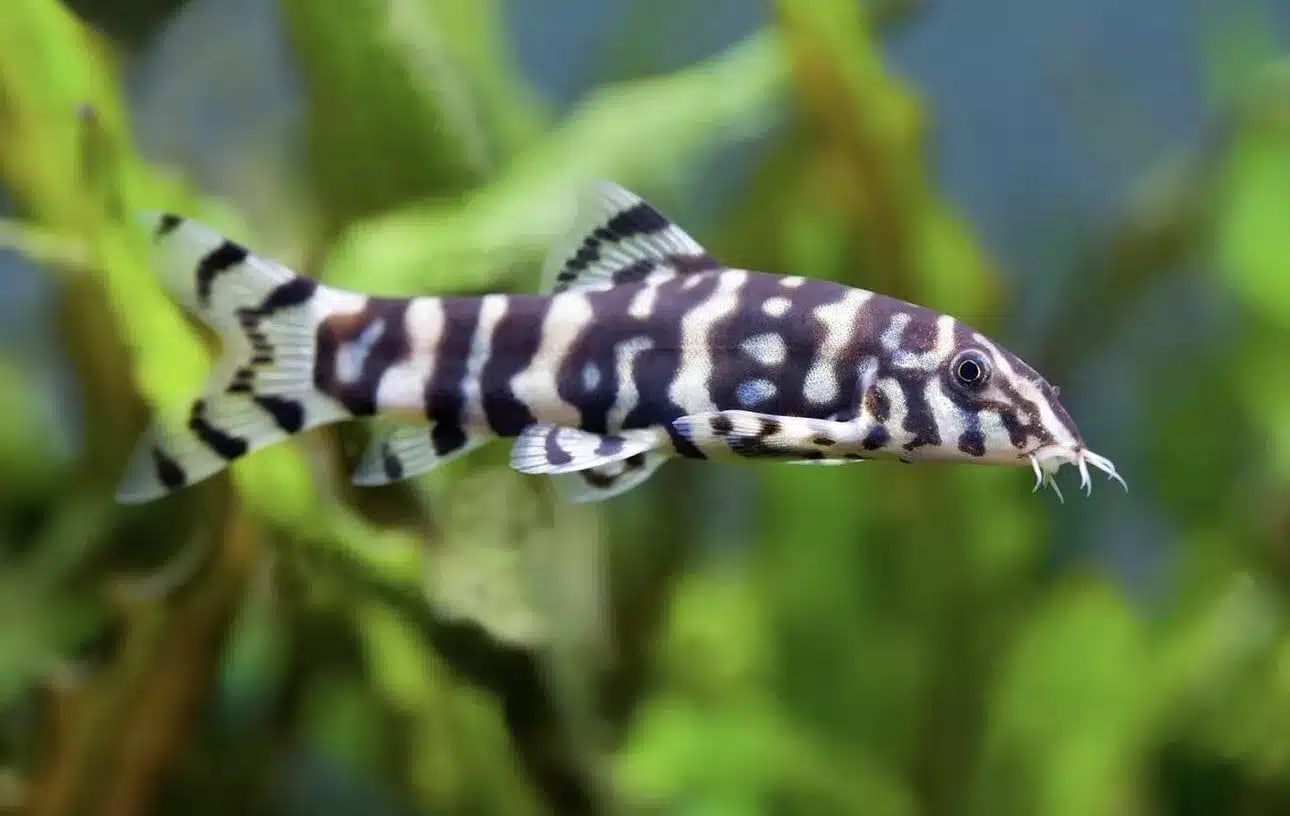
Almorha loach
Botia almorhae
Parameter dashboard
19-27.5 °C
6-7.5
16 cm
6 years
Care guide
The yo-yo loach is a lively, medium-sized botiid from the Ganges and Indus river drainages of northern India, Nepal, and Pakistan. Its common name derives from the distinctive juvenile pattern of alternating 'i' and 'y' shaped dark bars on a pale body, which often resemble the word 'yo-yo'. As the fish matures these markings break up into a variable pattern of spots. True Botia almorhae reaches 14–16 cm, but many fish sold as yo-yo loaches may belong to the closely related species B. lohachata or the undescribed B. sp. 'Kosi'.
In nature this species inhabits rivers and streams with rocky substrates, gathering in pools and calmer areas. The aquarium should mimic these conditions with a soft sandy substrate, smooth rocks, and driftwood that creates shady hiding spots. A base of at least 120 cm x 45 cm is recommended for a group. Good filtration and regular water changes are essential, as botiids are intolerant of organic waste. Unlike some of their relatives, yo-yo loaches prefer well-oxygenated water with moderate flow rather than turbulent conditions.
Yo-yo loaches are gregarious and should be kept in groups of at least six, ideally ten or more, to establish a stable social hierarchy. When kept singly they can become withdrawn or aggressive. They are generally peaceful with tankmates that are not small enough to be intimidated, but may nip the fins of slow-moving or long-finned species. Their diet is omnivorous with a carnivorous lean — they relish bloodworm, Tubifex, Artemia, and also accept quality dried foods with vegetable matter. They are enthusiastic snail hunters but should not be relied upon for pest control.
Source
Further reading on identification and aquarium care.
Tankmate compatibility (sample)
Pairwise screening against other species in the database (prioritizing the same family when data is available).
Review first (9)
Caution or avoid from automated rules — confirm before mixing.
| Species | Assessment | Notes |
|---|---|---|
| Clown loach Chromobotia macracanthus Caution | Caution | Fish 2x+ larger may eat smaller tankmates · close relatives, and one of them is territorial, so both claim the same kind of space Open pair in Compare → |
| Indonesian snakehead Channa micropeltes Caution | Caution | Fish 2x+ larger may eat smaller tankmates Open pair in Compare → |
| Neon tetra Paracheirodon innesi Caution | Caution | Fish 2x+ larger may eat smaller tankmates Open pair in Compare → |
| Pelew Stiphodon Stiphodon pelewensis Caution | Caution | Fish 2x+ larger may eat smaller tankmates · one is boisterous and the other a much smaller peaceful fish sharing the same floor, where it can be intimidated and outcompeted at feeding time Open pair in Compare → |
| Southern platyfish Xiphophorus maculatus Caution | Caution | Fish 2x+ larger may eat smaller tankmates Open pair in Compare → |
| Zebra loach Botia striata Caution | Caution | close relatives, and one of them is territorial, so both claim the same kind of space · one is boisterous and the other a much smaller peaceful fish sharing the same floor, where it can be intimidated and outcompeted at feeding time Open pair in Compare → |
| Boeseman's rainbowfish Melanotaenia boesemani Avoid | Avoid | Species with non-overlapping temperature ranges cannot coexist · the two share only a narrow band of temperature, so one of them sits at the edge of its range Open pair in Compare → |
| Electric blue ram Mikrogeophagus ramirezi Avoid | Avoid | Fish 2x+ larger may eat smaller tankmates · Species with non-overlapping temperature ranges cannot coexist · the two share only a narrow band of temperature, so one of them sits at the edge of its range Open pair in Compare → |
| Panda Uaru Uaru fernandezyepezi Avoid | Avoid | Species with non-overlapping temperature ranges cannot coexist · the two share only a narrow band of temperature, so one of them sits at the edge of its range Open pair in Compare → |
3 species with compatible assessment in this sampleCollapse to hide the list; use “Open pair in Compare” for the full matrix.
| Species | Assessment | Notes |
|---|---|---|
| Freshwater butterflyfish Pantodon buchholzi Compatible | Compatible | No rule-based conflicts detected for this pair. Open pair in Compare → |
| Three-lined rasbora Rasbora trilineata Compatible | Compatible | No rule-based conflicts detected for this pair. Open pair in Compare → |
| Twig Catfish Farlowella vittata Compatible | Compatible | No rule-based conflicts detected for this pair. Open pair in Compare → |
Same rule engine as Compare. Not a substitute for observation, tank size, or acclimation.
Related species
Was this page useful? Spot anything wrong?