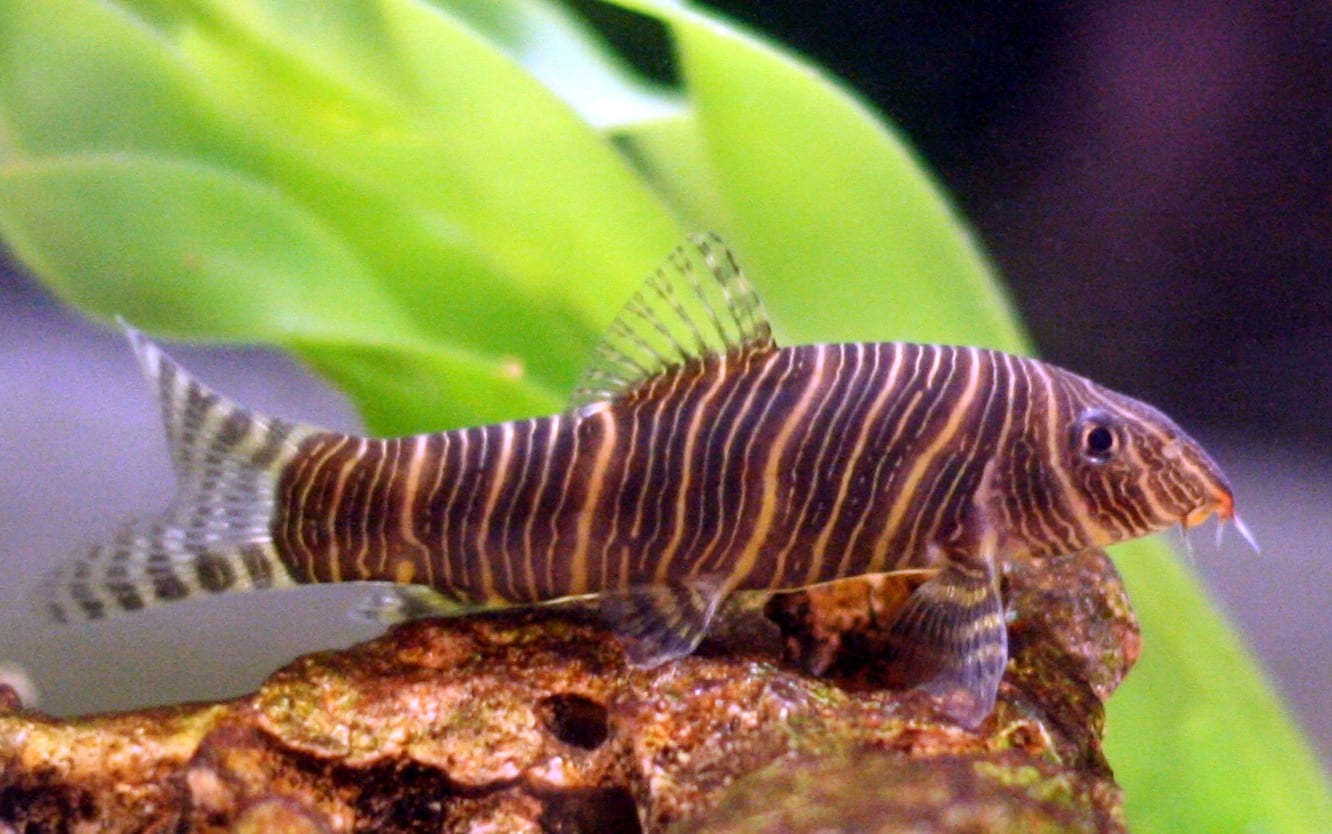
Zebra loach
Botia striata
Parameter dashboard
21-26 °C
6-7.5
9 cm
10 years
Care guide
Botia striata, the Zebra Loach, is a striking, striped botiid loach native to the Krishna River drainage in the Western Ghats of India, where it inhabits clear, well-oxygenated streams with rocky and sandy substrates. It reaches a standard length of 8–9 cm and requires an aquarium with a base of at least 120 × 30 cm with good water movement. Water conditions should be well-oxygenated with temperatures of 21–26 °C, pH of 6.0–7.5, and hardness of 18–179 ppm. The substrate should consist of sand or fine gravel, and the aquarium should include smooth rocks, driftwood, and shaded areas. Zebra Loaches are social and should be maintained in groups to observe their active and engaging behaviour. While peaceful, they are very active and may intimidate much smaller tankmates. Slow-moving or long-finned species such as Bettas, guppies, and angelfish should be avoided as trailing fins may be nipped. The natural diet is chiefly carnivorous — aquatic molluscs, insects, worms, and other invertebrates — and they will also consume soft-leaved aquatic plants. In the aquarium they accept a varied diet of quality dried sinking foods, live or frozen bloodworm, Tubifex, and Artemia, along with fresh vegetables such as cucumber, melon, and blanched spinach. They will prey on aquatic snails but should not be considered a reliable solution to infestations. B. striata is considered endangered in the wild due to habitat modification and dam construction across its limited range.
Source
Further reading on identification and aquarium care.
Tankmate compatibility (sample)
Pairwise screening against other species in the database (prioritizing the same family when data is available).
Review first (10)
Caution or avoid from automated rules — confirm before mixing.
| Species | Assessment | Notes |
|---|---|---|
| Almorha loach Botia almorhae Caution | Caution | close relatives, and one of them is territorial, so both claim the same kind of space · one is boisterous and the other a much smaller peaceful fish sharing the same floor, where it can be intimidated and outcompeted at feeding time Open pair in Compare → |
| Clown loach Chromobotia macracanthus Caution | Caution | Fish 2x+ larger may eat smaller tankmates Open pair in Compare → |
| Common otocinclus Otocinclus vittatus Caution | Caution | Fish 2x+ larger may eat smaller tankmates Open pair in Compare → |
| Glowlight tetra Hemigrammus erythrozonus Caution | Caution | Fish 2x+ larger may eat smaller tankmates Open pair in Compare → |
| Head-and-taillight tetra Hemigrammus ocellifer Caution | Caution | Fish 2x+ larger may eat smaller tankmates Open pair in Compare → |
| Hump-head Cyrtocara moorii Caution | Caution | Fish 2x+ larger may eat smaller tankmates · Species with non-overlapping pH ranges may not thrive together · the two share only a narrow band of temperature, so one of them sits at the edge of its range · one is boisterous and the other a much smaller peaceful fish sharing the same floor, where it can be intimidated and outcompeted at feeding time Open pair in Compare → |
| Threadfin rainbowfish Iriatherina werneri Caution | Caution | Fish 2x+ larger may eat smaller tankmates Open pair in Compare → |
| Zig-zag eel Mastacembelus armatus Caution | Caution | Fish 2x+ larger may eat smaller tankmates Open pair in Compare → |
| Boeseman's rainbowfish Melanotaenia boesemani Avoid | Avoid | Species with non-overlapping temperature ranges cannot coexist · the two share only a narrow band of temperature, so one of them sits at the edge of its range Open pair in Compare → |
| Electric blue ram Mikrogeophagus ramirezi Avoid | Avoid | Fish 2x+ larger may eat smaller tankmates · Species with non-overlapping temperature ranges cannot coexist · the two share only a narrow band of temperature, so one of them sits at the edge of its range Open pair in Compare → |
2 species with compatible assessment in this sampleCollapse to hide the list; use “Open pair in Compare” for the full matrix.
| Species | Assessment | Notes |
|---|---|---|
| Desert goby Chlamydogobius eremius Compatible | Compatible | No rule-based conflicts detected for this pair. Open pair in Compare → |
| Twig Catfish Farlowella vittata Compatible | Compatible | No rule-based conflicts detected for this pair. Open pair in Compare → |
Same rule engine as Compare. Not a substitute for observation, tank size, or acclimation.
Related species
Was this page useful? Spot anything wrong?