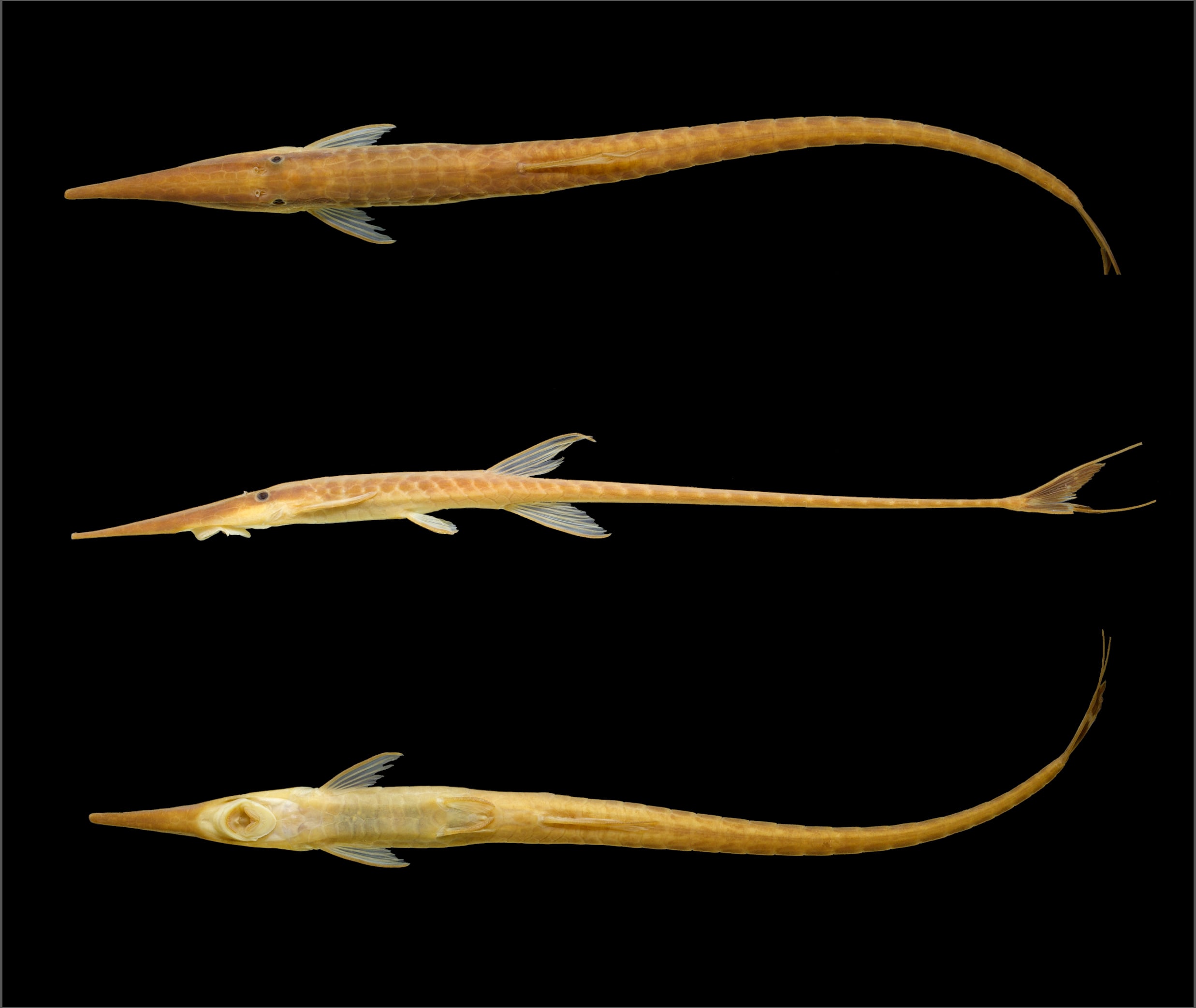
Twig Catfish
Farlowella vittata
Parameter dashboard
24-27 °C
6-7
15 cm
15 years
Care guide
The twig catfish reaches about 15 cm standard length, its elongated body and extended snout making it a near-perfect mimic of a submerged twig or branch. It comes from the Orinoco river basin in Colombia and Venezuela, where it inhabits gently flowing streams with submerged vegetation and tangled roots. The aquarium should measure at least 90 by 30 cm (about 81 L) with a sand substrate, rounded stones, driftwood branches, and subdued lighting. Water temperature of 24–27 °C and pH 6.0–7.0 suit it, but stability matters far more than the exact numbers — this fish is extremely sensitive to deteriorating water quality and requires pristine conditions. Diet is primarily vegetarian: algae wafers, spirulina tablets, blanched courgette, kale, and spinach. It will graze on diatoms and green algae but does not eat brush or beard algae. It is very peaceful but easily outcompeted for food by more vigorous tankmates, so choose companions carefully — small characins, danios, and peaceful loricariids work well. Males develop a broader snout with rows of odontotes. Aquarium lifespan estimates are around 15 years with suitable care.
Source
Further reading on identification and aquarium care.
Tankmate compatibility (sample)
Pairwise screening against other species in the database (prioritizing the same family when data is available).
Review first (9)
Caution or avoid from automated rules — confirm before mixing.
| Species | Assessment | Notes |
|---|---|---|
| Common otocinclus Otocinclus vittatus Caution | Caution | Fish 2x+ larger may eat smaller tankmates · the two share only a narrow band of temperature, so one of them sits at the edge of its range Open pair in Compare → |
| Leopard Frog Pleco Peckoltia compta Caution | Caution | Fish 2x+ larger may eat smaller tankmates · close relatives, and one of them is territorial, so both claim the same kind of space Open pair in Compare → |
| Nannoptopoma Nannoptopoma sternoptychum Caution | Caution | Fish 2x+ larger may eat smaller tankmates Open pair in Compare → |
| Oxyropsis Oxyropsis carinata Caution | Caution | the two share only a narrow band of temperature, so one of them sits at the edge of its range Open pair in Compare → |
| Royal Farlowella Sturisomatichthys festivus Caution | Caution | close relatives, and one of them is territorial, so both claim the same kind of space Open pair in Compare → |
| Royal panaque Panaque nigrolineatus Caution | Caution | Fish 2x+ larger may eat smaller tankmates Open pair in Compare → |
| Vampire Pleco Leporacanthicus galaxias Caution | Caution | close relatives, and one of them is territorial, so both claim the same kind of space · one is boisterous and the other a much smaller peaceful fish sharing the same floor, where it can be intimidated and outcompeted at feeding time Open pair in Compare → |
| Zebra pleco Hypancistrus zebra Caution | Caution | the two share only a narrow band of temperature, so one of them sits at the edge of its range · close relatives, and one of them is territorial, so both claim the same kind of space Open pair in Compare → |
| Blue-eye panaque Panaque suttonorum Avoid | Avoid | Species with non-overlapping temperature ranges cannot coexist · the two share only a narrow band of temperature, so one of them sits at the edge of its range Open pair in Compare → |
3 species with compatible assessment in this sampleCollapse to hide the list; use “Open pair in Compare” for the full matrix.
| Species | Assessment | Notes |
|---|---|---|
| Giant Whiptail Sturisomatichthys aureus Compatible | Compatible | No rule-based conflicts detected for this pair. Open pair in Compare → |
| Medusa Pleco Ancistrus ranunculus Compatible | Compatible | No rule-based conflicts detected for this pair. Open pair in Compare → |
| Whiptail catfish Farlowella acus Compatible | Compatible | No rule-based conflicts detected for this pair. Open pair in Compare → |
Same rule engine as Compare. Not a substitute for observation, tank size, or acclimation.
Related species
Was this page useful? Spot anything wrong?