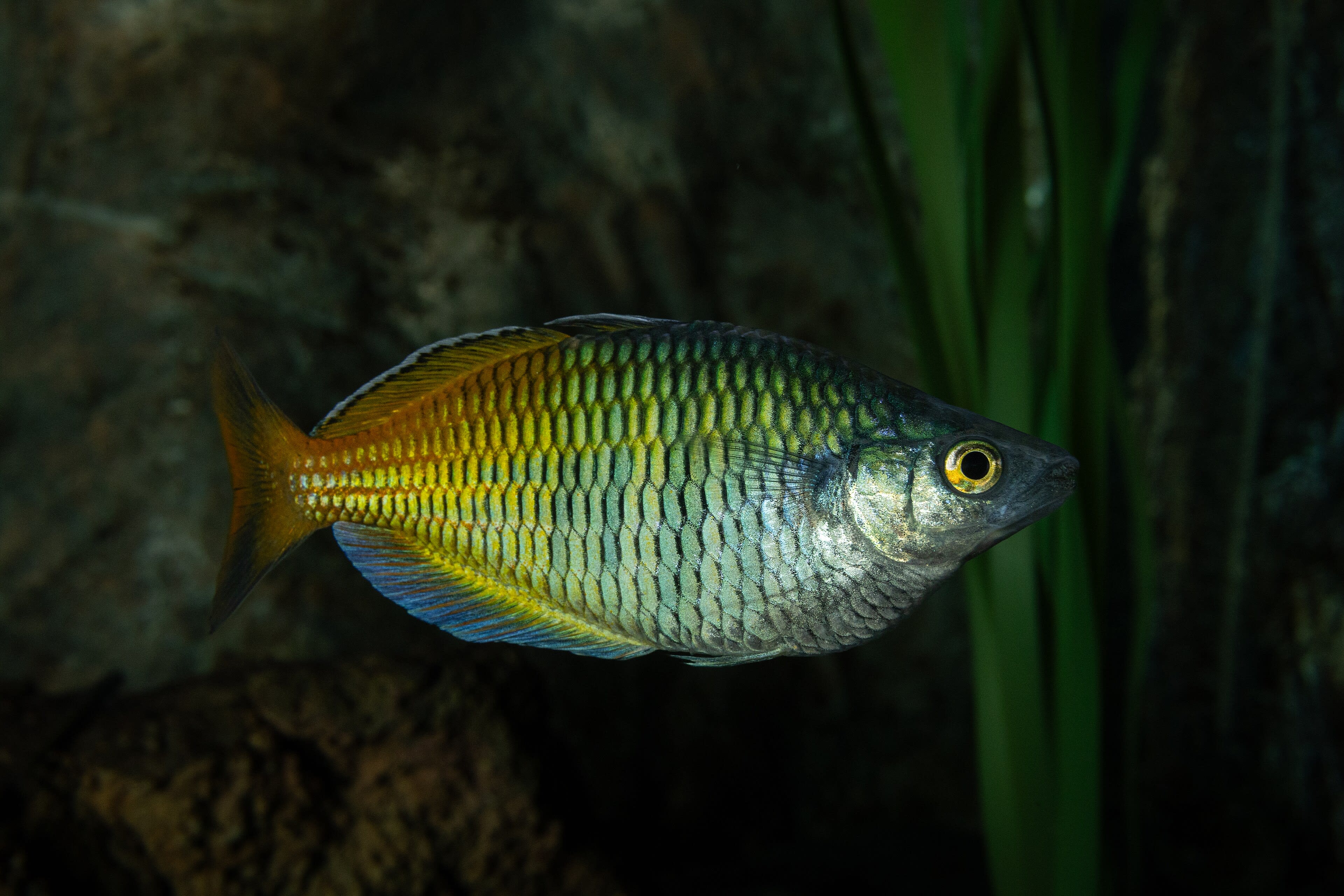
Boeseman's rainbowfish
Melanotaenia boesemani
Parameter dashboard
27-30 °C
7-8
11 cm
6 years
Care guide
Boeseman's rainbowfish is one of the most visually spectacular freshwater fish in the hobby, native to just three lakes — Ajamaru, Hain, and Aitinjo — in the remote Bird's Head Peninsula of West Papua, Indonesia. The species exhibits dramatic sexual dichromatism: the front half of the body is a deep metallic blue-grey or violet, transitioning sharply to a fiery orange or yellow on the posterior half. Males reach about 11 cm and develop a distinctly deeper, more compressed body than females, which are smaller and silverer overall. Listed as Endangered on the IUCN Red List since 2020, the wild populations face pressure from habitat degradation, making well-managed captive populations important.
Boesemani rainbowfish are active, peaceful shoalers that do best in groups of six or more. In a group, males constantly display to one another, intensifying their already vivid colours in a shimmering competition that is a joy to watch. They occupy the middle and upper water levels and are excellent dither fish, encouraging shyer tankmates to emerge. Suitable companions include other rainbowfish of similar size, larger tetras, peaceful barbs, and Corydoras catfish. Avoid slow-moving or long-finned species that may be nipped by their constant activity. They are omnivorous, accepting quality flake and granules as a staple, but regular offerings of live and frozen foods — brine shrimp, mosquito larvae, and daphnia — are essential for maintaining their intense colours and breeding condition.
Despite their restricted natural range, Boesemani's rainbowfish adapt well to captivity when their basic needs are met. A tank of 110 litres (about 30 US gallons) is the minimum for a school, though larger is better — they are powerful, active swimmers. The water must be hard and alkaline: pH 7.0 to 8.0, hardness 10 to 20 dH, and a steady temperature of 27 to 30°C. They are strictly tropical and will not thrive in cooler or soft, acidic water. A dark substrate, bright lighting, and open swimming areas bordered by hardy plants suit them best. Boesemani's are egg-scatterers that spawn over fine-leaved plants or spawning mops over several days; the eggs hatch in 7 to 12 days. Aquarium lifespan estimates are around 6 years with suitable care.
Sources
- seriouslyfish.com — https://www.seriouslyfish.com/species/melanotaenia-boesemani/
- fishbase.de — https://www.fishbase.de/summary/SpeciesSummary.php?ID=10489&AT=Ai
Further reading on identification and aquarium care.
Tankmate compatibility (sample)
Pairwise screening against other species in the database (prioritizing the same family when data is available).
Review first (10)
Caution or avoid from automated rules — confirm before mixing.
| Species | Assessment | Notes |
|---|---|---|
| Dwarf rainbowfish Melanotaenia praecox Caution | Caution | the two share only a narrow band of temperature, so one of them sits at the edge of its range Open pair in Compare → |
| Green swordtail Xiphophorus hellerii Caution | Caution | the two share only a narrow band of temperature, so one of them sits at the edge of its range Open pair in Compare → |
| Guayas cichlid Cichlasoma festae Caution | Caution | Fish 2x+ larger may eat smaller tankmates Open pair in Compare → |
| Threadfin rainbowfish Iriatherina werneri Caution | Caution | Fish 2x+ larger may eat smaller tankmates Open pair in Compare → |
| Flying fox Epalzeorhynchos kalopterum Avoid | Avoid | Species with non-overlapping temperature ranges cannot coexist · the two share only a narrow band of temperature, so one of them sits at the edge of its range Open pair in Compare → |
| Japanese rice fish Oryzias latipes Avoid | Avoid | Fish 2x+ larger may eat smaller tankmates · Species with non-overlapping temperature ranges cannot coexist · the two share only a narrow band of temperature, so one of them sits at the edge of its range Open pair in Compare → |
| Lizard Loach Homaloptera orthogoniata Avoid | Avoid | Species with non-overlapping temperature ranges cannot coexist · the two share only a narrow band of temperature, so one of them sits at the edge of its range Open pair in Compare → |
| Panda corydoras Corydoras panda Avoid | Avoid | Fish 2x+ larger may eat smaller tankmates · Species with non-overlapping temperature ranges cannot coexist · the two share only a narrow band of temperature, so one of them sits at the edge of its range Open pair in Compare → |
| Red rainbowfish Glossolepis incisus Avoid | Avoid | Species with non-overlapping temperature ranges cannot coexist · the two share only a narrow band of temperature, so one of them sits at the edge of its range Open pair in Compare → |
| Zebra loach Botia striata Avoid | Avoid | Species with non-overlapping temperature ranges cannot coexist · the two share only a narrow band of temperature, so one of them sits at the edge of its range Open pair in Compare → |
2 species with compatible assessment in this sampleCollapse to hide the list; use “Open pair in Compare” for the full matrix.
| Species | Assessment | Notes |
|---|---|---|
| Alien betta Betta splendens hybrid Compatible | Compatible | No rule-based conflicts detected for this pair. Open pair in Compare → |
| Leopard Frog Pleco Peckoltia compta Compatible | Compatible | No rule-based conflicts detected for this pair. Open pair in Compare → |
Same rule engine as Compare. Not a substitute for observation, tank size, or acclimation.
Related species
Was this page useful? Spot anything wrong?