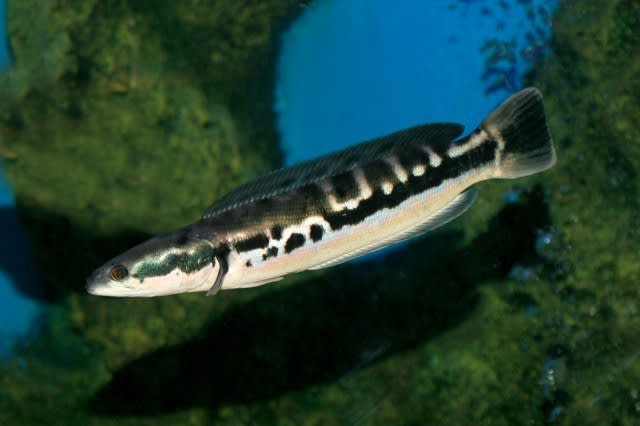
Indonesian snakehead
Channa micropeltes
Parameter dashboard
24-30 °C
6-8
130 cm
Care guide
The giant snakehead, Channa micropeltes, is one of the largest members of the snakehead family, native to the rivers, swamps, and canals of Southeast Asia across the Mekong and Chao Phraya basins, the Malay Peninsula, Sumatra, and Borneo. It can reach well over a metre and is an obligate air-breather: a primitive lung behind the gills lets it breathe atmospheric air and survive in stagnant, low-oxygen water, and it can even wriggle across damp ground. Juveniles are bright red with black stripes, which is why they are sold as red snakeheads, while adults turn a bluish-black and white.
This is an apex freshwater predator that feeds mainly on fish, with some crustaceans, and it will eat any tankmate it can fit in its mouth. It is fast, powerful, and territorial, more so as it matures, so it is effectively a single-specimen fish for all but the largest systems. Feed meaty foods such as whole frozen fish, prawns, and pellets made for predatory species, and never use live feeder fish, which carry disease. A secure, heavy lid is mandatory, since a startled snakehead is strong enough to push a lid aside and can survive for a time out of water.
Owning this fish is a major commitment. An adult needs an enormous tank, on the order of 1500 litres or more, with warm water at 24 to 30 degrees Celsius and robust filtration to handle its waste. Snakeheads are devoted parents that build a nest and guard a dense school of red fry fiercely. Before buying, check local law: Channa species are banned or restricted in many countries and across the United States, where importing or transporting them is illegal without a permit, because escaped or released snakeheads become damaging invasive predators.
Sources
- en.wikipedia.org — https://en.wikipedia.org/wiki/Channa_micropeltes
- fishbase.se — https://www.fishbase.se/summary/Channa-micropeltes.html
Further reading on identification and aquarium care.
Tankmate compatibility (sample)
Pairwise screening against other species in the database (prioritizing the same family when data is available).
Review first (6)
Caution or avoid from automated rules — confirm before mixing.
| Species | Assessment | Notes |
|---|---|---|
| Assamese snakehead Channa stewartii Caution | Caution | Fish 2x+ larger may eat smaller tankmates · Multiple territorial species in the same swim layer cause stress · the two share only a narrow band of temperature, so one of them sits at the edge of its range · close relatives, and one of them is territorial, so both claim the same kind of space Open pair in Compare → |
| Bluefinned snakehead Channa bleheri Caution | Caution | Fish 2x+ larger may eat smaller tankmates · Multiple territorial species in the same swim layer cause stress · the two share only a narrow band of temperature, so one of them sits at the edge of its range · close relatives, and one of them is territorial, so both claim the same kind of space Open pair in Compare → |
| Colored snakehead Channa pulchra Caution | Caution | Fish 2x+ larger may eat smaller tankmates · the two share only a narrow band of temperature, so one of them sits at the edge of its range · close relatives, and one of them is territorial, so both claim the same kind of space Open pair in Compare → |
| Goldspotted snakehead Channa aurantimaculata Caution | Caution | Fish 2x+ larger may eat smaller tankmates · close relatives, and one of them is territorial, so both claim the same kind of space Open pair in Compare → |
| Small snakehead Channa asiatica Caution | Caution | Fish 2x+ larger may eat smaller tankmates · the two share only a narrow band of temperature, so one of them sits at the edge of its range · close relatives, and one of them is territorial, so both claim the same kind of space Open pair in Compare → |
| Walking snakehead Channa orientalis Avoid | Avoid | Fish 2x+ larger may eat smaller tankmates · Species with non-overlapping temperature ranges cannot coexist · the two share only a narrow band of temperature, so one of them sits at the edge of its range · close relatives, and one of them is territorial, so both claim the same kind of space Open pair in Compare → |
Same rule engine as Compare. Not a substitute for observation, tank size, or acclimation.
Related species
Was this page useful? Spot anything wrong?