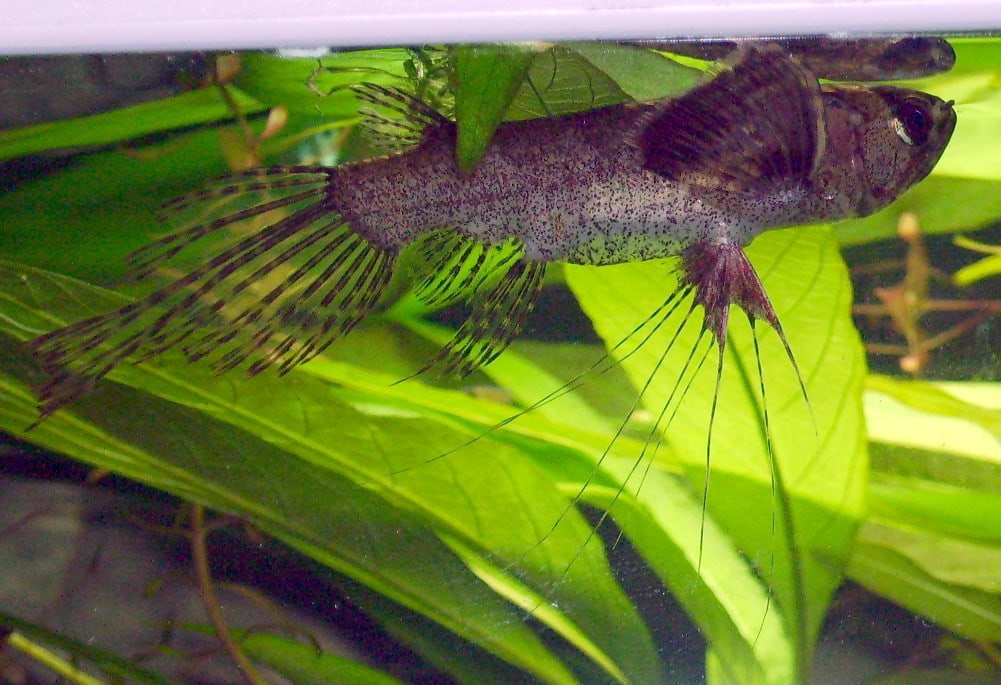
Freshwater butterflyfish
Pantodon buchholzi
Parameter dashboard
25-30 °C
6-7.5
11.9 cm
5 years
Care guide
The African butterfly fish (Pantodon buchholzi) is a surface-dwelling predator from the slow-moving, tannin-stained waters of West and Central Africa. Named for its large, wing-like pectoral fins, this fish is a specialised surface ambush predator that spends almost all its time at the waterline, where its flattened head and upward-pointing mouth are perfectly adapted to snatch insects and small prey from above. It is a facultative air-breather and can jump out of the water when startled.
In the aquarium a long, shallow tank of 100 litres or more is ideal, with minimal water movement, dim lighting, and plenty of surface cover from tall plants or floating species such as frogbit and water sprite. A tight-fitting lid is absolutely essential — these fish are accomplished jumpers. They are best kept singly or in pairs; males can be territorial with each other. Like many insectivores they can be shy at first and benefit from a dark substrate and subdued lighting.
The African butterfly fish is strictly carnivorous and feeds only at the surface. Live or frozen foods such as bloodworm, brine shrimp, small crickets, and wingless fruit flies are eagerly taken; they can sometimes be weaned onto floating pellets. They are peaceful toward fish too large to eat but will prey on any fish small enough to fit in their mouth. Good tankmates include medium-sized corydoras, larger tetras, and peaceful bottom-dwellers. They are sensitive to poor water quality and should be added only to a mature aquarium with stable parameters.
Sources
- seriouslyfish.com — https://seriouslyfish.com/species/Pantodon-buchholzi
- fishbase.de — https://www.fishbase.de/summary/Pantodon-buchholzi.html
Further reading on identification and aquarium care.
Tankmate compatibility (sample)
Pairwise screening against other species in the database (prioritizing the same family when data is available).
Review first (11)
Caution or avoid from automated rules — confirm before mixing.
| Species | Assessment | Notes |
|---|---|---|
| Bamboo Shrimp Atyopsis moluccensis Caution | Caution | this fish is not shrimp-safe, so shrimplets get eaten and adult shrimp can be harassed Open pair in Compare → |
| Blackline penguinfish Thayeria boehlkei Caution | Caution | Fish 2x+ larger may eat smaller tankmates Open pair in Compare → |
| Chocolate gourami Sphaerichthys osphromenoides Caution | Caution | Fish 2x+ larger may eat smaller tankmates Open pair in Compare → |
| Eyespot pufferfish Tetraodon biocellatus Caution | Caution | the two share only a narrow band of temperature, so one of them sits at the edge of its range Open pair in Compare → |
| Harlequin rasbora Trigonostigma heteromorpha Caution | Caution | Fish 2x+ larger may eat smaller tankmates Open pair in Compare → |
| Sumatra barb Puntigrus tetrazona Caution | Caution | the two share only a narrow band of temperature, so one of them sits at the edge of its range Open pair in Compare → |
| White Seam Betta Betta albimarginata Caution | Caution | Fish 2x+ larger may eat smaller tankmates Open pair in Compare → |
| Chameleon fish Badis badis Avoid | Avoid | Species with non-overlapping temperature ranges cannot coexist · the two share only a narrow band of temperature, so one of them sits at the edge of its range Open pair in Compare → |
| Colored snakehead Channa pulchra Avoid | Avoid | Fish 2x+ larger may eat smaller tankmates · Species with non-overlapping temperature ranges cannot coexist · the two share only a narrow band of temperature, so one of them sits at the edge of its range Open pair in Compare → |
| Green terror Andinoacara rivulatus Avoid | Avoid | Fish 2x+ larger may eat smaller tankmates · Species with non-overlapping temperature ranges cannot coexist · the two share only a narrow band of temperature, so one of them sits at the edge of its range Open pair in Compare → |
| Ruby barb Pethia padamya Avoid | Avoid | Fish 2x+ larger may eat smaller tankmates · Species with non-overlapping temperature ranges cannot coexist · the two share only a narrow band of temperature, so one of them sits at the edge of its range Open pair in Compare → |
1 species with compatible assessment in this sampleCollapse to hide the list; use “Open pair in Compare” for the full matrix.
| Species | Assessment | Notes |
|---|---|---|
| Siamese flying fox Crossocheilus oblongus Compatible | Compatible | No rule-based conflicts detected for this pair. Open pair in Compare → |
Same rule engine as Compare. Not a substitute for observation, tank size, or acclimation.
Was this page useful? Spot anything wrong?