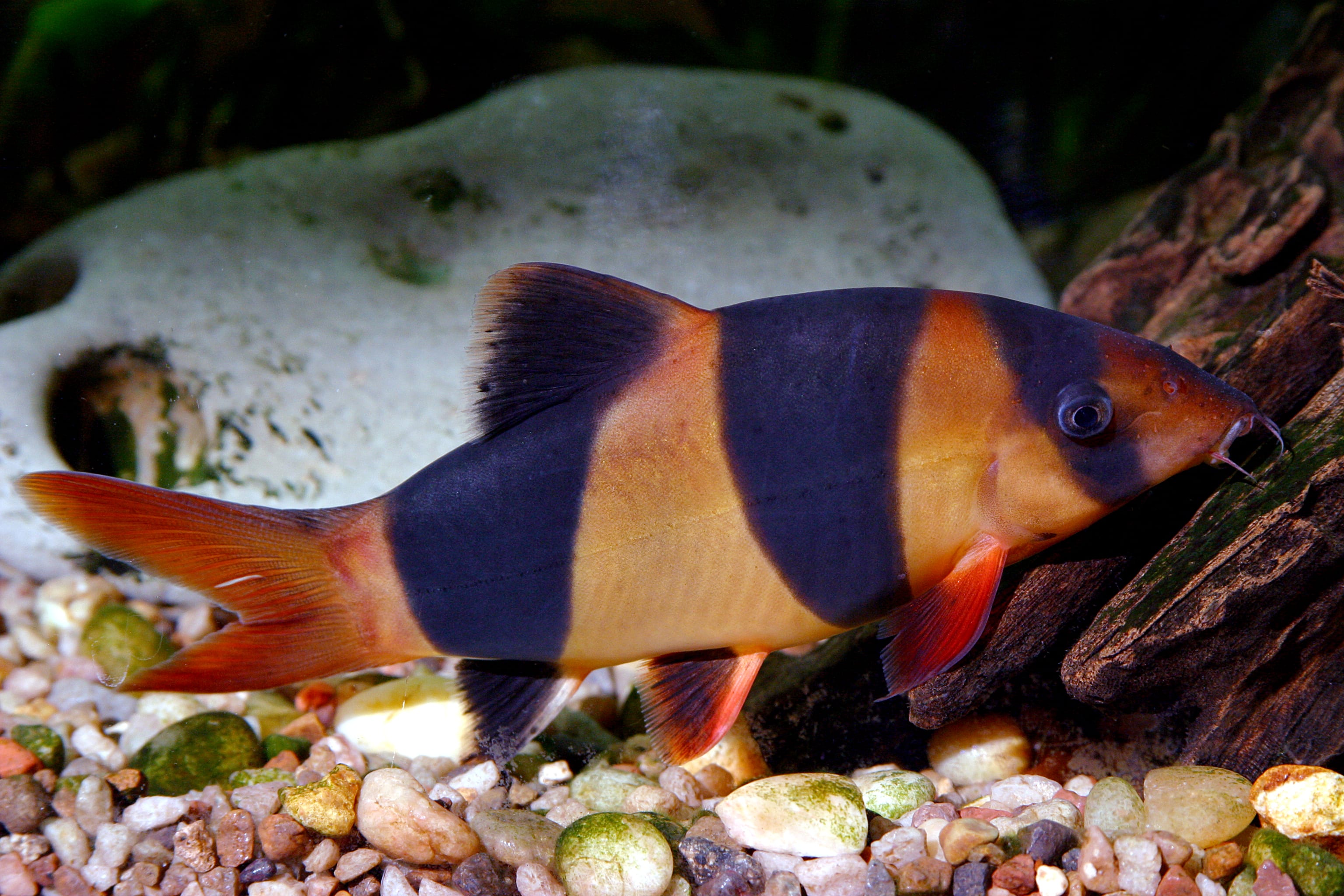
Clown loach
Chromobotia macracanthus
Parameter dashboard
24-30 °C
5-7
40 cm
15 years
Care guide
Aquarium lifespan estimates are around 15 years with suitable care. Keep a group of at least five; isolated fish may become withdrawn or aggressive, while a dominant fish can bully companions in a pair or trio. An adult group needs a tank base of at least 180 by 60 centimetres, with a volume reference of about 648 litres. A smaller aquarium is temporary accommodation for juveniles, not their permanent home.
Provide a mature aquarium with oxygenated water, some flow, sand or fine gravel, and smooth shelters. Avoid sharp edges and narrow holes in which fish can become trapped, and fit a secure lid. The published water range is 24–30 °C and pH 5.0–7.0. Regular partial water changes and effective filtration help control accumulated organic waste.
Offer varied sinking foods, live or frozen invertebrates, and some vegetable matter. These loaches eat snails but are not a solution to a snail infestation. Choose robust, peaceful tankmates; very small fish may be intimidated and slow, long-finned fish may be nipped.
Source
Further reading on identification and aquarium care.
Tankmate compatibility (sample)
Pairwise screening against other species in the database (prioritizing the same family when data is available).
Review first (10)
Caution or avoid from automated rules — confirm before mixing.
| Species | Assessment | Notes |
|---|---|---|
| Almorha loach Botia almorhae Caution | Caution | Fish 2x+ larger may eat smaller tankmates · close relatives, and one of them is territorial, so both claim the same kind of space Open pair in Compare → |
| Bleeding-heart tetra Hyphessobrycon erythrostigma Caution | Caution | Fish 2x+ larger may eat smaller tankmates Open pair in Compare → |
| Endlers guppy Poecilia wingei Caution | Caution | Fish 2x+ larger may eat smaller tankmates · Species with non-overlapping pH ranges may not thrive together Open pair in Compare → |
| Ghost shrimp Palaemon paludosus Caution | Caution | Fish 2x+ larger may eat smaller tankmates · this fish is not shrimp-safe, so shrimplets get eaten and adult shrimp can be harassed Open pair in Compare → |
| Glowlight Danio Danio choprae Caution | Caution | Fish 2x+ larger may eat smaller tankmates Open pair in Compare → |
| Gold Ring Danio Brachydanio tinwini Caution | Caution | Fish 2x+ larger may eat smaller tankmates Open pair in Compare → |
| Hoplo Catfish Megalechis thoracata Caution | Caution | Fish 2x+ larger may eat smaller tankmates Open pair in Compare → |
| Moga Hypsophrys nicaraguensis Caution | Caution | Species with non-overlapping pH ranges may not thrive together Open pair in Compare → |
| Snakehead Betta Betta channoides Caution | Caution | Fish 2x+ larger may eat smaller tankmates Open pair in Compare → |
| Zebra loach Botia striata Caution | Caution | Fish 2x+ larger may eat smaller tankmates Open pair in Compare → |
2 species with compatible assessment in this sampleCollapse to hide the list; use “Open pair in Compare” for the full matrix.
| Species | Assessment | Notes |
|---|---|---|
| Finescale tigerfish Datnioides microlepis Compatible | Compatible | No rule-based conflicts detected for this pair. Open pair in Compare → |
| Red Spotted Severum Heros efasciatus Compatible | Compatible | No rule-based conflicts detected for this pair. Open pair in Compare → |
Same rule engine as Compare. Not a substitute for observation, tank size, or acclimation.
Related species
Was this page useful? Spot anything wrong?