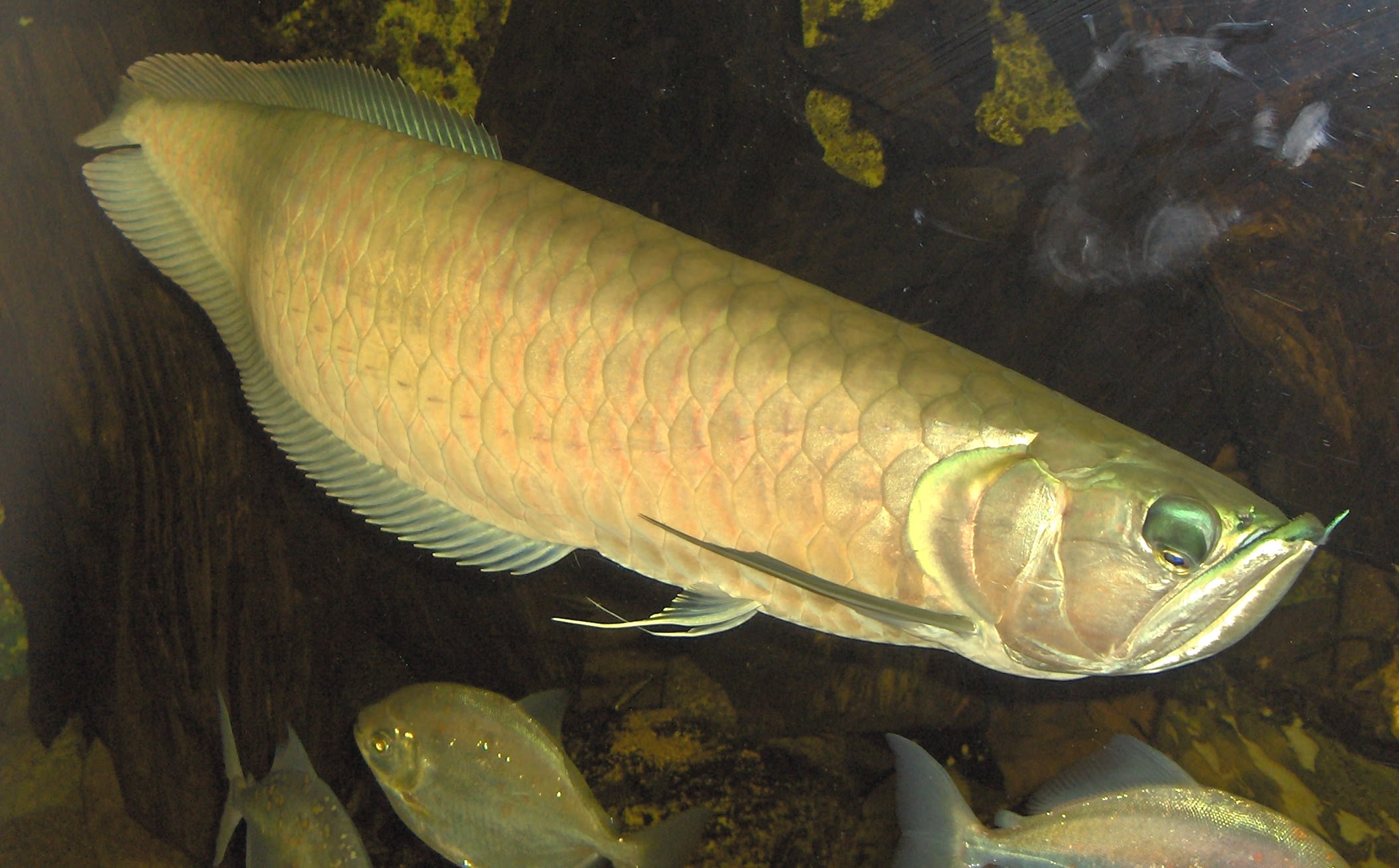
Arawana
Osteoglossum bicirrhosum
Parameter dashboard
20-30 °C
5-7.5
80 cm
15 years
Care guide
The silver arowana is one of the most iconic large freshwater fish in the aquarium hobby, instantly recognisable by its sleek, elongated body, large metallic scales, and upward-facing mouth. It is native to the Amazon, Rupununi, and Oyapock river basins of South America, where it inhabits slow-moving tributaries, backwaters, and seasonally flooded forests. Adults reach an impressive 70-80 cm in standard length, with the total length including the tail approaching 90 cm in well-maintained specimens.
This is a surface-dwelling, generalised predator that feeds on fish, terrestrial insects, and fallen fruits and nuts. It is famed for its ability to leap spectacularly out of the water to catch insects, and a secure, heavy cover is absolutely essential. Despite its predatory nature, it is not overly aggressive toward tankmates too large to swallow and can be maintained with other sizable, robust species. A single specimen requires an enormous aquarium — at least 1000 litres — with excellent filtration, high dissolved oxygen, and moderate water movement. Floating or overhanging vegetation provides cover and reduces stress.
Water conditions should be 20-30°C, pH 5.0-7.5, with soft to moderately hard water. Stable water chemistry is critical and weekly water changes of 30-50% are mandatory. The silver arowana is a long-lived species, often exceeding 20 years in captivity, and develops a unique personality, often learning to take food from its keeper's hand. It is strictly for experienced aquarists with the resources to accommodate its monumental space requirements and exacting water quality needs.
Sources
- seriouslyfish.com — https://www.seriouslyfish.com/species/osteoglossum-bicirrhosum/
- fishbase.de — https://www.fishbase.de/summary/Osteoglossum-bicirrhosum.html
Further reading on identification and aquarium care.
Tankmate compatibility (sample)
Pairwise screening against other species in the database (prioritizing the same family when data is available).
Review first (11)
Caution or avoid from automated rules — confirm before mixing.
| Species | Assessment | Notes |
|---|---|---|
| Black Arowana Osteoglossum ferreirai Caution | Caution | close relatives, and one of them is territorial, so both claim the same kind of space Open pair in Compare → |
| Butterfly splitfin Ameca splendens Caution | Caution | Fish 2x+ larger may eat smaller tankmates Open pair in Compare → |
| Dwarf rasbora Boraras maculatus Caution | Caution | Fish 2x+ larger may eat smaller tankmates Open pair in Compare → |
| Elephantnose fish Gnathonemus petersii Caution | Caution | Fish 2x+ larger may eat smaller tankmates Open pair in Compare → |
| Emerald Dwarf Rasbora Danio erythromicron Caution | Caution | Fish 2x+ larger may eat smaller tankmates Open pair in Compare → |
| Gold Shell Dweller Lamprologus ocellatus Caution | Caution | Fish 2x+ larger may eat smaller tankmates · Species with non-overlapping pH ranges may not thrive together Open pair in Compare → |
| Guppy Poecilia reticulata Caution | Caution | Fish 2x+ larger may eat smaller tankmates Open pair in Compare → |
| Honey gourami Trichogaster chuna Caution | Caution | Fish 2x+ larger may eat smaller tankmates Open pair in Compare → |
| Least rasbora Boraras urophthalmoides Caution | Caution | Fish 2x+ larger may eat smaller tankmates Open pair in Compare → |
| Three-lined rasbora Rasbora trilineata Caution | Caution | Fish 2x+ larger may eat smaller tankmates Open pair in Compare → |
| White cloud mountain minnow Tanichthys albonubes Caution | Caution | Fish 2x+ larger may eat smaller tankmates Open pair in Compare → |
1 species with compatible assessment in this sampleCollapse to hide the list; use “Open pair in Compare” for the full matrix.
| Species | Assessment | Notes |
|---|---|---|
| Black ghost knifefish Apteronotus albifrons Compatible | Compatible | No rule-based conflicts detected for this pair. Open pair in Compare → |
Same rule engine as Compare. Not a substitute for observation, tank size, or acclimation.
Related species
Was this page useful? Spot anything wrong?