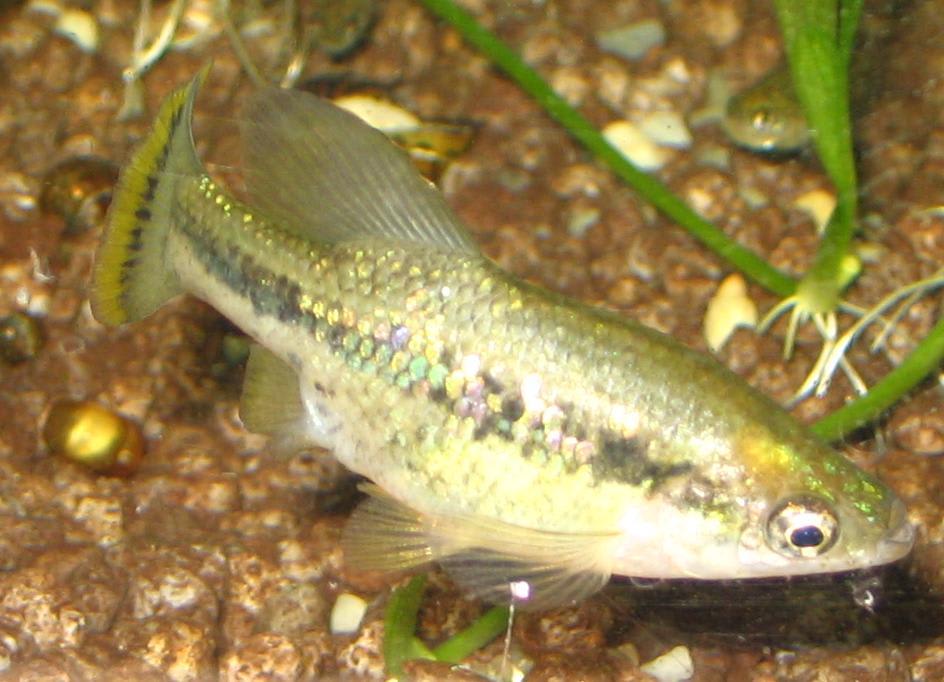
Butterfly splitfin
Ameca splendens
Parameter dashboard
20-26 °C
7-8
8 cm
5 years
Care guide
The butterfly splitfin comes from clear, spring-fed streams in western Mexico, where aquatic plants grow thickly and the water runs well-oxygenated and hard. Males reach about 8 cm and carry bright reflective scales along their flanks, edged in black and yellow on the tail, while females are plainer and slightly larger. Unlike the common guppy or molly, this goodeid does not store sperm — females must be re-fertilised for each brood, and gestation runs about 55–60 days before she releases a handful of very large fry. Those fry are born big enough to eat adult food immediately and the parents rarely bother them. A group of five or more works best; males establish a pecking order through display and light chasing but serious damage is rare. The tank needs at least 80 litres with good filtration and moderate flow, since these fish are messy feeders and sensitive to deteriorating water. They are omnivorous with a strong taste for algae, so include spirulina flake or blanched spinach in the rotation alongside regular prepared foods. pH should be in the 7.0 to 8.0 range and temperatures between 20°C and 26°C suit them year-round, reflecting the hard, alkaline water of their native springs. Dark substrate and dense planting bring out the males' best colour. Though sometimes labelled extinct in the wild, small populations still persist in the Ameca and Sayula basins, and the species has a solid captive population in the hobby.
Source
Further reading on identification and aquarium care.
Tankmate compatibility (sample)
Pairwise screening against other species in the database (prioritizing the same family when data is available).
Review first (6)
Caution or avoid from automated rules — confirm before mixing.
| Species | Assessment | Notes |
|---|---|---|
| Daisy's Rice Fish Oryzias woworae Caution | Caution | Fish 2x+ larger may eat smaller tankmates Open pair in Compare → |
| Gold Ring Danio Brachydanio tinwini Caution | Caution | Fish 2x+ larger may eat smaller tankmates Open pair in Compare → |
| Jewel tetra Hyphessobrycon eques Caution | Caution | Fish 2x+ larger may eat smaller tankmates Open pair in Compare → |
| Malawi eyebiter Dimidiochromis compressiceps Caution | Caution | Fish 2x+ larger may eat smaller tankmates Open pair in Compare → |
| Moga Hypsophrys nicaraguensis Caution | Caution | Fish 2x+ larger may eat smaller tankmates Open pair in Compare → |
| Rosy tetra Hyphessobrycon rosaceus Caution | Caution | Fish 2x+ larger may eat smaller tankmates Open pair in Compare → |
6 species with compatible assessment in this sampleCollapse to hide the list; use “Open pair in Compare” for the full matrix.
| Species | Assessment | Notes |
|---|---|---|
| Alien betta Betta splendens hybrid Compatible | Compatible | No rule-based conflicts detected for this pair. Open pair in Compare → |
| Checkered barb Oliotius oligolepis Compatible | Compatible | No rule-based conflicts detected for this pair. Open pair in Compare → |
| Cobalt Blue Goby Stiphodon semoni Compatible | Compatible | No rule-based conflicts detected for this pair. Open pair in Compare → |
| Colombian Tetra Hyphessobrycon columbianus Compatible | Compatible | No rule-based conflicts detected for this pair. Open pair in Compare → |
| Leopard Frog Pleco Peckoltia compta Compatible | Compatible | No rule-based conflicts detected for this pair. Open pair in Compare → |
| Ornate tetra Hyphessobrycon bentosi Compatible | Compatible | No rule-based conflicts detected for this pair. Open pair in Compare → |
Same rule engine as Compare. Not a substitute for observation, tank size, or acclimation.
Was this page useful? Spot anything wrong?