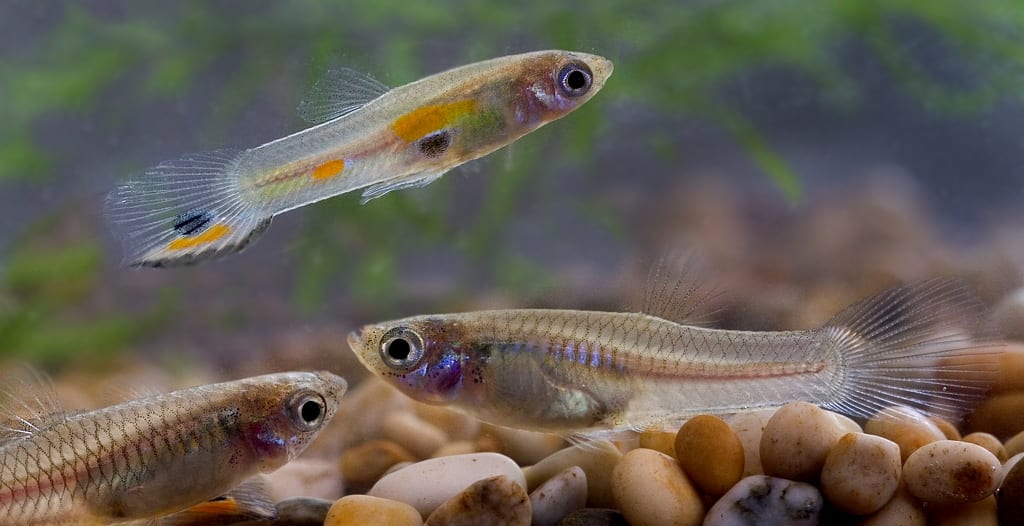
Guppy
Poecilia reticulata
Parameter dashboard
17-28 °C
7-8
6 cm
2 years
Care guide
The guppy is one of the most widely recognised and popular freshwater aquarium fish in the world, owing to its brilliant colouration, ease of breeding, and adaptability. It is native to northeastern South America and the southern Caribbean — Venezuela, Guyana, Suriname, French Guiana, Trinidad and Tobago, Barbados, the Netherlands Antilles, and northern Brazil. Through both deliberate introduction and accidental release, it has established feral populations on every continent except Antarctica. Wild guppies are more subdued in colour than their selectively bred aquarium counterparts, displaying small spots and splashes of colour on a grey-brown body, with an adult maximum of 6 cm standard length; males are typically smaller than females.
Guppies are livebearers — females give birth to fully-formed, free-swimming fry every 25-30 days, making them one of the easiest fish to breed in captivity. They are exceptionally peaceful and make ideal community fish for beginners, though males' long flowing fins can attract fin-nipping from tiger barbs, serpae tetras, or other semi-aggressive species. A group should be maintained with a ratio of one male to at least two females to prevent the males from constantly harassing the females. A tank of 40 litres is adequate for a small group, though larger volumes provide more stable water conditions. Dense planting with Java moss, floating plants, and fine-leaved vegetation provides cover for fry, some of which will survive in a well-structured aquarium without intervention.
Water conditions: 17-28°C, pH 7.0-8.0, with moderate to hard water — guppies are notably less tolerant of soft, acidic conditions. The diet is omnivorous with a strong insectivorous bias: high-quality flake and micro-pellet foods supplemented with live or frozen brine shrimp, daphnia, bloodworm, and mosquito larvae. They also graze on algae and biofilm. Guppies have been the subject of extensive evolutionary research, particularly on sexual selection and predator-prey dynamics. Their remarkable adaptability, stunning variety of tail shapes and colour morphs, and minimal care requirements make them a perennial favourite for aquarists of all experience levels.
Sources
- seriouslyfish.com — https://www.seriouslyfish.com/species/poecilia-reticulata/
- fishbase.org.au — https://www.fishbase.org.au/v4/summary/3228
Further reading on identification and aquarium care.
Tankmate compatibility (sample)
Pairwise screening against other species in the database (prioritizing the same family when data is available).
Review first (3)
Caution or avoid from automated rules — confirm before mixing.
| Species | Assessment | Notes |
|---|---|---|
| Green swordtail Xiphophorus hellerii Caution | Caution | Fish 2x+ larger may eat smaller tankmates Open pair in Compare → |
| Sailfin molly Poecilia latipinna Caution | Caution | Fish 2x+ larger may eat smaller tankmates Open pair in Compare → |
| Endlers guppy Poecilia wingei Avoid | Avoid | endler's livebearers and guppies crossbreed, so a shared tank fills with hybrids Open pair in Compare → |
2 species with compatible assessment in this sampleCollapse to hide the list; use “Open pair in Compare” for the full matrix.
| Species | Assessment | Notes |
|---|---|---|
| Molly Poecilia sphenops Compatible | Compatible | No rule-based conflicts detected for this pair. Open pair in Compare → |
| Southern platyfish Xiphophorus maculatus Compatible | Compatible | No rule-based conflicts detected for this pair. Open pair in Compare → |
Same rule engine as Compare. Not a substitute for observation, tank size, or acclimation.
Related species
Was this page useful? Spot anything wrong?