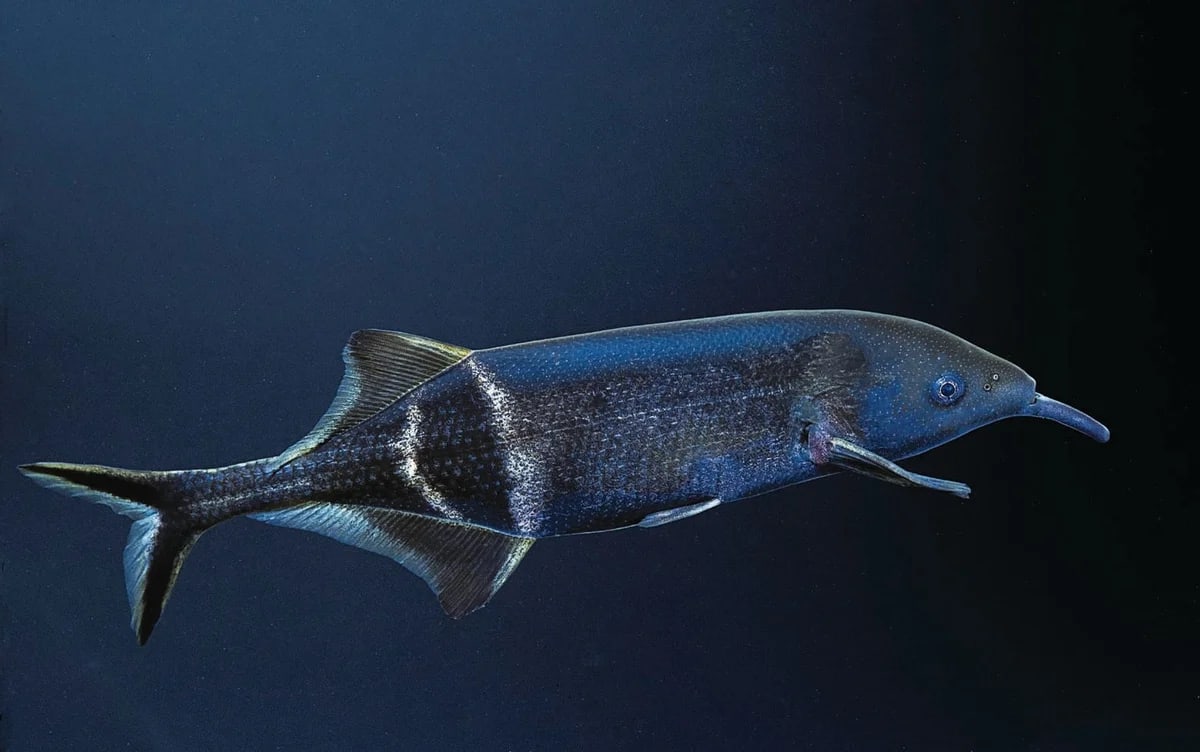
Elephantnose fish
Gnathonemus petersii
Parameter dashboard
23-28 °C
6-7.5
22.5 cm
10 years
Care guide
The elephantnose fish is one of the most fascinating oddball species available to the aquarium hobby, thanks to its unique proboscis-like lower lip, weak electric field generation, and relatively large brain. It has a vast distribution across West and Central Africa, recorded from Mali to Zambia, inhabiting the dark, muddy beds and heavily-vegetated areas of slow-moving rivers. Adults reach approximately 22.5 cm (9 inches) in standard length.
This is a nocturnal, quiet but territorial species. It is peaceful towards other species but should not be kept with very active or aggressive fish, as it will be out-competed at feeding time. It also does not mix well with other mormyrids. If keeping more than one, purchase at least five specimens to disperse aggression within the group. A tank of at least 243 litres (120cm x 45cm x 45cm) is required, with dim lighting, plenty of cover, and critically, a soft sand substrate — the fish uses its trunk-like lip to probe for food in the substrate and sharp-edged gravel will damage its mouthparts.
Water conditions should be 23-28°C, pH 6.0-7.5, with moderate hardness. Diet is unfussy and includes a range of dried, frozen, and live foods, with worms being a particular favourite. Offer food after lights out if it is reluctant to feed under bright lighting. The elephantnose is very sensitive to deteriorating water conditions and to many aquarium medications (being scaleless). It uses a weak electric field for navigation, prey detection, and communication with conspecifics in total darkness — one of the most remarkable adaptations in the freshwater aquarium world.
Sources
- seriouslyfish.com — https://www.seriouslyfish.com/species/gnathonemus-petersii/
- fishbase.se — https://www.fishbase.se/summary/Gnathonemus-petersii.html
Further reading on identification and aquarium care.
Tankmate compatibility (sample)
Pairwise screening against other species in the database (prioritizing the same family when data is available).
Review first (7)
Caution or avoid from automated rules — confirm before mixing.
| Species | Assessment | Notes |
|---|---|---|
| Dwarf rainbowfish Melanotaenia praecox Caution | Caution | Fish 2x+ larger may eat smaller tankmates Open pair in Compare → |
| Ember tetra Hyphessobrycon amandae Caution | Caution | Fish 2x+ larger may eat smaller tankmates Open pair in Compare → |
| Endlers guppy Poecilia wingei Caution | Caution | Fish 2x+ larger may eat smaller tankmates Open pair in Compare → |
| Hillstream loach Gastromyzon punctulatus Caution | Caution | Fish 2x+ larger may eat smaller tankmates Open pair in Compare → |
| Pygmy corydoras Corydoras pygmaeus Caution | Caution | Fish 2x+ larger may eat smaller tankmates Open pair in Compare → |
| Red Cherry Rasbora Rasbora lacrimula Caution | Caution | Fish 2x+ larger may eat smaller tankmates Open pair in Compare → |
| Temporaris Shell Dweller Telmatochromis temporalis Caution | Caution | Fish 2x+ larger may eat smaller tankmates · Species with non-overlapping pH ranges may not thrive together Open pair in Compare → |
5 species with compatible assessment in this sampleCollapse to hide the list; use “Open pair in Compare” for the full matrix.
| Species | Assessment | Notes |
|---|---|---|
| Freshwater angelfish Pterophyllum scalare Compatible | Compatible | No rule-based conflicts detected for this pair. Open pair in Compare → |
| Green swordtail Xiphophorus hellerii Compatible | Compatible | No rule-based conflicts detected for this pair. Open pair in Compare → |
| Haitian cichlid Nandopsis haitiensis Compatible | Compatible | No rule-based conflicts detected for this pair. Open pair in Compare → |
| Sunshine Pleco Scobinancistrus aureatus Compatible | Compatible | No rule-based conflicts detected for this pair. Open pair in Compare → |
| Whiptail Catfish Loricaria simillima Compatible | Compatible | No rule-based conflicts detected for this pair. Open pair in Compare → |
Same rule engine as Compare. Not a substitute for observation, tank size, or acclimation.
Was this page useful? Spot anything wrong?