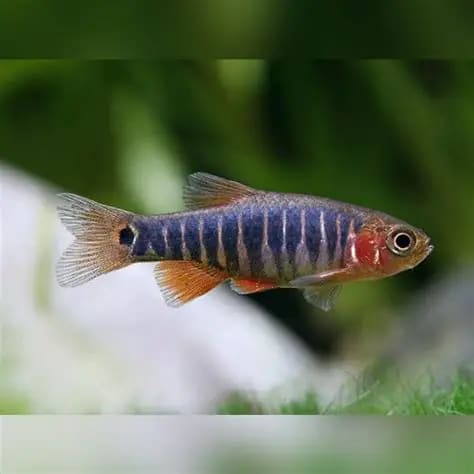
Emerald Dwarf Rasbora
Danio erythromicron
Parameter dashboard
20-24 °C
7-8
2 cm
3 years
Care guide
The emerald dwarf rasbora (Danio erythromicron, also classified as Celestichthys erythromicron and formerly Microrasbora erythromicron) is a tiny, strikingly coloured cyprinid native to Lake Inle and its surrounding watershed in Myanmar. Reaching about 2 cm standard length, it features an iridescent emerald-green body with a series of vertical dark bars and vivid red highlights on the dorsal and caudal fins. Lake Inle is a shallow, high-altitude (∼900 m) limestone lake, and this species reflects those conditions in its care requirements.
Despite its minute size, the emerald dwarf rasbora needs a tank with a footprint of at least 60 × 30 cm (~54 L / 15 gal) due to the sometimes combative behaviour of dominant males. A densely planted setup with a dark substrate, floating plants, and gentle sponge filtration mirrors its natural habitat. Crucially, provide neutral to mildly alkaline, moderately hard water — pH 7.0–8.0 and hardness 12–20 dGH — matching the limestone geology of Lake Inle. Provide neutral-to-alkaline water. Temperature should be kept on the cool side at 20–24°C.
This species is timid and shoaling by nature, and is best kept in groups of 20 or more to spread intra-species aggression and encourage natural boldness. They probably feed on small invertebrates, algae and other small organisms in nature; offer daily meals of small live and frozen foods such as Daphnia and Artemia, alongside high-quality micro-pellets. They rarely rise to the surface, so sinking or slow-sinking foods are preferred. Suitable tankmates include other small Myanmar cyprinids such as Celestichthys choprae and Microdevario species. Avoid hybridisation risk with galaxy rasboras (Celestichthys margaritatus).
Keep twenty or more fish where space allows. Provide a base of at least 60 × 30 cm with dense cover.
Source
Further reading on identification and aquarium care.
Tankmate compatibility (sample)
Pairwise screening against other species in the database (prioritizing the same family when data is available).
Review first (4)
Caution or avoid from automated rules — confirm before mixing.
| Species | Assessment | Notes |
|---|---|---|
| Blue danio Brachydanio kerri Caution | Caution | Fish 2x+ larger may eat smaller tankmates Open pair in Compare → |
| Giant danio Devario malabaricus Caution | Caution | Fish 2x+ larger may eat smaller tankmates Open pair in Compare → |
| Orange Fin Danio Danio kyathit Caution | Caution | Fish 2x+ larger may eat smaller tankmates Open pair in Compare → |
| Zebra danio Danio rerio Caution | Caution | Fish 2x+ larger may eat smaller tankmates Open pair in Compare → |
4 species with compatible assessment in this sampleCollapse to hide the list; use “Open pair in Compare” for the full matrix.
| Species | Assessment | Notes |
|---|---|---|
| Dwarf danio Danio nigrofasciatus Compatible | Compatible | No rule-based conflicts detected for this pair. Open pair in Compare → |
| Galaxy rasbora Danio margaritatus Compatible | Compatible | No rule-based conflicts detected for this pair. Open pair in Compare → |
| Glowlight Danio Danio choprae Compatible | Compatible | No rule-based conflicts detected for this pair. Open pair in Compare → |
| Gold Ring Danio Brachydanio tinwini Compatible | Compatible | No rule-based conflicts detected for this pair. Open pair in Compare → |
Same rule engine as Compare. Not a substitute for observation, tank size, or acclimation.
Related species
Was this page useful? Spot anything wrong?