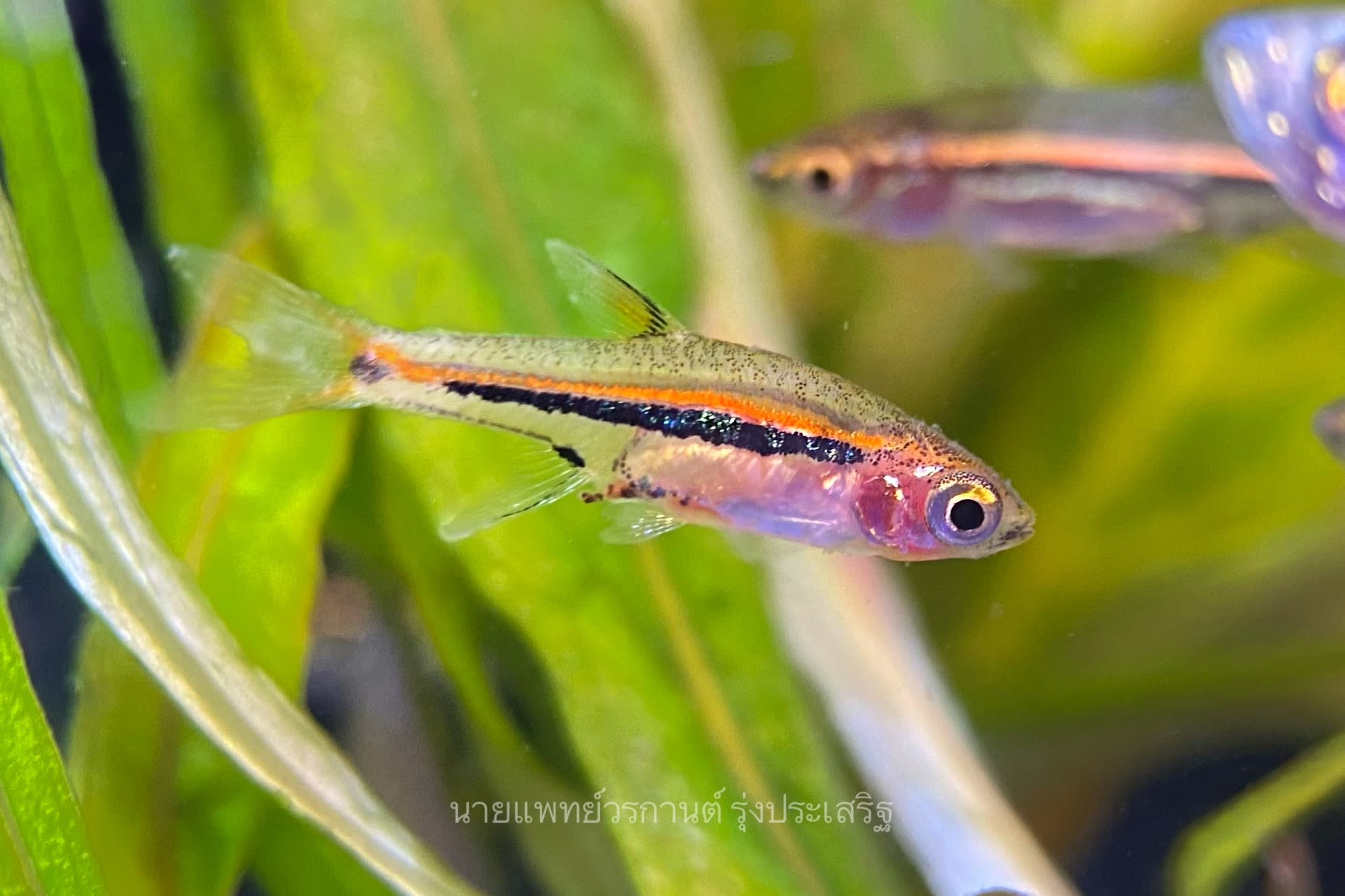
Least rasbora
Boraras urophthalmoides
Parameter dashboard
24-28 °C
6-7
2 cm
3 years
Care guide
The least rasbora or exclamation-point rasbora (Boraras urophthalmoides) is one of the smallest freshwater aquarium fish in the world, reaching a maximum size of just 2 cm (0.8 in). It is native to shallow, densely vegetated marshes, rice paddies, and slow-moving ponds across Thailand, Cambodia, and Vietnam. The common name "exclamation-point rasbora" refers to the prominent dark spot on the caudal peduncle, which is elongated into a horizontal dash — resembling an exclamation mark when combined with the dark midlateral stripe. Its tiny size and brilliant red–orange colouration when in peak condition make it a sought-after nano-species.
Keep this species in soft, acidic water: pH 6.0–7.0, hardness 2–10 dGH, and temperature 24–28°C. It is sensitive to water quality and parameter swings, so a mature, stable aquarium is essential. A tank of at least 20 L (5 gal) will house a small group, but 40 L (10 gal) or more is strongly recommended for a proper shoal. Dense planting, floating plants to diffuse light, a dark substrate, and gentle sponge filtration replicate their natural environment best.
Least rasboras are extremely peaceful but timid, and must be kept in groups of at least eight to ten to feel secure and display natural behaviour. They are micropredators with tiny mouths — offer infusoria, vinegar eels, microworms, baby brine shrimp, and finely crushed flake or micro-pellets. They will not compete well with larger or more boisterous tankmates. Ideal companions include chili rasboras, pygmy corydoras, dwarf shrimp, and other nano-species. Their small bioload makes them suitable for heavily planted nano-tanks. Aquarium lifespan estimates are around 3 years with suitable care.
Sources
- aquainfo.nl — https://aquainfo.nl/en/article/boraras-urophthalmoides-least-rasbora/
- en.wikipedia.org — https://en.wikipedia.org/wiki/Sparrow_rasbora
- seriouslyfish.com — https://www.seriouslyfish.com/species/boraras-urophthalmoides/
Further reading on identification and aquarium care.
Tankmate compatibility (sample)
Pairwise screening against other species in the database (prioritizing the same family when data is available).
Review first (11)
Caution or avoid from automated rules — confirm before mixing.
| Species | Assessment | Notes |
|---|---|---|
| Checkered barb Oliotius oligolepis Caution | Caution | Fish 2x+ larger may eat smaller tankmates · the two share only a narrow band of temperature, so one of them sits at the edge of its range Open pair in Compare → |
| Clown rasbora Rasbora kalochroma Caution | Caution | Fish 2x+ larger may eat smaller tankmates Open pair in Compare → |
| Fiveband barb Desmopuntius pentazona Caution | Caution | Fish 2x+ larger may eat smaller tankmates Open pair in Compare → |
| Harlequin rasbora Trigonostigma heteromorpha Caution | Caution | Fish 2x+ larger may eat smaller tankmates Open pair in Compare → |
| Panda Garra Garra flavatra Caution | Caution | Fish 2x+ larger may eat smaller tankmates Open pair in Compare → |
| Red Cherry Rasbora Rasbora lacrimula Caution | Caution | the two share only a narrow band of temperature, so one of them sits at the edge of its range Open pair in Compare → |
| Ruby barb Pethia padamya Caution | Caution | Fish 2x+ larger may eat smaller tankmates · the two share only a narrow band of temperature, so one of them sits at the edge of its range Open pair in Compare → |
| Siamese flying fox Crossocheilus oblongus Caution | Caution | Fish 2x+ larger may eat smaller tankmates Open pair in Compare → |
| Reticulated Sae Crossocheilus reticulatus Avoid | Avoid | Fish 2x+ larger may eat smaller tankmates · Species with non-overlapping temperature ranges cannot coexist · the two share only a narrow band of temperature, so one of them sits at the edge of its range Open pair in Compare → |
| Rosy barb Pethia conchonius Avoid | Avoid | Fish 2x+ larger may eat smaller tankmates · Species with non-overlapping temperature ranges cannot coexist · the two share only a narrow band of temperature, so one of them sits at the edge of its range Open pair in Compare → |
| Sawbwa barb Sawbwa resplendens Avoid | Avoid | Species with non-overlapping temperature ranges cannot coexist · the two share only a narrow band of temperature, so one of them sits at the edge of its range Open pair in Compare → |
1 species with compatible assessment in this sampleCollapse to hide the list; use “Open pair in Compare” for the full matrix.
| Species | Assessment | Notes |
|---|---|---|
| Dwarf rasbora Boraras maculatus Compatible | Compatible | No rule-based conflicts detected for this pair. Open pair in Compare → |
Same rule engine as Compare. Not a substitute for observation, tank size, or acclimation.
Related species
Was this page useful? Spot anything wrong?