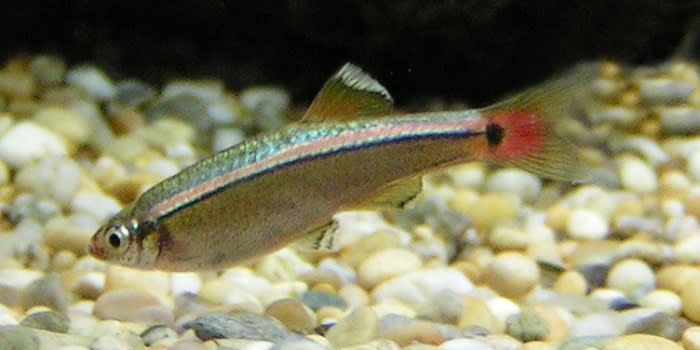
White cloud mountain minnow
Tanichthys albonubes
Parameter dashboard
14-22 °C
6-8
4 cm
5 years
Care guide
The white cloud mountain minnow was once thought extinct in the wild, but small populations still survive in spring-fed streams around the Pearl River Delta in China and in parts of northern Vietnam. It is a cool-water species that thrives between 14°C and 22°C, which means it can live comfortably in an unheated indoor aquarium in most climates. Adults reach about 4 cm and carry a beautiful iridescent stripe along the flank that glows gold in good light, with a red tail and dorsal fin. They are exceptionally peaceful and should be kept in groups of eight or more to bring out their natural schooling behaviour. A 30-litre tank with dark substrate, dense planting, and some floating plants is enough for a small school. pH can range from 6.0 to 8.0 and hardness is flexible, matching the adaptable nature of the species. In the wild they feed on small insects, worms, and zooplankton, and in captivity they accept any fine-grade flake or granule, with regular treats of brine shrimp and daphnia to keep them in condition. Males display more intense colour when competing for females, and breeding is easy in a planted tank—they scatter eggs among fine-leaved plants with no parental care, and fry often appear without intervention. Several colour varieties exist including long-fin, gold, and albino, though standard wild-type fish tend to be hardier. Aquarium lifespan estimates are around 5 years with suitable care. They are an excellent choice for beginners and for cool-water or species-only setups where their subtle beauty can be appreciated.
Source
Further reading on identification and aquarium care.
Tankmate compatibility (sample)
Pairwise screening against other species in the database (prioritizing the same family when data is available).
Review first (8)
Caution or avoid from automated rules — confirm before mixing.
| Species | Assessment | Notes |
|---|---|---|
| Blue-eye panaque Panaque suttonorum Caution | Caution | Fish 2x+ larger may eat smaller tankmates Open pair in Compare → |
| Blue gularis Fundulopanchax sjostedti Avoid | Avoid | Fish 2x+ larger may eat smaller tankmates · Species with non-overlapping temperature ranges cannot coexist · the two share only a narrow band of temperature, so one of them sits at the edge of its range Open pair in Compare → |
| Chinese algae-eater Gyrinocheilus aymonieri Avoid | Avoid | Fish 2x+ larger may eat smaller tankmates · Species with non-overlapping temperature ranges cannot coexist · the two share only a narrow band of temperature, so one of them sits at the edge of its range Open pair in Compare → |
| Eyespot pufferfish Tetraodon biocellatus Avoid | Avoid | Fish 2x+ larger may eat smaller tankmates · Species with non-overlapping temperature ranges cannot coexist · the two share only a narrow band of temperature, so one of them sits at the edge of its range Open pair in Compare → |
| Gold Cap Caudopunctatus Neolamprologus caudopunctatus Avoid | Avoid | Species with non-overlapping temperature ranges cannot coexist · the two share only a narrow band of temperature, so one of them sits at the edge of its range Open pair in Compare → |
| Leopard Frog Pleco Peckoltia compta Avoid | Avoid | Species with non-overlapping temperature ranges cannot coexist · the two share only a narrow band of temperature, so one of them sits at the edge of its range Open pair in Compare → |
| Rummy-nose tetra Hemigrammus rhodostomus Avoid | Avoid | Species with non-overlapping temperature ranges cannot coexist · the two share only a narrow band of temperature, so one of them sits at the edge of its range Open pair in Compare → |
| Siamese fighting fish Betta splendens Avoid | Avoid | Species with non-overlapping temperature ranges cannot coexist · one of these species is highly aggressive and is usually best kept on its own · the two share only a narrow band of temperature, so one of them sits at the edge of its range Open pair in Compare → |
4 species with compatible assessment in this sampleCollapse to hide the list; use “Open pair in Compare” for the full matrix.
| Species | Assessment | Notes |
|---|---|---|
| Blue lyretail Fundulopanchax gardneri Compatible | Compatible | No rule-based conflicts detected for this pair. Open pair in Compare → |
| Desert goby Chlamydogobius eremius Compatible | Compatible | No rule-based conflicts detected for this pair. Open pair in Compare → |
| Leopard corydoras Corydoras julii Compatible | Compatible | No rule-based conflicts detected for this pair. Open pair in Compare → |
| Zhou's goby Rhinogobius zhoui Compatible | Compatible | No rule-based conflicts detected for this pair. Open pair in Compare → |
Same rule engine as Compare. Not a substitute for observation, tank size, or acclimation.
Was this page useful? Spot anything wrong?