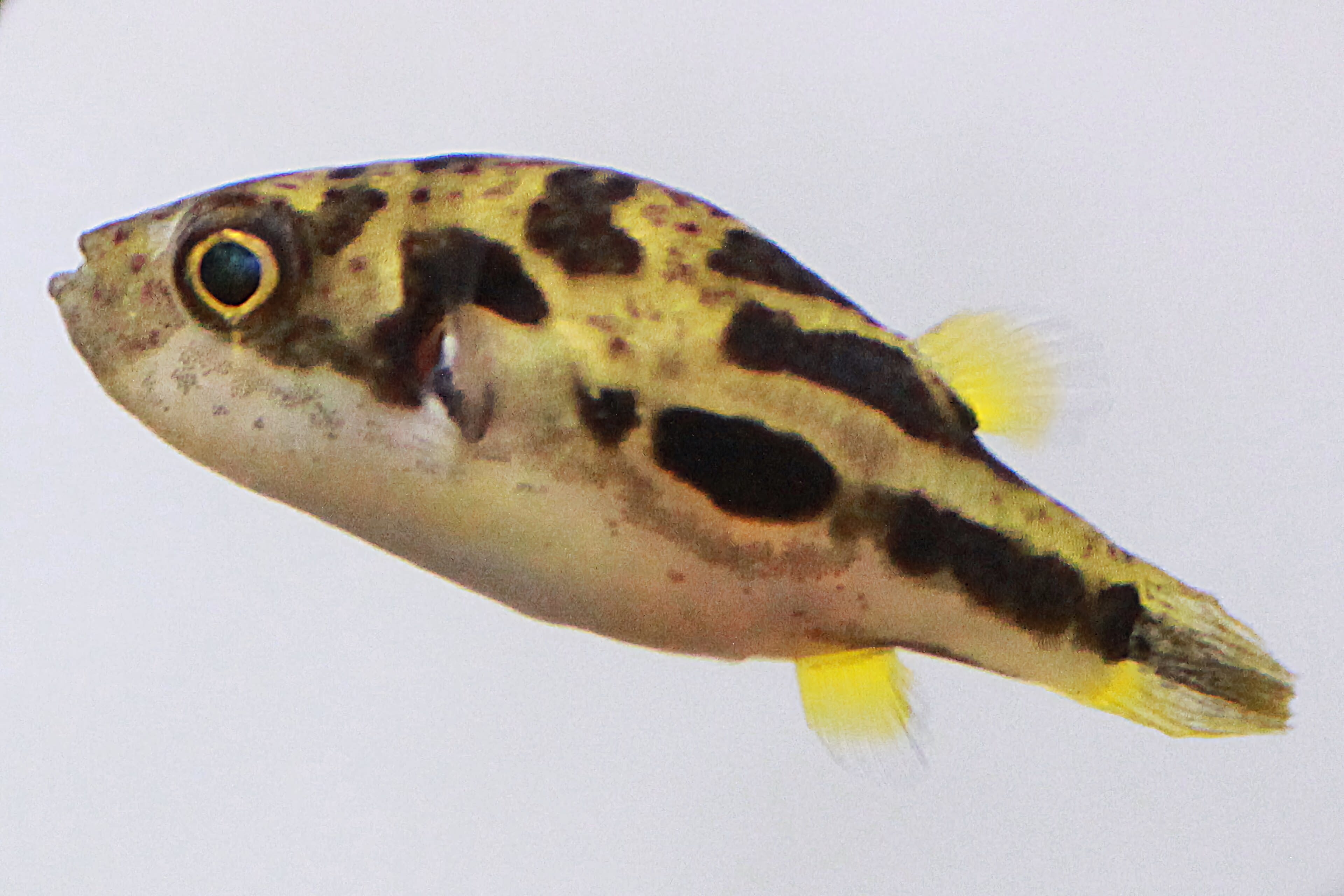
Malabar pufferfish
Carinotetraodon travancoricus
Parameter dashboard
22-28 °C
6.8-8
2.5 cm
5 years
Care guide
The dwarf puffer, also known as the Malabar or pea puffer, is one of the smallest puffer species in the world and certainly one of the most popular, treasured for its cute appearance, amusing personality, and fascinating swimming motion. Endemic to the state of Kerala in southern India, it inhabits sluggish, heavily-vegetated inland waters, typically staying close to cover. Adults reach only 2.5 cm (1 inch), making them one of the most diminutive fish regularly found in the trade.
Despite their small size, dwarf puffers are not recommended for community tanks — they tend to nip the fins of slow-moving or long-finned fish and do not compete well for food with more active species. They are best kept in a species-only setup, either singly in a tank as small as 12.6 litres or in a group with careful management. A heavily-planted aquarium with twisted roots and broken lines of sight is essential to reduce aggression, and floating plants to diffuse lighting encourage more confident behaviour.
Water conditions should be 22-28°C, pH 6.8-8.0, with moderate hardness. As with all puffers, diet is critical — they relish snails (essential for keeping their continuously-growing teeth ground down), shellfish, worms, and other live and frozen foods. Dried foods are not usually accepted. They are sensitive to deteriorating water conditions, making regular partial water changes essential. With proper care, these tiny puffers reward their keeper with years of engaging, inquisitive behaviour.
Sources
- seriouslyfish.com — https://www.seriouslyfish.com/species/carinotetraodon-travancoricus/
- fishbase.se — https://www.fishbase.se/summary/Carinotetraodon-travancoricus.html
Further reading on identification and aquarium care.
Tankmate compatibility (sample)
Pairwise screening against other species in the database (prioritizing the same family when data is available).
Review first (9)
Caution or avoid from automated rules — confirm before mixing.
| Species | Assessment | Notes |
|---|---|---|
| Banded panchax Epiplatys annulatus Caution | Caution | Species with non-overlapping pH ranges may not thrive together Open pair in Compare → |
| Bleeding-heart tetra Hyphessobrycon erythrostigma Caution | Caution | Fish 2x+ larger may eat smaller tankmates Open pair in Compare → |
| Bolivian Ram Mikrogeophagus altispinosus Caution | Caution | Fish 2x+ larger may eat smaller tankmates Open pair in Compare → |
| Eyespot pufferfish Tetraodon biocellatus Caution | Caution | Fish 2x+ larger may eat smaller tankmates · close relatives, and one of them is territorial, so both claim the same kind of space Open pair in Compare → |
| Guppy Poecilia reticulata Caution | Caution | Fish 2x+ larger may eat smaller tankmates Open pair in Compare → |
| Hump-head Cyrtocara moorii Caution | Caution | Fish 2x+ larger may eat smaller tankmates · Multiple territorial species in the same swim layer cause stress Open pair in Compare → |
| Malawi eyebiter Dimidiochromis compressiceps Caution | Caution | Fish 2x+ larger may eat smaller tankmates Open pair in Compare → |
| Moga Hypsophrys nicaraguensis Caution | Caution | Fish 2x+ larger may eat smaller tankmates Open pair in Compare → |
| Globe fish Tetraodon lineatus Avoid | Avoid | Fish 2x+ larger may eat smaller tankmates · Multiple territorial species in the same swim layer cause stress · one of these species is highly aggressive and is usually best kept on its own · close relatives, and one of them is territorial, so both claim the same kind of space · Fahaka puffers are best kept alone: they can seriously injure or kill tankmates, including larger fish. Open pair in Compare → |
3 species with compatible assessment in this sampleCollapse to hide the list; use “Open pair in Compare” for the full matrix.
| Species | Assessment | Notes |
|---|---|---|
| Head-and-taillight tetra Hemigrammus ocellifer Compatible | Compatible | No rule-based conflicts detected for this pair. Open pair in Compare → |
| Javanese ricefish Oryzias javanicus Compatible | Compatible | No rule-based conflicts detected for this pair. Open pair in Compare → |
| Rosy tetra Hyphessobrycon rosaceus Compatible | Compatible | No rule-based conflicts detected for this pair. Open pair in Compare → |
Same rule engine as Compare. Not a substitute for observation, tank size, or acclimation.
Related species
Was this page useful? Spot anything wrong?